
 Back
Back





IN THE HIGH COURT OF JUDICATURE AT CALCUTTA
SUJOY PAUL, CJ, PARTHA SARATHI SEN, J.
Pallab Kanti Chattopadhyay – Petitioner
Versus
Union of India And Ors. – Respondents
C.O.C.T. 2 of 2013
Decided On : 03-02-2026
| Table of Content |
|---|
| 1. jurisdiction and pay protection (Para 1 , 2 , 3) |
| 2. legal arguments regarding seniority (Para 4 , 5 , 6) |
| 3. application of stepping up principle (Para 12 , 18 , 19) |
| 4. final ruling and consequence (Para 20 , 21 , 22 , 23) |
JUDGMENT :
SUJOY PAUL, CJ.
1. This petition filed under Article 226/227 of the Constitution assails the order of Central Administrative Tribunal, Calcutta Bench in O.A. No. 392 of 2007 dated 27.11.2012, whereby the tribunal rejected the prayer of the petitioner for giving him pay protection at par in comparison with his junior, who was already getting higher pay in the same scale or pay.
2. The case of petitioner in nutshell, is that from the date of initial appointment till occupying the post of Field Officer on which petitioner and private respondents were appointed through direct recruitment, petitioner was all along senior to the private respondent. The respondent, for no valid reason on the direct recruitment post of Field Officer fixed the pay of private respondent more than the petitioner and declined the prayer of petitioner for stepping up of pay. The petitioner has meticulously prepared a comparative chart, which contains the relevant dates of holding different posts by petitioner & pvt. respondent, the pay scale and qualifications that were necessary to decide this matter. The said chart will indicate in juxtaposition, the journey of the petitioner and the private respondent in the department. The chart is reproduced for ready reference.
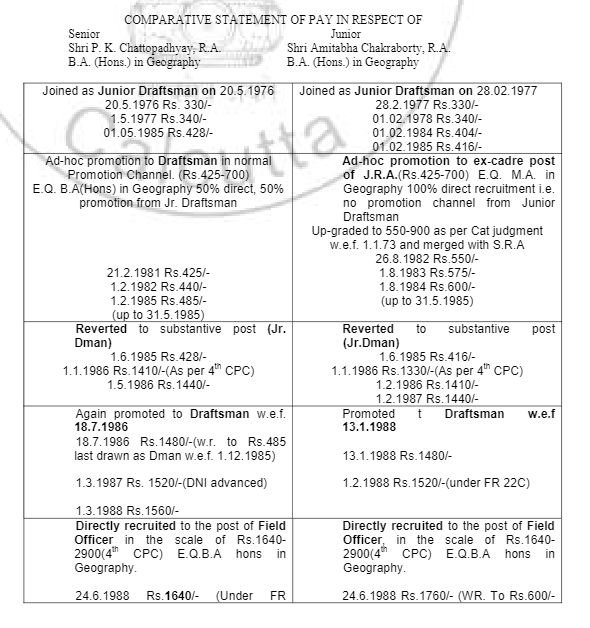
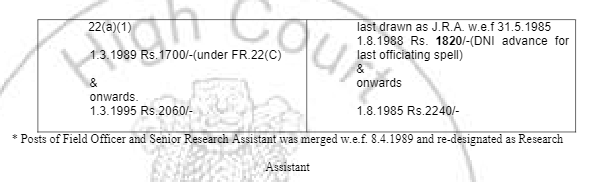
3. The facts so mentioned in the chart prepared by the petitioner were not disputed by the respondent department. Thus, on the basis of admitted facts, the pivotal question before us is as to whether the private respondent was entitled to get the higher pay and if yes, why petitioner should be deprived of the fruits of the stepping up of the pay at par with junior. Pertinently, this question cropped up because after becoming unsuccessful before the tribunal, the petitioner filed COCT 6 of 2011 before this Court.
4. This Court by order dated 25.04.2011 remanded the matter back to the tribunal to i) decide whether the petitioner would be entitled to the similar benefit as of Amitava Chakraborty or ii) whether Amitava Chakraborty would be re-fixed at a lower scale to take care of the grievance of the petitioner.
5. In turn, the tribunal decided the application by impugned order and rejected it by holding that the petitioner has not filed any seniority list to show that he is senior to the private respondent. By placing reliance on certain pay fixations made in favour of private respondent, learned tribunal opined that O.A. was barred by time because the private respondent went on a deputation as Junior Research Assistant (JRA) before 01.11.1982 and as per section 21(2) of Administrative Tribunals Act , 1985, the tribunal does not have jurisdiction when cause of action arose before that date. The tribunal on the one hand stated that id did not have jurisdiction to decide the matter and on the other hand, dealt with the matter on merits and opined that principle of stepping up of pay is not attracted when their pay in the post before direct appointment was different. For these cumulative reasons, the claim of petitioner was dismissed by the tribunal.
CONTENTION OF PETITIONER:
6. Ms. Debjani Sengupta, learned counsel for petitioner by taking this Court to the aforesaid comparative statement contended that since initial appointment on the post of Junior Draftsman and further promotion as Draftsman, the petitioner was not only senior qua private respondent, petitioner was consistently drawing higher pay in the same scale than the private respondent. The categorical pleading in the O.A. that petitioner is all along senior to the private respondent, has not been disputed by the private respondent or the department. Thus, even if the seniority list has not been filed by the petitioner, it will not cause any dent to petitioner’s claim.
7. It is further canvassed that the
Stepping up of pay is applicable when a senior employee is paid less than a junior in the same cadre and pay scale.


The principle that a senior employee cannot receive less pay than a junior is upheld, prompting the court to direct equal pay adjustments based on established seniority and promotion timelines.

A government employee senior in service must not receive lesser pay than a junior in the same cadre, and the absence of justifiable reasons for pay disparity constitutes a violation of constitutional....

Stepping up of senior's pay allowed when anomaly arises from junior's FR 22(I)(a)(1) option, despite pre-2006 ACP, in same cadre with identical scales.

Entitlement of a senior employee to stepping up of pay equal to that of a junior employee, conditions for stepping up of pay, and the applicability of various judgments related to equal pay for equal....



An indispensable Tool for Legal Professionals, Endorsed by Various High Court and Judicial Officers
Please visit our Training & Support
Center or Contact Us for assistance

Scan Me!
India’s Legal research and Law Firm App, Download now!


For Daily Legal Updates, Join us on :



 Back to top


