
 Back
Back





IN THE HIGH COURT OF CHHATTISGARH, BILASPUR
Goutam Bhaduri, Sanjay S. Agrawal, JJ.
Nilesh Kumar Shukla S/o Shri C.L.Shukla - Appellant
Vs.
Renuka Shukla W/o Shri Nilesh Kumar Shukla - Respondent
FAM No. 198 of 2016 With FAM No. 84 of 2017
Decided On : 18-04-2024
Dissolution of Marriage - Hindu Marriage Act, 1955 - Section 9, Section 302, Section 309, Section 498-A - Summary of Acts and Sections
Fact of the Case:
The case involves a husband seeking divorce and a wife seeking restitution of conjugal rights. The wife was charged with the murder of her child and attempted suicide, leading to the husband seeking divorce on grounds of cruelty. The wife, on the other hand, claimed to have been assaulted by unidentified people, resulting in the death of her child.
Finding of the Court:
The court found that the wife's actions, including the murder of her child and the subsequent trial, amounted to cruelty towards the husband. The court also emphasized the husband's obligation to provide maintenance to the wife and children after the divorce.
Issues: The main issues revolved around the alleged cruelty by the wife, the husband's request for divorce, and the determination of maintenance for the wife and children.
Ratio Decidendi: The court relied on the evidence of the husband, the dying declaration of the wife, and legal precedents to establish the cruelty of the wife and the husband's obligation to provide maintenance.
Final Decision: The court allowed the husband's appeal for divorce and dismissed the wife's appeal for restitution of conjugal rights. The court also directed the husband to pay maintenance of Rs.25,000 per month to the wife.
JUDGMENT/ORDER :
The following judgment of the Court has been dictated by Hon’ble Goutam Bhaduri, J.
Heard.
1. The present appeals are against the judgment and decree dated 26.07.2016 passed by the Additional Principal Family Court in Civil Suit No.266-A/2014. The appeal filed by the husband bearing FAM No.198/2016 is against the dismissal of application for grant of divorce and another appeal bearing No.84/2017 filed by the wife is against the dismissal of application under Section 9 of the Hindu Marriage Act, 1955 for restitution of conjugal rights. Since, both the petitions stood dismissed by the learned Family Court by common judgment. These instant two appeals are being heard analogously as the germane of issue is one and the same.
2. In earlier bout of litigation, two appeals bearing nos. bearing FAM No.54 of 2010 & FAM No. 119 of 2010 were filed by the wife against the initial judgment and decree dated 19.04.2010 passed by the Principal Judge, Family Court, Durg in Civil Suit Nos. 232-A/2008 & 233-A/2008 whereby the application filed by the wife for restitution of conjugal rights was dismissed whereas the application filed by the husband for dissolution of marriage was allowed. This Court by order dated 18.09.2014 while disposing of those appeals remanded the case to the learned Family Court with certain observations as have been made in paras 8 and 9, which are reproduced below:-
“8. On close scrutiny of evidence, we do not find any evidence upto the mark adduced on behalf of the respondent to prove such ground for dissolution of marriage by a decree of divorce. The appellant has also not adduced sufficient evidence to establish the fact that only the respondent has deserted her and she was not responsible for such separate living. In these circumstances, finding of the Court below in both the cases is not sustainable, therefore, both the appeals deserve to be allowed.
9. In the result, the appeals filed on behalf of the appellant are allowed. Impugned judgment and decree is hereby set aside. The case is remitted to the Court below concerned to decide the case afresh after providing opportunity of hearing and adducing evidence to both the parties. It is also expected from the Family Court concerned to make further attempts for reconciliation of matrimonial dispute between the parties. The parties shall remain in attendance before the Court below on 17.11.2014.”
Thereafter the learned Family Court passed the impugned judgment and decree dated 26.07.2016, both the petitions one by the husband seeking divorce and another by wife seeking restitution of conjugal rights, were dismissed. Hence these appeals.
3. The facts of this case are that on 09.01.1997, both the appellant and the Respondent got married and out of their wedlock, a baby girl was borne on 10.12.1997 namely, Nainy. The wife alleged that after the birth of the child, the behaviour of the husband became hostile and he started demanding money. Since, the father of the wife died earlier as such, the demand was being catered by her mother.
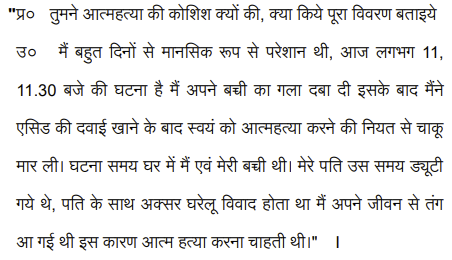
4. On the contrary, the husband stated that the wife in turn used to demand money and the demand was beyond the reach of fulfillment. Further more, the wife used to misbehave with the in-laws as also the husband, therefore, difference of opinions started between them. The husband, who was working in Bhilai Steel Plant stated that on 31.05.2002, when he came back from his office he saw that his daughter Naini was lying dead and the wife was lying in the pool of blood and was in an unconscious stage. He tried to call the relatives but the phone lines were found to be separated from the source. He went out and called his relatives thereafter with the help of the other neighbors and the family members, the wife was admitted in I.C.U., Bhilai hospital, Sector-9. When she regained consciousness, her dying declaration was recorded. Subsequently, she was charged under Section 302 of I.P.C. for killing her daughter and under Section 309 for attem
AI
The main legal point established in the judgment is that the actions of one spouse, such as committing a serious crime or making false allegations, can amount to cruelty towards the other spouse, jus....

The court established that a spouse's long-term separation and failure to reconcile can constitute grounds for divorce based on cruelty and desertion under the Hindu Marriage Act.

Cruelty as a ground for divorce under the Hindu Marriage Act can be established through evidence of mental suffering, with the standard of proof being preponderance of probabilities.

Unfounded baseless allegations by spouse amounts to cruelty and may provide ground for dissolution of marriage.
Cruelty in marriage requires substantial proof of grave conduct; mere quarrels and allegations do not suffice to dissolve marriage under the Hindu Marriage Act.

The court established that wrongful criminal allegations can constitute mental cruelty justifying a divorce under Section 13(1)(ia) of the Hindu Marriage Act, 1955.


Unfounded allegations of adultery by one spouse against the other constitute mental cruelty of the gravest character to warrant divorce.

The main legal point established in the judgment is that mental cruelty, as a ground for dissolution of marriage, need not cause injury to the petitioner's health, and it must be of such a nature tha....

Conduct constituting unfounded accusations can constitute mental cruelty and justify divorce when the marriage is irretrievably broken.



An indispensable Tool for Legal Professionals, Endorsed by Various High Court and Judicial Officers
Please visit our Training & Support
Center or Contact Us for assistance

Scan Me!
India’s Legal research and Law Firm App, Download now!


For Daily Legal Updates, Join us on :



 Back to top


