Back
Back





2026 Supreme(Chh) 49
IN THE HIGH COURT OF CHHATTISGARH AT BILASPUR
SANJAY KUMAR JAISWAL, J.
Abc – Petitioner
Versus
State Of C.G – Respondent
CRMP/3495 of 2025
Decided On : 29-01-2026
For the Petitioner: Shri T. K. Jha behalf of Parth Kumar Jha
For the Respondent:Shri. Sumit Singh Advocate, Shri. Arvind Kumar Dubye Advocate
Discretionary power under Section 311 CrPC should ensure justice without allowing repetitive witness recall to compromise the trial's integrity, particularly in sensitive cases.
Headnote:(A) Criminal Procedure Code, 1973 - Section 311 - Evidence Act - Section 138 - Recall of witnesses - The discretionary power under Section 311 should not be resorted to for filling lacunae or due to convenience; it must aim at ensuring justice and truth. If the evidence is essential for a just decision, the court may summon or re-examine witnesses. However, repetitive recall must not compromise the trial's integrity or impose undue hardship on witnesses, particularly victims in sensitive cases. (Paras 17, 9, 15)
(B) The court emphasized the need for clear reasoning when exercising this discretionary power to prevent injustice to both parties, ensuring fair opportunities throughout the trial. The object is to find out the truth, yet it must balance protecting against potential prejudice to the accused. (Paras 17.1, 17.4, 17.12)
Facts of the case:
The petitioner sought to recall a victim's testimony in a POCSO case after comprehensive prior examination. The court found previous opportunities adequate and ruled against the recall request based on trial integrity principles.
Findings of Court:
The application for recall was denied to prevent any hindrance to legal proceedings and protect victims from repeated court appearances.
Issues: The court deliberated if recall of the victim served the ends of justice without undermining trial integrity and victim sensitivity.
Ratio Decidendi: The court ruled that allowing recalls without strong justification risks undermining the trial process. It upheld that the rights of the accused and the victims must be balanced, emphasizing the necessity of judicious use of Section 311.
Result: Application denied.
JUDGMENT :
SANJAY KUMAR JAISWAL, J.
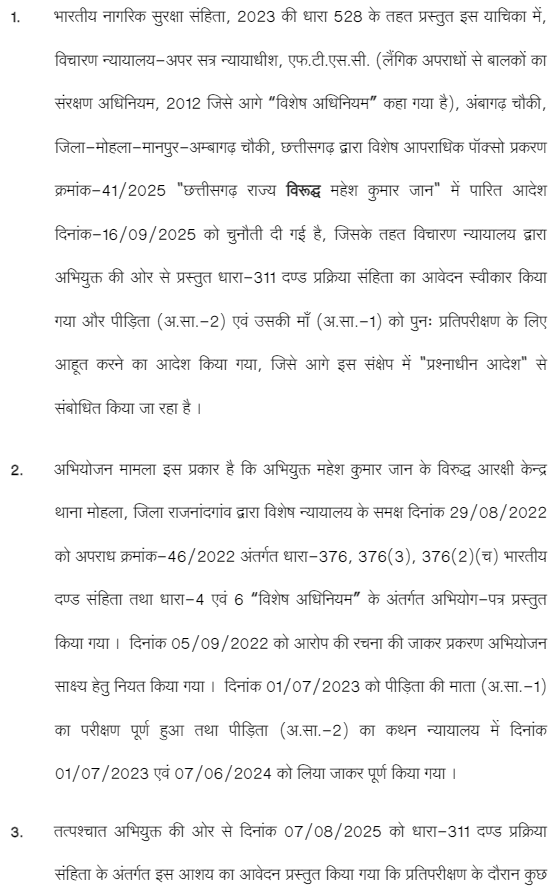
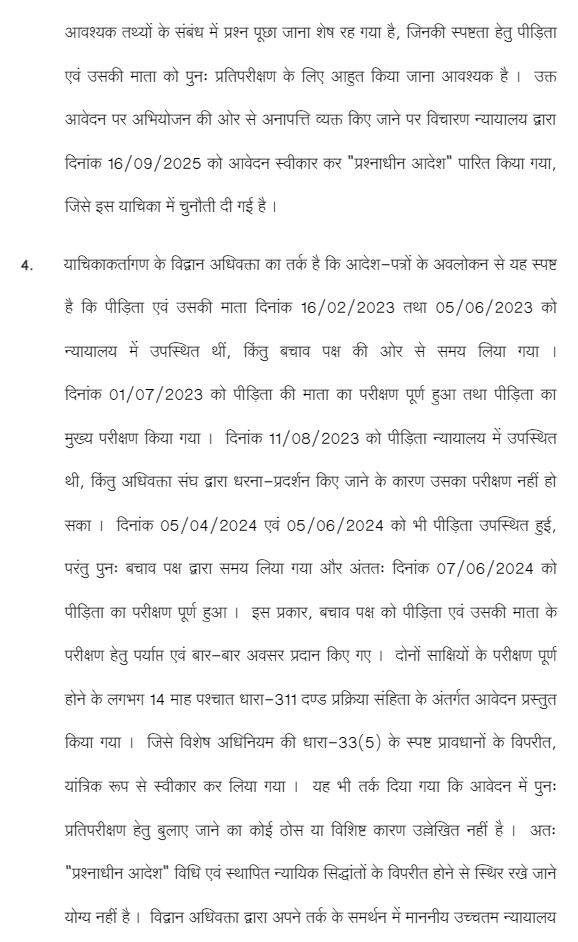
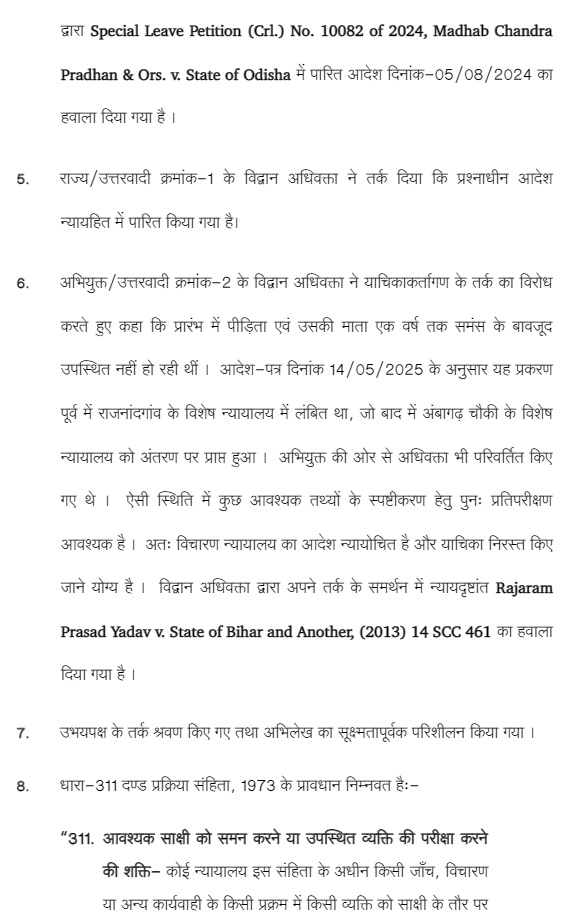
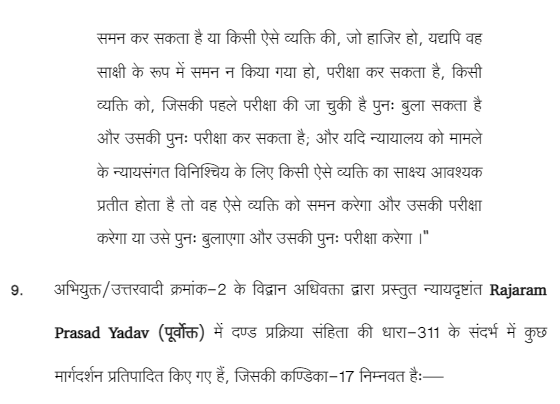
“17. From a conspectus consideration of the above decisions, while dealing with an application under Section 311 CrPC read along with Section 138 of the Evidence Act, we feel the following principles will have to be borne in mind by the courts:
17.1. Whether the court is right in thinking that the new evidence is needed by it? Whether the evidence sought to be led in under Section 311 is noted by the court for a just decision of a case?
17.2. The exercise of the widest discretionary power under Section 311 CrPC should ensure that the judgment should not be rendered on inchoate, inconclusive and speculative presentation of facts, as thereby the ends of justice would be defeated.
17.3. If evidence of any witness appears to the court to be essential to the just decision of the case, it is the power of the court to summon and examine or recall and reexamine any such person.
17.4. The exercise of power under Section 311 CrPC should be resorted to only with the object of finding out the truth or obtaining proper proof for such facts, which will lead to a just and correct decision of the case.
17.5. The exercise of the said power cannot be dubbed as filling in a lacuna in a prosecution case, unless the facts and circumstances of the case make it apparent that the exercise of power by the court would result in causing serious prejudice to the accused, resulting in miscarriage of justice.
17.6. The wide discretionary power should be exercised judiciously and not arbitrarily.
17.7. The court must satisfy itself that it was in every respect essential to examine such a witness or to recall him for further examination in order to arrive at a just decision of the case.
17.8. The object of Section 311 CrPC simultaneously imposes a duty on the court to determine the truth and to render a just decision.
17.9. The court arrives at the conclusion that additional evidence is necessary, not because it would be impossible to pronounce the judgment without it, but because there would be a failure of justice without such evidence being considered.
17.10. Exigency of the situation, fair play and good sense should be the safeguard, while exercising the discretion. The court should bear in mind that no party in a trial can be foreclosed from correcting errors and that if proper evidence was not adduced or a relevant material was not brought on record due to any inadvertence, the court should be magnanimous in permitting such mistakes to be rectified.
17.11. The court should be conscious of the position that after all the trial is basically for the prisoners and the court should afford an opportunity to them in the fairest manner possible. In that parity of reasoning, it would be safe to err in favour of the accused getting an opportunity rather than protecting the prosecution against possible prejudice at the cost of the accused. The court should bear in mind that improper or capricious exercise of such a discretionary power, may lead to undesirable results.
17.12. The additional evidence must not be received as a disguise or to change the nature of the case against any of the party
17.13. The power must be exercised keeping in mind that the evidence that is likely to be tendered, would be germane to the issue involved and also ensure that an opportunity of rebuttal is given to the other party.
17.14. The power under Section 311 CrPC must therefore, be invoked by the court only in order to meet the ends of justice for strong and valid reasons and the same must be exercised with care, caution and circumspection. The court should bear in mind that fair trial entails the interest of the accused, the victim and the society and, therefore, the grant of fair and proper opportunities to the persons concerned, must be ensured being a constitutional goal, as well as a human right.”
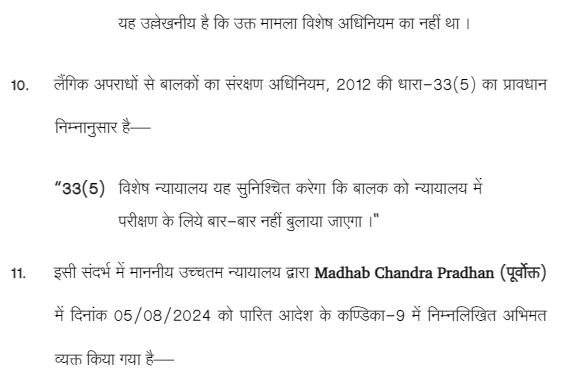
“9. From a perusal of the record of the case, it is abundantly clear that ample opportunities were given to the defence counsel to cross-examine the victim. When th