
 Back
Back





HIGH COURT OF CHHATTISGARH AT BILASPUR
Sanjay K. Agrawal, Arvind Kumar Verma, JJ.
Udayram Basant, S/o Kirtan Basant – Appellant
Versus
Smt. Jyoti, W/o Udayram Basant - Respondent
FAM No. 43 of 2019
Decided On : 27-01-2026
| Table of Content |
|---|
| 1. legal grounds for appeal based on earlier judgment. (Para 1 , 2) |
| 2. parties' arguments regarding the dismissal of the suit. (Para 3 , 4) |
| 3. court's analysis of res judicata. (Para 5 , 6 , 7 , 8 , 9 , 10) |
| 4. merits of the case regarding grounds of divorce. (Para 11 , 12 , 13 , 14 , 15 , 16 , 17 , 18 , 19) |
| 5. final decision to dismiss the appeal. (Para 20 , 21) |
JUDGMENT :
Sanjay K. Agrawal, J.
1. Invoking the jurisdiction of this Court under Section 19(1) of the Family Courts Act, 1984 read with Section 28 of the Hindu Marriage Act, 1955 (for short, ‘the Act of 1955’), the appellant herein/husband has preferred this appeal calling in question legality, validity and correctness of judgment & decree dated 7-12-2018 passed by the Judge, Family Court, Mahasamund in Civil Suit No.76A/2014, by which the appellant’s/husband’s application claiming decree for dissolution of marriage on the grounds enumerated under Sections 13(1)(ia) & (ib) of the Act of 1955, has been dismissed finding no merit.
2. The aforesaid challenge has been made on the following factual backdrop: -
2.1) Marriage of the appellant herein and the respondent herein was solemnized on 29-4-1993 at Talapara, Bilaspur, as per Hindu rites and customs and out of their wedlock, they were blessed with a daughter namely, Rashmi and a son namely, Sandeep. Thereafter, the appellant-husband and the respondent-wife both resided separately from September, 2001 leading to filing of Civil Suit No.24-A/2002 on 3-7-2002 by the husband before the 1st Additional District Judge, Bastar at Jagdalpur on the grounds enumerated under Sections 13(1)(ia) & (ib) of the Act of 1955 which was dismissed by the said Court on 24-4-2004 finding no merit feeling aggrieved against which the husband had filed appeal being First Appeal No.109/2004 before this Court and this Court also by judgment dated 18-6-2007 dismissed the appeal affirming the judgment & decree of the trial Court holding that the husband has failed to establish the grounds under Sections 13(1)(ia) & (ib) of the Act of 1955.
2.2) After lapse of 11 years, on 1-12-2014, the appellant herein/ husband again preferred Civil Suit No.76A/2014, now, before the Family Court, Mahasamund stating that from September, 2001, husband & wife both are residing separately and therefore marriage has irretrievably broken down and as such, since the marriage between them cannot revive, decree of divorce be granted in his favour.
2.3) The respondent herein/wife filed reply before the Family Court stating that since the earlier suit filed by the husband had already been dismissed on 24-4-2004 affirmed in appeal, the present application/suit is hit by the principle of res judicata contained in Section 11 of the Code of Civil Procedure, 1908 (for short, ‘the Code’) and denied the other allegations made.
2.3) The Family Court, on the basis of material available on record, framed following four issues and one additional issue and arrived at the findings recorded therein:-
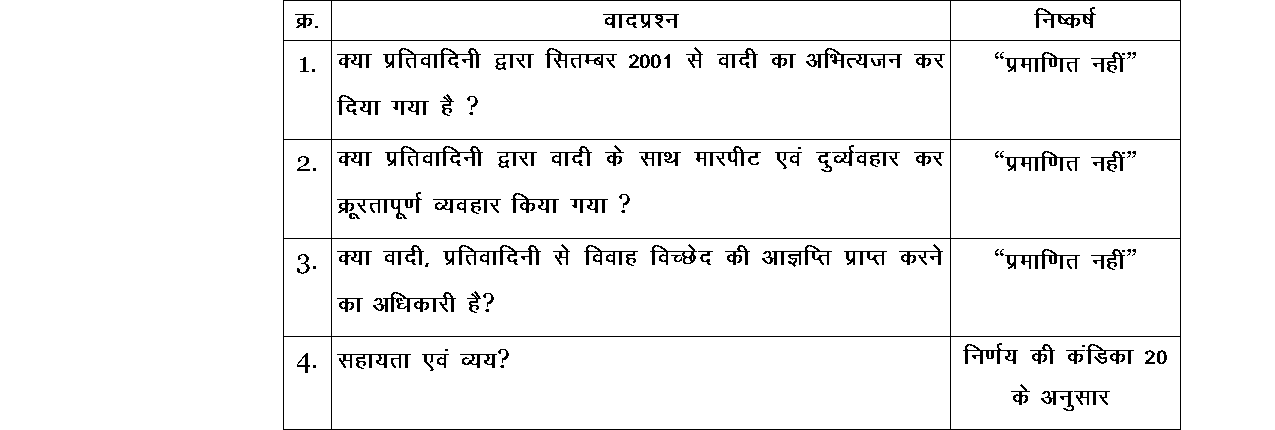
vfrfjDr okniz'u

2.4) The Family Court by its impugned judgment held that the application/suit is hit by the principle of res judicata and also on merits held that the plaintiff/husband has failed to establish the ground under Section 13 of the Act of 1955 against which this appeal has been preferred.
3. Mr. Badruddin Khan, learned counsel appearing on behalf of the appellant herein/husband, would submit that the Family Court is absolutely unjustified in dismissing the suit by recording a finding which is perverse to the record and the principle of res judicata is not applicable to matrimonial offences and therefore the judgment & decree impugned be set aside and decree be granted in favour of the appellant herein/husband.
4. On the other hand, Mr. Animesh Verma, learned counsel appearing on behalf of the respondent herein/wife, would support the impugned judgment & decree and oppose the appeal and submit that the Family Court has rightly dismissed the suit invoking the principle of res judica
AI
The principle of res judicata applies to matrimonial disputes, preventing re-litigation of previously dismissed claims of cruelty and desertion.

The principle of res judicata does not apply when a subsequent matrimonial case is based on a new cause of action, allowing for the appeal to be upheld.

False allegations and criminal proceedings against a spouse can constitute mental cruelty, affirming grounds for divorce under Hindu Marriage Act.

The main legal point established in the judgment is the requirement to establish a fresh cause of action for seeking divorce, the continuous nature of desertion, and the interconnection between the i....
Cruelty is a sufficient ground for divorce under the Hindu Marriage Act, and a finding of cruelty necessitates the granting of a divorce, independent of other grounds such as desertion.


Lack of cohabitation post-restitution decree adjudges eligibility for divorce under S.13 of the Hindu Marriage Act.
Trivial disputes between spouses do not constitute cruelty under the Hindu Marriage Act, and the burden of proof lies on the party alleging such cruelty.

Long separation and absence of cohabitation can constitute cruelty under Section 13(1)(ia) of the Hindu Marriage Act, warranting a decree of divorce.



An indispensable Tool for Legal Professionals, Endorsed by Various High Court and Judicial Officers
Please visit our Training & Support
Center or Contact Us for assistance

Scan Me!
India’s Legal research and Law Firm App, Download now!


For Daily Legal Updates, Join us on :



 Back to top


