
 Back
Back





HIGH COURT OF CHHATTISGARH AT BILASPUR
SANJAY K. AGRAWAL, SANJAY KUMAR JAISWAL, JJ.
Smt. Maglince John, W/o. Thomas John – Appellant
Versus
Shri Thomas John, S/o. Shri Ram Bhau – Respondent
FA(MAT) No. 303 of 2023
Decided On : 12-11-2025
| Table of Content |
|---|
| 1. appellant's appeal against family court's decree (Para 1 , 2) |
| 2. background of marriage and separation leading to divorce (Para 3 , 4 , 5 , 6) |
| 3. arguments from appellant and respondent's counsel (Para 8 , 9) |
| 4. court's consideration of the case (Para 10 , 11) |
| 5. legal definitions and interpretation of desertion (Para 12 , 13 , 14 , 15 , 16) |
| 6. establishing grounds of cruelty and desertion in this case (Para 17 , 19 , 20) |
| 7. conclusion supporting family court's decree (Para 21) |
JUDGMENT :
Sanjay K. Agrawal, J.
1. Feeling aggrieved and dissatisfied with judgment & decree dated 27-10-2023 passed by the 2nd Additional Principal Judge, Family Court, Bilaspur in Civil Suit No.502-A/2019, the appellant herein has preferred this appeal under Section 19(1) of the Family Courts Act, 1984, by which the application under Section 10(ix) & (x) of the Divorce Act, 1869 filed by the respondent herein has been allowed.
2. Following facts are necessary to adjudicate this appeal preferred by the appellant herein/wife: -
3. Marriage between the appellant and the respondent was solemnized on 15-5-1986 as per the Christian rituals at Vijayawada, Andhra Pradesh and out of their wedlock, they were blessed with two daughters – Martina & Monica and one son – Richard. However, Martina entered into marriage with one E. Vijay Kumar on 24-11- 2011 against the wish of the respondent that has led to matrimonial discard between them leading to which the appellant lodged a complaint against the respondent which is said to be false by the respondent and consequently, the appellant/wife started residing with her daughter Martina and son-in-law E. Vijay Kumar.
4. It is the case of the respondent/husband that on 16-9-2016, the appellant/wife forced him to leave the house and both started living separately in the same house, but in different floors, as the husband started living in ground floor and the wife started living in first floor along with her daughter Martina & son-in-law E. Vijay Kumar and other family members. Furthermore, application for maintenance was filed by the appellant/wife which was granted by the Family Court, Bilaspur on 23-12-2017. Thereafter, on 2-8-2019, the respondent/husband filed application for divorce under Section 10(ix) & (x) of the Divorce Act, 1869 i.e. on the ground of desertion under Section 10(ix) and on the ground of cruelty under Section 10(x).
5. It is the further case of the respondent/husband that he and his wife both are residing separately from 16-9-2016 and since then they were not residing as husband & wife and as such, there is abandonment with intention to bring cohabitation permanently to an end and therefore he is entitled for decree of divorce on the ground of desertion and furthermore, qua the ground of cruelty, as since last more than two years they have not lived as husband & wife and she made false report to the police station. In that view of the matter, he is entitled for divorce on the ground of cruelty and desertion as well.
6. The appellant/wife filed written statement before the Family Court disputing the correctness of pleadings made in the application for divorce and denying and refuting that it is the husband who is responsible for such a conduct and as such, the respondent/husband is not entitled for decree of divorce on the aforesaid grounds. She has further stated that since her daughter Martina entered into love marriage, therefore, the respondent/husband started saying her and her daughter to be criminals and he used to commit marpit, and it is the respondent who is residing separately deliberately leaving his wife and other family members.
7. The Family Court framed four issues and answered the same in affirmative as under: -

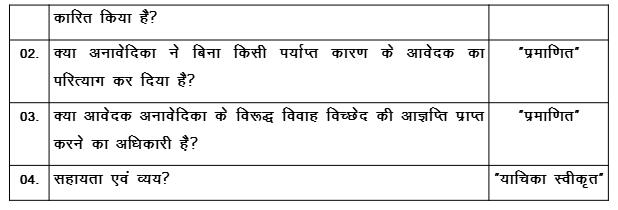
8. Mr. Ravindra Sharma, learned counsel appearing on behalf of the appellant herein/wife, would submit that the Family Court is absolutely unjustified in granting decree of divorce on the ground of desertion and cruelty, as both the grounds are not established by the res
AI
The court affirmed that desertion and cruelty, under the Divorce Act, 1869, were established, allowing for divorce as neither party was willing to maintain the marital relationship.

For a decree of divorce under cruelty or desertion, credible evidence substantiating these claims is essential. The court found no such evidence and upheld the Family Court's decision.


The court held that prolonged separation and actions causing mental anguish, including false accusations, constitute sufficient grounds for divorce under the Hindu Marriage Act.

The court ruled that claims of cruelty and desertion must be substantiated with credible evidence, emphasizing that allegations alone are insufficient for divorce under the Hindu Marriage Act.
The burden of proof lies with the appellant to establish claims of cruelty and desertion, which must be supported by credible evidence, and mere allegations without proof are insufficient for divorce....
The appeal court found the Family Court's dismissal of divorce due to cruelty and desertion to be perverse, establishing that the husband's behavior justified dissolution of marriage.

Prolonged separation exceeding a decade constitutes mental cruelty, and refusal to resume cohabitation indicates desertion, justifying divorce under Hindu Marriage Act.
Grounds for divorce under Hindu Marriage Act must be substantiated by convincing evidence; mere allegations of cruelty or adultery without proof do not warrant decree of divorce.



An indispensable Tool for Legal Professionals, Endorsed by Various High Court and Judicial Officers
Please visit our Training & Support
Center or Contact Us for assistance

Scan Me!
India’s Legal research and Law Firm App, Download now!


For Daily Legal Updates, Join us on :



 Back to top


