
 Back
Back





HIGH COURT OF CHHATTISGARH AT BILASPUR
Narendra Kumar Vyas, J.
Mohan Lal Jain (Died Through Lrs) - Appellant
Versus
Tejkaran Jain S/o Late Kunwar Lal Jain - Respondent
SA No. 67 of 2017
Decided On : 16-12-2025
| Table of Content |
|---|
| 1. factual background of the case (Para 1 , 3 , 4) |
| 2. defendant's contentions regarding the family arrangement (Para 5 , 6 , 8) |
| 3. trial court's findings on issues (Para 13 , 14) |
| 4. arguments of the appellant and respondents (Para 16 , 17) |
| 5. court's analysis and reasoning (Para 18 , 19) |
| 6. legal requirements for family settlements (Para 20 , 21 , 23 , 24) |
| 7. final conclusion of the court's ruling (Para 26 , 27) |
JUDGMENT :
Narendra Kumar Vyas, J.
1. This is plaintiffs’ second appeal filed under Section 100 of Civil Procedure Code, 1908 against the judgment and decree dated 23.11.2016 passed by the learned Additional District Judge, District Raipur (C.G.) in Civil Appeal No. 2A/2011 by which the appeal has been dismissed against the judgment and decree dated 11.10.2010 passed by the learned 16th Civil Judge, Class-II, Raipur (C.G.) in Civil Suit No. 30A/2009 dismissing the suit filed by the plaintiffs.
2. The parties have been described as per their description before the trial Court in Civil Suit No. 30A/2009.
3. The second appeal has been admitted by this Court on 01.07.2025 on the following substantial question of law:-
“Whether both the Courts below were justified in dismissing claim of the plaintiff/appellant on the count that the family settlement is not properly stamped, registered and attested in violation of provisions of Registration Act, 1908?”
4. Brief facts as reflected from the record are that:
(a) The plaintiffs have filed a suit on 21.04.2009 for declaration and permanent injunction before learned 13th Civil Judge, Class-II Raipur mainly contending that the plaintiff and defendant No. 1 are real brothers and they have two more brothers namely Sohanlal Jain and Dilip Kumar Jain. Their father Shri Kanwarlal Jain expired on 15.03.2008. A family arrangement was executed on 16.04.1992 between the plaintiff and defendant No. 1 and his brothers including the defendant No. 1 and the plaintiff have taken possession of their respective shares as per the family arrangement.
(b) It is also the case of the plaintiff that late Kanwar Lal Jain had purchased the land after selling the gold ornaments of his wife bearing Kharsa No. 228/1, area 0.040 acre and Khasra No. 229, area 0.036 hectare through sale deed dated 10.12.1974 in the name of defendant No. 1 which is hereinafter referred to as “suit property”. Since the property was purchased in the name of defendant No. 1, therefore, it was recorded in the name of defendant No. 1 only and in the year 1984 for his business purpose he required loan, therefore, mortgaged the property in the Central Bank of India, Vivekananda Ashram, Raipur.
(c) Thereafter, the plaintiff and defendant’s father has purchased land bearing Khasra No. 227, area 0.057 hectare and Khasra No. 228/2, area 0.042 hectare in the name of plaintiff, but the original title holder of these properties is their father. Since the plaintiff required money for his business purposes, therefore, he has mortgaged property in the Central Bank of India, Vivekananda Ashram, Raipur and obtained the loan.
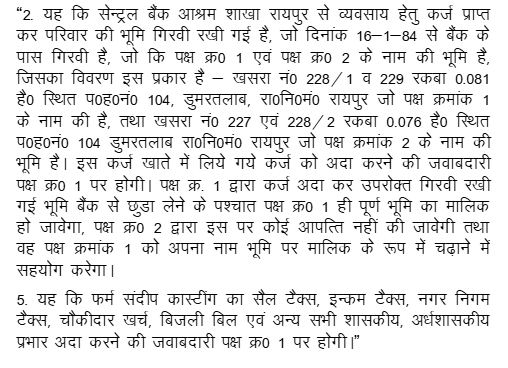
(d) Subsequently a family settlement was executed in presence of father of the plaintiff and defendant on 16.04.1992 according to which the land bearing Khasra No. 228/1 and land Khasra No. 229 were mortgaged by the plaintiff, therefore, the plaintiff has to pay the loan of the bank account, accordingly the plaintiff has paid loan to the bank and obtained “No Objection Certificate” on 29.09.2000. It is also the case of the plaintiff that at the time of family settlement, the plaintiff was in possession of the property as a title holder. It is also the case of the plaintiff that after getting redemption of mortgage property, the plaintiff has requested the defendant No.1 to record the suit property in the name of plaintiff, but he has not considered the same, and also not accepted the family arrangement and started interfering in possession of the property. It is also the case of the plaintiff that the defendant No. 1 raised an
AI
A family settlement intended to transfer property rights must be registered; otherwise, it is inadmissible as evidence.

Existence of an unregistered family arrangement deed does not confer partition rights absent proper registration and stamp duty where required by law.

The main legal point established in the judgment is the admissibility and validity of a Family Settlement Deed, emphasizing that it does not require registration if it does not create or extinguish a....


Family settlements may not require registration if agreed upon previously, as affirmed by established legal principles.
Point of law : Family property - Settlement - Admission - Statement made in the earlier plaint constitutes an admission under Order XII Rule 6 CPC. Thus, the Plaintiffs would be bound by the said adm....
Point of law: Family property – Settlement – Admission - Statement made in the earlier plaint constitutes an admission under Order XII Rule 6 CPC. Thus, the Plaintiffs would be bound by the said admi....



An indispensable Tool for Legal Professionals, Endorsed by Various High Court and Judicial Officers
Please visit our Training & Support
Center or Contact Us for assistance

Scan Me!
India’s Legal research and Law Firm App, Download now!


For Daily Legal Updates, Join us on :



 Back to top


