Back
Back





2025 Supreme(Chh) 320
HIGH COURT OF CHHATTISGARH AT BILASPUR
RAJANI DUBEY, AMITENDRA KISHORE PRASAD, JJ.
Shankar Lal Rathia, S/o. Goverdhan Rathia – Appellant
Versus
State Of Chhattisgarh, Through P.S.- Kharsiya – Respondent
CRA No. 840 of 2015, CRA No. 846 of 2015
Decided On : 20-11-2025
For the Appellants :Mr. F.S. Khare, Advocate and Mrs. Indira Tripathi, Advocate
For the Respondent:Mr. Ashish Shukla, Addl. Advocate General.
Circumstantial evidence alone, without corroboration, is insufficient for conviction; inconsistencies in witness testimonies weaken the prosecution's case.
Headnote:(A) Indian Penal Code, 1860 - Sections 302 and 201 - Appeals against conviction for murder and concealing evidence - Prosecution failed to establish the chain of circumstances beyond reasonable doubt to justify conviction - Witnesses of last seen were inconsistent, leading the court to doubt prosecution's claims - Memorandum statements and recoveries were deemed unreliable due to procedural irregularities noted by the court. (Paras 31-34)
Facts of the case:
The appellants were convicted for the murder of Chetan Dansena, whose body was found under a bridge, with the prosecution alleging asphyxia due to strangulation as the cause of death. The case was primarily based on circumstantial evidence and witness testimony regarding the last seen theory. (Paras 1-6)
Findings of Court:
The court found that the prosecution's evidence was insufficient to establish guilt beyond reasonable doubt, noting serious inconsistencies and weaknesses in witness testimonies, especially regarding the last seen theory and the validity of memorandum statements. (Paras 32-34)
Issues: The main issue was determining whether the prosecution had sufficiently proven the homicide was committed by the appellants based solely on circumstantial evidence and the accuracy of witness testimonies. (Paras 12-18)
Ratio Decidendi: The court ruled that mere presence of last seen evidence is not enough for conviction without further corroborative evidence linking the accused to the crime. The prosecution must establish a clear connection between the accused and the crime beyond reasonable doubt. (Paras 30-31)
Result: Appeals allowed; conviction and sentence set aside, and the appellants were acquitted due to the prosecution's failure to prove guilt beyond reasonable doubt.
| Table of Content |
|---|
| 1. overview of the appeals and convictions. (Para 1 , 2) |
| 2. summary of the prosecution's case. (Para 3 , 4) |
| 3. trial process overview. (Para 5 , 6) |
| 4. defense argument on procedural flaws. (Para 7) |
| 5. defense argument on witness reliability. (Para 8) |
| 6. state's counterargument supporting the conviction. (Para 9) |
| 7. court's examination of evidence. (Para 10 , 11) |
| 8. key question: nature of the death. (Para 12 , 16) |
| 9. witness statements about the scene. (Para 13 , 14 , 15) |
| 10. further examination of witness credibility. (Para 17 , 18) |
| 11. challenges to the last seen evidence. (Para 19 , 20 , 21 , 22) |
| 12. analysis of memorandum statements and their validity. (Para 23 , 24 , 25 , 26) |
| 13. court's conclusions on prosecution evidence. (Para 27 , 28) |
| 14. legal principles regarding last seen evidence. (Para 29 , 30 , 31) |
| 15. final judgment on the prosecution's burden. (Para 32) |
| 16. outcome of the appeals. (Para 33) |
| 17. order for bond and trial court compliance. (Para 34 , 35) |
Judgment :
Rajani Dubey, J.
1. Since the aforesaid appeals arise out of the same judgment of conviction and order of sentence dated 02.07.2015 passed by the 2nd Additional Sessions Judge, Raigarh (C.G.), in Sessions Trial No.20/2015, they are being heard together and disposed of by this common judgment.
2. By the impugned judgment, the appellants have been convicted and sentenced as under :
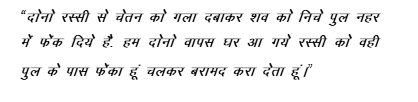
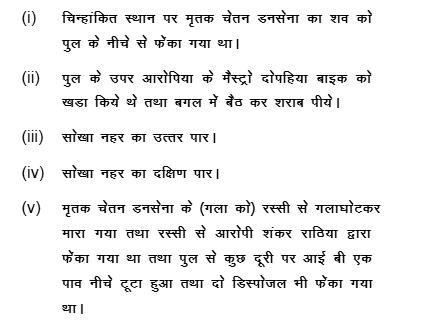
3. The prosecution story, in brief, is that on 23.11.2014, an information was given in Police Station - Kharsia by informant Malti Bai (PW-1) to the effect that the dead body of an unknown person was lying under the Adhapathra Sokhanala canal bridge. On the basis of this information, police registered merg intimation (Ex.P-1). After due inquiry, the deceased was identified as Chetan Dansena. During merg inquiry, inquest on the body of deceased was prepared and dead body was sent for postmortem examination to Community Health Center, Kharsiya, where Dr. Naveen Agrawal (PW-5) conducted postmortem on the body of deceased and gave his report under Ex.P-9 opining the cause of death of deceased to be asphyxia as a result of strangulation and death was homicidal in nature. After receiving the postmortem report and having confirmed that the deceased died homicidal death, on 28.11.2014, an FIR (Ex.P-12) for the offence under Section 302, 201 of IPC was registered against the unknown person and the police authority swung into action. Nazri naksha was prepared by the police. Statements of the witnesses were recorded according to their description. Accused/appellant Shankarlal in CRA No.840/2015 and Rukmani Bai in CRA No.846/2015 were taken into custody on 29.11.2014, and thereafter their memorandum statements were recorded. On the basis of memorandum statement of accused/appellant Shankar Lal in CRA No. 840/2015, upon his production/disclosure, a plastic rope, I.B. liquor bottle and disposable glasses were seized from the spot. On the basis of memorandum statement of accused/appellant Rukmani Bai @ Gidhhin in CRA No.846/2015, a blue colour two wheeler Maestro vehicle and shell of quilt (godri) were seized upon her production. Thereafter, upon finding the evidence of involvement of the accused/appellants in the commission of crime, accused/appellants Shankar Lal and Rukmani Bai were arrested vide arrest memo Ex.P-14 and P-15 respectively.
4. After completing usual investigation, charge sheet was filed against the accused-appellants under Sections 302, 201 of IPC before the jurisdictional Magistrate, who in turn, committed the case to the Court of Sessions for trial. The learned trial Court, on the basis of material contained in the charge sheet, framed charges against the appellants under Sections 302/34 and 201 of the IPC. The appellants having abjured guilt were subjected to trial.
5. So as to hold the accused-appellants guilty, the prosecution has examined as many as 12 witnesses. Statements of the accused-appellants were also recorded under Section 313 of the Cr.P.C. in which they denied th