Back
Back





2025 Supreme(Chh) 462
IN THE HIGH COURT OF CHHATTISGARH AT BILASPUR
RAJANI DUBEY, AMITENDRA KISHORE PRASAD, JJ.
Onkar Singh @ Konda S/o Asharam – Appellant
Versus
State of Chhattisgarh – Respondent
CRA No. 1843 of 2019
Decided On : 02-09-2025
For the Appellants : Y.C. Sharma, Anand Kumar Gupta, Pooja Lonia
For the Respondent: M. Asha
Conviction under IPC Section 302 cannot rely solely on circumstantial evidence of 'last seen together' without corroboration; mere suspicion is insufficient for guilt.
Headnote:(A) Code of Criminal Procedure, 1973 - Section 374(2) - Indian Penal Code, 1860 - Sections 302, 201/34 - Appeal against conviction for murder - Circumstantial evidence deemed insufficient - Court emphasized that conviction cannot solely rely on the last seen together theory without corroborative evidence. (Paras 30, 32).
(B) Evidence Law - The last seen theory does not amount to a conviction without further corroborative evidence, and mere suspicion is insufficient to substantiate guilt. (Paras 30, 32).
(C) The court assessed the nature of evidence detailing that the prosecution failed to establish guilt beyond reasonable doubt. (Paras 30, 32).
Facts of the case:
The appellant was convicted of murdering two individuals found dead in a brick kiln, with evidence leading to the prosecution relying primarily on circumstantial evidence and a last seen together theory lacking corroboration.
Findings of Court:
The court ruled that insufficient proof was presented, primarily relying on last seen evidence, leading to the reversal of the conviction.
Issues: The critical questions concerned the sufficiency of circumstantial evidence in substantiating the murder conviction and whether the prosecution met the burden of proof.
Ratio Decidendi: The court determined that lack of corroborative evidence coupled with reliance on weak circumstantial evidence rendered the conviction unsustainable, reiterating that mere suspicion is inadequate for proving guilt beyond reasonable doubt.
Result: Appeal allowed; the appellant acquitted.
| Table of Content |
|---|
| 1. details of conviction and facts of the case. (Para 1 , 2 , 3) |
| 2. evidence presented in trial. (Para 4 , 5) |
| 3. arguments and criticisms of the trial court's decision. (Para 6 , 8) |
| 4. consideration of evidence and nature of death. (Para 10 , 11 , 16) |
| 5. evaluation of evidence sufficiency for conviction. (Para 30 , 33) |
| 6. outcome of the appeal and directives post-judgment. (Para 34 , 35 , 36) |
JUDGMENT :
RAJANI DUBEY, J.
1. This appeal is preferred under Section 374 (2) of the Code of Criminal Procedure, 1973 against the judgment of conviction and order of sentence dated 25.06.2019 passed by the learned Additional Sessions Judge, Gariyaband (C.G.) in Sessions Trial No. 23/2017, wherein the said Court convicted the appellant and sentenced him as under:-
| Conviction | Sentence |
| U/S 302 of IPC | For life imprisonment and fine of Rs. 500/- in default of payment of fine to undergo additional R.I. for 02 months. |
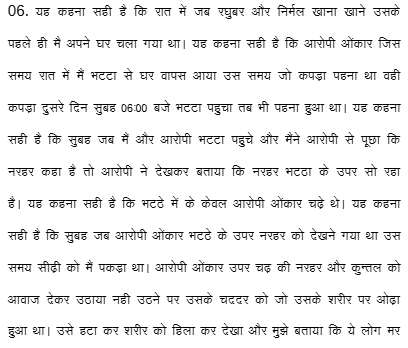
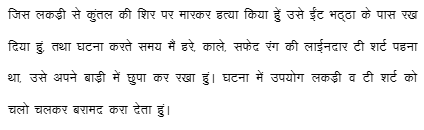
2. The case of the prosecution, as unfolded from the impugned judgment and the records of the case, is that on 02.03.2017, on receiving information about a murder in village Onwa Ghanghtinala in the Police Station- Ghura, the station incharge went to the spot for verification and registered a dehati morgue intimation of the death of Narhar Dhruv and Kuntal Dhruv as told by Santosh Kumar, according to which the informant Santosh was asked by Kantilal Dhruv through mobile phone to come home early in the morning at about 8 am, he went to the brick kiln of Narhar Dhruv along with village’s sarpanch Pahad Singh, where the bodies of his younger brother Kuntal Dhruv and Narhar Dhruv of the village were lying dead on the brick kiln. During the inquest, the statement of the witnesses were recorded and after giving notice to the witnesses for preparing dead body map of the deceased persons, Naksha Panchayatnama was prepared. From the spot, a ladder made of bamboo pole which had blood stains on it, one white colour jersey, one black colour Micromax mobile, 5 pieces of country made liquor, 4 pieces of disposable glasses, 1 grey colour Micromax mobile were seized in presence of the witnesses. For Panchnama proceedings of the dead bodies, a doctor from FSL Raipur came and conducted the Panchnama proceedings. A spot map was prepared. The bodies of deceased Narhar Dhruv and Kuntal Dhruv were sent to CHC Chura for post-mortem, where a team of two doctors conducted the post- mortem of both the bodies and gave a report in which, according to their opinion the nature of death of both the deceased was mentioned as homicidal, to which on 03.03.2017 for offence punishable under Section 302 of IPC has been registered against the unknown person. During the course of investigation, a ladder made of bamboo pole was seized from the spot. Memorandum statement of the appellant was recorded and on the basis of his memorandum statement, a half green- black coloured T-shirt with blood-like stains produced by the appellant and a Semhar wood with blood-like stains were seized. On finding evidence of crime against the accused, he was arrested and his family members were informed about his arrest. The aforesaid articles were sent to FSL for its medical examination.
3. After completion of due and necessary investigation, charge-sheet was led before the jurisdictional Magistrate who, in turn, committed the case for trial. On the basis of the material contained in the charge-sheet, learned trial Court framed charges against the appellant for alleged commission of offence under Sections 302 (two times) of IPC. The appellant having abjured guilt was subjected to trial.
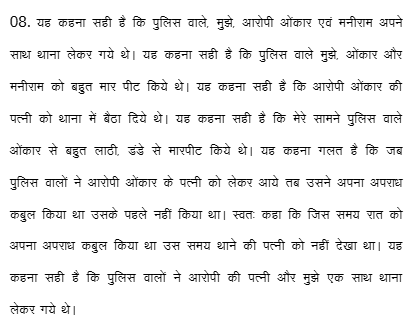
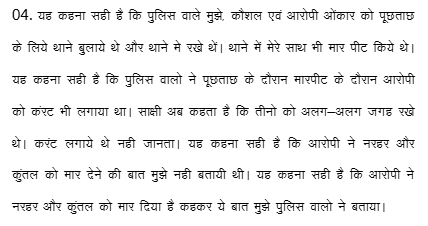
4. In order to prove its case, the prosecution has examined as many as 14 witnesses and exhibited several documents. Statement of the accused/appellant was also recorded under Section 313 of Cr.P.C in which he denied all the incriminating circumstances appearing against him in the prosecution case, pleaded innocence and false implication.
5. Learned trial Court after appreciating the oral and documentary on