Back
Back





2025 Supreme(Chh) 242
HIGH COURT OF CHHATTISGARH AT BILASPUR
RAJANI DUBEY, AMITENDRA KISHORE PRASAD, JJ.
Ramavtar, S/o. Ramkumar Uraon – Appellant
Versus
State Of Chhattisgarh, Through Police Station Seetapur – Respondent
CRA No. 1282 of 2018
Decided On : 28-11-2025
For the Appellant :Mr. Rakesh Kumar Jha and Mr. Vivek Siddharth Ojha, Advocates
For the Respondent:Mr. Ankur Kashyap, Dy. Govt. Advocate
Conviction based on circumstantial evidence requires a complete chain proving guilt beyond reasonable doubt; mere suspicion is insufficient.
Headnote:(A) Indian Penal Code, 1860 - Sections 363, 366, 376(1) and 302 - Appeal against conviction - The trial court convicted the appellant based on circumstantial evidence for the kidnapping, rape, and murder of a minor girl. The appeal contends that the circumstantial evidence does not form a complete chain of guilt beyond reasonable doubt. The prosecution failed to prove the last seen theory due to lack of corroborative evidence. Court emphasized on strict adherence to procedures surrounding DNA evidence, finding the prosecution's case insufficient for conviction. Appellant acquitted on benefit of doubt. (Paras 6, 10, 29, 30)
(B) Circumstantial Evidence - Must establish a complete chain pointing unequivocally to guilt of the accused; mere suspicion is insufficient for conviction. (Paras 26-28)
(C) In cases involving DNA Evidence, adherence to established collection and transportation procedures is imperative. (Paras 25)
Facts of the case:
The deceased, an 8-9 year old girl, went missing after a marriage function, and her body was later found in a field. The accused, last seen with the victim, claimed innocence, arguing inadequate evidence for prosecution.
Findings of Court:
The prosecution's circumstantial evidence was insufficient to establish guilt beyond a reasonable doubt. The court must give the benefit of doubt to the accused.
Issues: Whether the death was homicidal and if the accused was the author of the crime?
Ratio Decidendi: The court pointed out the lack of a complete evidentiary chain and emphasized the principle that suspicion cannot substitute proof.
Result: Appeal allowed, conviction set aside, appellant acquitted.
| Table of Content |
|---|
| 1. medical evidence of homicide and sexual assault. (Para 11 , 14) |
| 2. failures in establishing a reliable chain of evidence. (Para 26 , 29) |
| 3. appellant acquitted due to lack of evidence. (Para 30 , 31) |
Judgment :
Rajani Dubey, J.
1.Challenge in this appeal is to the legality and validity of the judgment of conviction and order of sentence dated 12th July, 2018 passed by learned Additional Sessions Judge, FTC, Surguja (Ambikapur) in ST No.393/2011 whereby the accused/appellant stands convicted and sentenced as under:
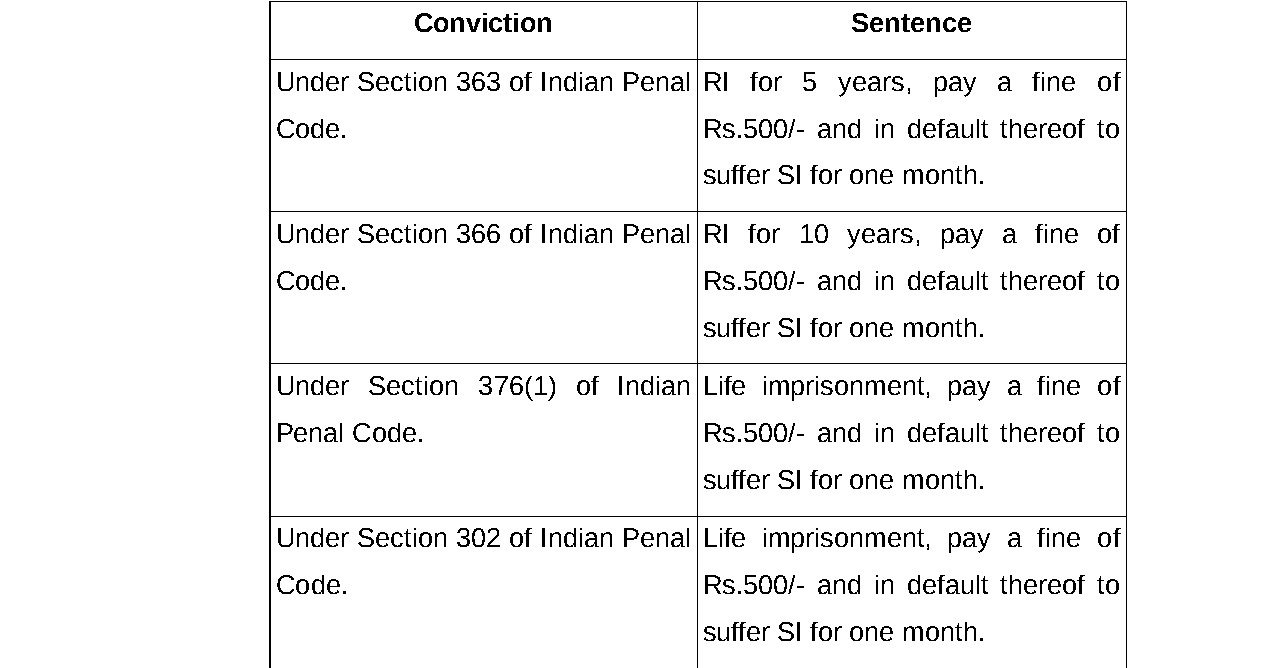
All the sentences were directed to run concurrently.
02. Case of the prosecution, in brief, is that on 27.5.2011 the deceased had gone to Village-Chainpur by bus in marriage ceremony of one Rupesh Uraon of her village where her maternal grant parents reside, along with other villagers including the accused/appellant. Her father (PW-1) also went to Village-Chainpur at the house of his mother- in-law (PW-2) and father-in-law (PW-3) where the deceased was also present. On being asked, the deceased told that she came with the accused. After marriage function being over, when her father went to the house of his father-in-law for taking her back to the village, she was not found there. His mother-in-law (PW-2) informed that at around 8-9 pm the deceased came with the accused and was saying that she would return with him by bus. Though her father searched her everywhere but she was not found. At around 1 am when the marriage party returned to the village, he met the accused and asked him about his daughter, on which he replied that he left her at her maternal grandmother’s house. However, next day when he went with his nephew Sushil to Village-Chainpur, the Village Kotwar informed him that one girl is lying dead in the agricultural field. He went there and saw that it is his daughter and thereafter informed the police about the same.
03. During investigation, the police registered Merg No.53/2011 on 28.5.2011 (Ex.P/1), prepared spot map Ex.P/6, inquest memo Ex.P/5, seized plastic slippers and one underwear from the spot and thereafter sent the dead body for postmortem to Community Health Center, Sitapur where Dr. Vidyabhushan Toppo (PW-8) conducted her postmortem and gave report of Ex.P/10. The wearing apparels of the accused were also seized on being produced by his father. The seized articles were sent for chemical examination to FSL and statements of the witnesses were recorded. After obtaining due permission, DNA test of the accused was also done. After completion of usual investigation charge sheet under Sections 363, 376(2)(f) and 302 of IPC was filed against the accused/appellant. Learned trial Court framed charges under Sections 363, 366, 376(1) and 302 of IPC against him, to which he abjured his guilt and prayed for trial.
04. In order to substantiate its case the prosecution examined 13 witnesses in all. Statement of the accused was recorded under Section 313 of CrPC wherein he denied all the incriminating circumstances appearing against him in the prosecution case, pleaded innocence and false implication. However, no witness was examined by him in his defence.
05. After hearing counsel for the respective parties and appreciation of oral and documentary evidence on record, the learned trial Court convicted and sentenced the appellant as mentioned above. Hence this appeal.
06. Learned counsel for the appellant would submit that the impugned judgment is per se illegal and contrary to the material available on record. The entire case of the prosecution is based on circumstantial evidence but there is no complete chain of circumstances which points towards guilt of the appellant beyond all reasonable doubt. As per evidence of PW-1 and PW-2, the appellant and the deceased left the house of PW-2 separately and after that no one saw them together. PW-13 CS Netam, IO, states that there were two merg intimation i.e. Merg No.51/2011 and Merg No.53/2011 and the appellant has been prosecuted in relation to Merg No.51/