
 Back
Back





IN THE HIGH COURT OF DELHI AT NEW DELHI
NAJMI WAZIRI, J.
Rakesh Kumar – Petitioner
Versus
Vijayanta Arya (DCP) and Others – Respondents
Cont. Cas(C) 480 of 2020 and Cm Appl. 25054 of 2020
Decided on : 28-10-2021
| Table of Content |
|---|
| 1. custody and related procedural requirements. (Para 1) |
| 2. supreme court directives on arrest. (Para 2) |
| 3. procedural obligations of police in criminal cases. (Para 3) |
| 4. importance of compliance with statutory norms by police. (Para 4) |
| 5. clarification of the statutory provisions related to police procedure. (Para 5) |
| 6. breach of protocol by investigating officer. (Para 6 , 12) |
| 7. indications of extortion and intimidation. (Para 7 , 11) |
| 8. procedural lapse in notification prior to arrest. (Para 8 , 10) |
| 9. petitioner’s rights in the context of police notice. (Para 9) |
| 10. court orders and contempt proceedings. (Para 13 , 14) |
NAJMI WAZIRI, J.
The hearing was conducted through video conferencing.
1. The petitioner was taken into custody on 23.08.2020 by R-3, Sub-Inspector, Mr. Kuldeep posted at PS : Maury a Enclave, Block-FP, Poorvi Pitampura, Delhi-34.
2. No notice was served upon him in terms of the dicta of the Supreme Court in Arnesh Kumar v. State of Bihar, which directed inter-alia as under:
“…
13. Our endeavour in this judgment is to ensure that police officers do not arrest accused unnecessarily and Magistrate do not authorise detention casually and mechanically. In order to ensure what we have observed above, we give the following direction:
(1) All the State Governments to instruct its police officers not to automatically arrest when a case Under Section 498-A of the Penal Code, 1860 is registered but to satisfy themselves about the necessity for arrest under the parameters laid down above flowing from Section 41, Code of Criminal Procedure;
(2) All police officers be provided with a check list containing specified sub clauses Under Section 41(l)(b)(ii);
(3) The police officer shall forward the checklist duly filed and furnish the reasons and materials which necessitated the arrest, while forwarding/producing the accused before the Magistrate for further detention;
(4) The Magistrate while authorising detention of the accused shall peruse the report furnished by the police officer in terms aforesaid and only after recording its satisfaction, the Magistrate will authorise detention,
(5) The decision not to arrest an accused, be forwarded to the Magistrate within two weeks from the date of the institution of the case with a copy to the Magistrate which may be extended by the Superintendent of police of the district for the reasons to be recorded in writing;
(6) Notice of appearance in terms of Section 41A of Code of Criminal Procedure be served on the accused within two weeks from the date of institution of the case, which may be extended by the Superintendent of Police of the District for the reasons to be recorded in writing;
(7) Failure to comply with the directions aforesaid shall apart from rendering the police officers concerned liable for departmental action they shall also be liable to be punished for contempt of court to be instituted before High Court having territorial jurisdiction.
(8) Authorising detention without recording reasons as aforesaid by the judicial Magistrate concerned shall be liable for departmental action by the appropriate High Court.
3. In Amandeep Singh Johar v. State of NCT of Delhi [W.P.(C) No. 7608/2017] a Division Bench of this court on 07.02.2018 directed Delhi police to strictly follow the procedure for effecting service under Section 41A of the Cr. P.C.:—
“15…
Procedure for issuance of notices/order by police officers under Sections 41A
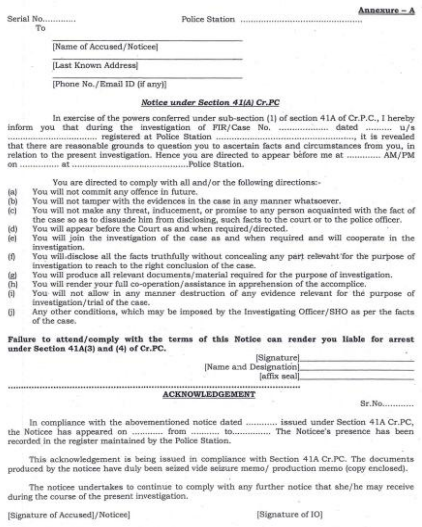
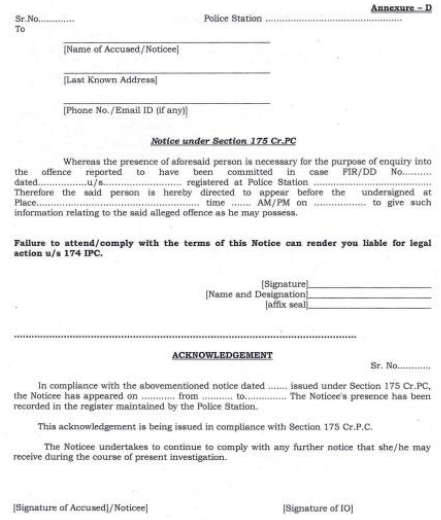
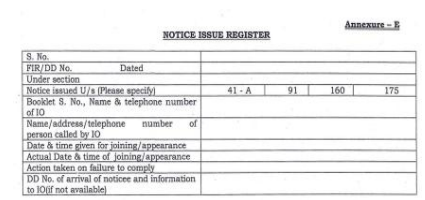
“(i) Police officers should be mandatorily required to issue notices under Section 41A CrPC (in the prescribed format) formally to be served in the manner and in accordance with the terms of the provisions contained in Chapter VI of the Code. Model form of notice under Section 41 A CrPC is reproduced herein below:—
“MODEL SECTION 41A CrPC NOTICE
Sr.No………….
Police Station……………..
To,
[Name of Accused/Noticee]
[Last Known Address]
[Phone No./Email ID (if any)]
Notice under Section 41(A) Cr. P.C.
In exercise of the powers conferred under subsection (1) of section 41A of
AI
Police must strictly follow procedural requirements before arresting individuals, ensuring the protection of their constitutional rights against unlawful detention.

Notices under Section 41A of the Cr.P.C. must include the crime number and relevant details to ensure transparency and protect the rights of the noticee.
Notices issued without disclosing the corresponding FIR and crime details violate legal standards under Section 41-A of the Cr.P.C., necessitating all mandatory information for legal validity.

The court clarified that procedural non-compliance in issuing notices under Section 41A does not equate to contempt if the accused is given opportunities to comply with the investigation.


Police notice for appearance – I.O. has to be careful and specific while issuing notice.

The court quashed criminal proceedings due to police failure to follow procedural mandates, highlighting the necessity for judicial oversight to prevent abuse of process and protect individual rights....

Failure to comply with procedural requirements under Section 41-A of Cr.P.C. during arrest was ruled as a violation of personal liberty and contempt of court.

Point of law: Under Section 41A to Section 41B is a sufficient guard to secure the attendance of an accused person to aid investigation in cases, where the punishability of the alleged offences does ....



An indispensable Tool for Legal Professionals, Endorsed by Various High Court and Judicial Officers
Please visit our Training & Support
Center or Contact Us for assistance

Scan Me!
India’s Legal research and Law Firm App, Download now!


For Daily Legal Updates, Join us on :



 Back to top


