
 Back
Back





IN THE HIGH COURT OF DELHI AT NEW DELHI
ANUP JAIRAM BHAMBHANI, J.
Thokchom Shyamjai Singh & Ors. – Petitioners
Versus
Union Of India Through Home Secretary & Ors. - Respondents
W.P.(CRL) 1929/2024 & CRL.M.A. 18784/2024
Decided on : 20–02-2025
(A) Unlawful Activities (Prevention) Act, 1967 - Section 43-B - Code of Criminal Procedure, 1973 - Section 50 - Constitutional mandate of serving grounds of arrest in writing - Petitioners challenged their arrest and subsequent remand orders, claiming non-compliance with statutory requirements - Court held that the requirement to furnish written grounds of arrest is mandatory and must be complied with to uphold constitutional rights. (Paras 17-19, 33-37)
(B) Arrest - Validity - The court found that the petitioners were not served with written grounds of arrest, rendering their arrest illegal and unconstitutional, thus quashing the remand orders. (Paras 36-38)
Facts of the case:
The petitioners were arrested by the NIA on 13.03.2024 under various sections of the IPC and UAPA, and they contended that their arrest was illegal due to non-compliance with the requirement of written grounds of arrest. (Paras 2-4)
Findings of Court:
The court determined that the NIA failed to comply with the constitutional mandate of providing written grounds of arrest, leading to the conclusion that the arrest was illegal. (Paras 36-37)
Issues: The main issues were whether the petitioners were served with written grounds of arrest and the legality of their subsequent remand orders. (Paras 12-13)
Ratio Decidendi: The court ruled that the requirement to provide written grounds of arrest is a constitutional safeguard that must be adhered to, and failure to do so renders the arrest illegal. (Paras 17-19, 33-34)
Result: The petitioners' arrest was set aside, and they were ordered to be released from custody. (Paras 37-38)
JUDGMENT :
ANUP JAIRAM BHAMBHANI, J.
1.Does the constitutional mandate of serving grounds of arrest in writing to an arrestee under the Unlawful Activities (Prevention) Act, 1967 (" UAPA ‟) come into effect from the date of the Supreme Court verdict in Pankaj Bansal vs. Union of India & Ors., (2024) 7 SCC 576 or in Prabir Purkayastha vs. State (NCT of Delhi), (2024) 8 SCC 254 ? That is the question that presents itself for decision in the present matter.
PETITIONERS’ CHALLENGE
2. By way of the present petition filed under Article 226 read with Article 227 of the Constitution, the petitioners, who are ordinarily residents of the State of Manipur, seek to challenge their arrest by the respondent No.2/National Investigation Agency ("NIA‟) on 13.03.2024 in case FIR No. RC-23/2023/NIA/DLI dated 19.07.2023 registered under sections 120-B/121-A/122 of the Indian Penal Code, 1860 ("IPC‟) and sections 18/18-B/39 of the UAPA at P.S.: NIA, New Delhi.
3. The petitioners also challenge remand order dated 14.03.2024 whereby the petitioners were initially remanded to NIA custody; and the subsequent orders passed by the learned Special Court in the subject FIR, extending their custody from time-to-time, including the orders remanding them to judicial custody, where they are presently lodged.
4. The principal ground raised by the petitioners challenging their arrest on 13.03.2024 is that the arrests were made in contravention of the requirements of Section 50 of the Code of Criminal Procedure, 1973 ("Cr.P.C.‟) read with Section 43-B of the UAPA . It is the petitioners‟ contention that since they were not served with the grounds of arrest in writing as mandated by the interpretation of the aforesaid statutory provisions in line with Article 22(1) of the Constitution, their arrest was illegal and unconstitutional, and deserves to be set-aside.
5. The petitioners further allege, that since their arrest on 13.03.2024 is illegal, the consequent remand order dated 14.03.2024 and other orders passed by the learned Special Court are also illegal and deserve to be quashed.
RESPONDENTS’ ALLEGATIONS
6. Briefly, the NIA‟s case against the petitioners is that petitioner No.1 is the Chief of Army of the United National Liberation Front ("UNLF‟), a designated terrorist organization listed at Entry No.14 of the First Schedule to the UAPA ; petitioner No.2 is the Chief of Intelligence of the UNLF; and petitioner No.3 is an active member of the UNLF and a close associate of petitioners Nos.1 and 2.
7. It is the NIA‟s allegation that the petitioners have been spearheading terrorist activities of the UNLF inter-alia by raising funds for that organization by resorting to extortion; and have also been recruiting the cadres and procuring weapons to foment violence in the State of Manipur, by fanning ethnic strife.
8. The NIA alleges that the petitioners are part of a trans-national conspiracy hatched by Myanmar-based terror outfits, to exploit the ethnic unrest in the State of Manipur and to wage war against the Government of India.
9. The NIA alleges that at the time of their arrest in Imphal, Manipur, the petitioners were moving in an un-numbered car, carrying weapons and ammunition alongwith foreign currency and foreign SIM-cards. The NIA says that the petitioners were flown to Delhi and were produced before the learned Special Court at Patiala House, New Delhi within 24 hours of their arrest for seeking their police custody remand.
10. Chargesheet has since been filed against the petitioners alleging offences under sections 120-B/121-B and 122 of the IPC and sections 18/18-B and 39 of the UAPA .
UNDISPUTED FACTUAL POSITION
11. The undisputed factual matrix that is relevant for deciding the rival contentions is the following :
11.1. Admittedly at the time of their arrest on 13.03.2024, the petitioners were served with 03 separate arrest memos, all dated 13.03.2024, containing their respective names and other particulars, which arrest memos were also signed by 02 witnesses in ea
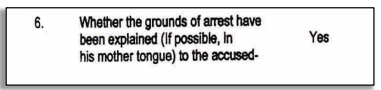
The requirement to provide written grounds of arrest is mandatory under Article 22(1) of the Constitution, and failure to comply renders the arrest illegal.

(1) Arrest – Any person arrested for allegation of commission of offences under provisions of UAPA or any other offences has a fundamental and a statutory right to be informed about grounds of arrest....


The arrest of an individual must comply with constitutional and statutory requirements, including providing specific grounds for arrest, which must be communicated in writing to ensure the accused's ....

Absence of written grounds of arrest does not mandate bail absent prejudice; substantial compliance via awareness suffices in serious offences, especially pre-'henceforth' rulings.

The court established that under the UAPA, knowledge of a person's terrorist activities is crucial for liability under Section 19, and the restrictions on bail under Section 43D(5) apply when there a....

The court reaffirmed that informing an arrested person of the grounds for arrest is a constitutional requirement, and non-compliance invalidates the arrest and remand.


The court affirmed that grounds of arrest must be communicated in writing to the accused, ensuring compliance with constitutional rights and enabling effective legal defense.

The grounds for arrest must be communicated in writing as required by Section 43B of UAPA to uphold constitutional rights, rejecting mere oral information.



An indispensable Tool for Legal Professionals, Endorsed by Various High Court and Judicial Officers
Please visit our Training & Support
Center or Contact Us for assistance

Scan Me!
India’s Legal research and Law Firm App, Download now!


For Daily Legal Updates, Join us on :



 Back to top


