
 Back
Back





IN THE HIGH COURT OF DELHI AT NEW DELHI
JASMEET SINGH, J.
Gauri Kansal (Minor) Through Father Anil Kansal. – Appellant
Versus
Govt. Of Nct delhi & ors. –Respondent
W.P. (C) 1649 of 2026 & C.M. APPL. 8024 of 2026
Decided On : 19-02-2026
| Table of Content |
|---|
| 1. challenge to admission criteria based on sibling points. (Para 1 , 2 , 3 , 4 , 5 , 6 , 7 , 8 , 9 , 10 , 11 , 12) |
| 2. petitioner's argument on arbitrariness of admission criteria. (Para 13 , 14 , 15 , 16) |
| 3. respondent's defence of admission criteria legality. (Para 17 , 18 , 19 , 20 , 21) |
| 4. judicial recognition of educational institutions' autonomy. (Para 22 , 23 , 24 , 25 , 26) |
| 5. criteria for awarding sibling points examined. (Para 27 , 28 , 29 , 30 , 31) |
| 6. clarification on legitimate expectations regarding admission criteria. (Para 32 , 33 , 34 , 35 , 36) |
| 7. court's dismissal of the writ petition. (Para 38 , 39) |
JUDGMENT :
JASMEET SINGH, J.
1. This is a writ petition filed under Article 226 of the Constitution of India seeking to challenge the Admission Criteria of the respondent denying sibling points to the petitioner’s daughter.
FACTUAL BACKGROUND
2. The petitioner is a citizen of India and his daughter is a candidate for admission in the respondent No. 3 school for academic session 2026-2027.
3. The respondent No. 3 is a private unaided school situated in New Delhi established and managed by Ashoka Education and Welfare society and registered at 13, School Site, Rohini, New Delhi. The school is an English-medium, coeducational institution affiliated with the Central Board of Secondary Education and governed by the Directorate of Education (“DoE”), Government of NCT of Delhi.
4. The Government of NCT of Delhi vide Circular dated 23.11.2025, issued the Admission Schedule and Guidelines for Entry-Level Classes (below six years of age) for open seats, i.e. other than EWS/DG/CWSN, in private unaided recognised schools for the Academic Session 2026-2027 with a view to ensure a fair, transparent and uniform admission process.
5. While complying to the said circular, the respondent No.3 issued a notification inviting online applications for admission to entry-level classes for the Academic Session 2026-27. The said admission process commenced from December, 2025.
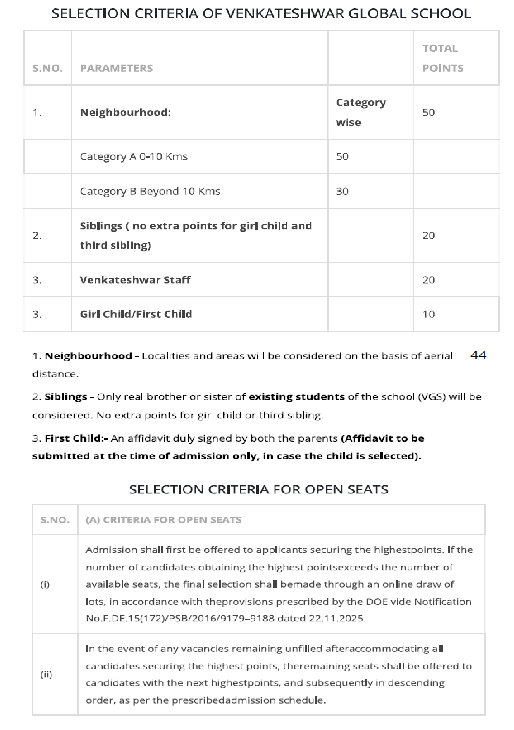
6. The petitioner applied online for admission of his minor daughter, Miss. Gauri Kansal (“Child”), to pre-school class of the respondent No. 3 for Academic session 2026-27 vide application dated 27.12.2025 and was allotted registration No. 26-2475. As per the petitioner, the child, according to the admission criteria, should have been allotted 70 points (50 points under the neighbourhood category and 20 points under the sibling category).
7. The result and first admission list based on the draw of lots under Open Seat/ General Category was published on 16.01.2026, wherein the aggregate points scored by each applicant were reflected next to their name. The child only secured 60 points, i.e. 50 points for neighbourhood and 10 points for being girl child as opposed to 70 points as expected by the petitioner.
8. The petitioner, thereafter, addressed an email dated 16.01.2026 to the respondent No. 3 and requested the correction of the said points as reflected in the result. He specified in the email that the child is entitled to sibling points as his elder son (from his first wife), Master Maulik Kansal, had been a student of the school and had passed out in year 2020. Thereafter, having received no response, the petitioner sent a follow-up email reiterating the same grievance on 20.01.2026
9. The respondent No. 3, on the same day, responded to the email of the petitioner stating that as per the admission criteria the candidate should be a real brother or sister of an existing student of the respondent No. 3, to be eligible for the sibling points. Since, the petitioner’s son was neither the real sibling of the child nor was currently enrolled with the school, sibling points could not be granted.
10. The petitioner again responded to the said reply of the respondent No. 3 and stated that the petitioner is the biological father of both the child and Master Maulik Kansal and that the child is born out of the second marriage. Therefore, Master Maulik Kansal and the child are
AI
Private unaided schools possess the autonomy to determine admission criteria, and the explicit refusal of sibling points based on the definition of 'sibling' adheres to constitutional standards of fa....

The main legal point established in the judgment is the entitlement of siblings to points under the 'sibling category' for admission in a recognized private un-aided school, emphasizing the importanc....

The court found that minority institutions can be regulated by the State regarding admissions while retaining their autonomy, ensuring compliance with educational standards and merit without violatin....

The right of minority educational institutions to administer admissions under Article 30(1) is subject to reasonable regulations by the State to maintain educational standards.


The court established that the government has the authority to formulate scholarship policies and eligibility criteria, provided they are not arbitrary or in violation of statutory provisions, and th....

Uniform admission guidelines for educational institutions must be strictly adhered to; age eligibility cannot be relaxed arbitrarily as it leads to discrimination against other students.

The restriction imposed by the 2016 Rules on the right guaranteed under Article 19(1)(g) is reasonable and thus saved by clause (6) of Article 19.

The fixation of government seat quotas in unaided minority institutions is unconstitutional and violates their fundamental right to autonomy under Article 30(1) of the Constitution.



An indispensable Tool for Legal Professionals, Endorsed by Various High Court and Judicial Officers
Please visit our Training & Support
Center or Contact Us for assistance

Scan Me!
India’s Legal research and Law Firm App, Download now!


For Daily Legal Updates, Join us on :



 Back to top


