
 Back
Back





IN THE HIGH COURT OF GUJARAT AT AHMEDABAD
A.Y. KOGJE, N.S. SANJAY GOWDA, JJ.
Seher, D/o. Mushtaque Mukadam, W/o. Minhajuddin M. Shaikh - Appellant
Versus
Minhajuddin Moinuddin Shaikh – Respondent
R/First Appeal No. 1264 of 2025
Decided On : 14-07-2025
| Table of Content |
|---|
| 1. procedure of family appeal under the family courts act (Para 1 , 2) |
| 2. background and mutual agreement of parties on marriage dissolution (Para 4) |
| 3. legal options for divorce under muslim law (Para 5 , 6) |
| 4. court's recognition of valid divorce and family court's jurisdiction (Para 7 , 8) |
| 5. dissolution of marriage by mutual consent (Para 9 , 10 , 11) |
ORDER :
A.Y. KOGJE, J.
1. Present First Appeal is preferred under Section 19 of the FAMILY COURTS ACT , 1984 against judgment and decree dated 19-03- 2025 passed in Family Suit No.3012 of 2024 passed by the Family Court No.4 at Ahmedabad.
2. By the impugned judgment and decree, the plaint, which was filed for dissolution of Muslim marriage under Section 2 (ix) of the Dissolution of Muslim Marriages Act, 1939, came to be rejected under Order-7, Rule-11 of CIVIL PROCEDURE CODE , 1908. While doing so, the Family Court has concluded that the appellant-wife has not stated exact ground on which, she seeks dissolution and when marriage is already dissolved under Muslim Law, it is not permissible for the Family Court to pass decree of dissolution of the same marriage.
3. The Court has held that the Family Court is not for certification of talaq / divorce, which is already legally executed. Therefore, unless statue provides for the Family Court to dissolve marriage between the parties under the Muslim Law or any other form of marriage and as there is no law to dissolve the muslim marriage by way of decree, when the marriage is already legally dissolved under the Muslim Law, suit is not maintainable under Section 2 (ix) of the Dissolution of Muslim Marriages Act, 1939 and therefore, in exercise of Order-7, Rule-11 of CIVIL PROCEDURE CODE , 1908, the plaint is rejected.
4. The parties before the Court have unanimously agreed to dissolve the Muslim Marriage (Nikah) between them and the facts in brief are as under:
4.1 The appellant got married with the respondent on 02.01.2015 at Ahmedabad as per rites and rituals of Muslim Shariat and they were blessed with two sons, Ibrahim and Muhammad. Due to irreconcilable differences in thoughts, habits, and preferences, the couple was unhappy and unable to live together, so they started living separately since July, 2022, and all attempts for their reconciliation failed.
4.2. It has been further submitted by the appellant that on 10.03.2024, the opponent pronounced "Talak-e-ehsan" (Islamic divorce), which the appellant accepted and she completed her Iddat period from 10.03.2024 to 26.06.2024. The opponent paid Rs.77,000/- as maintenance during this period and had already settled the Mehar amount at the time of marriage.
4.3. It has been further submitted by the appellant that after having lived apart for 2.5 years, both the parties had agreed to dissolve their marriage. It has been agreed that the appellant would have sole custody of the children and the opponent would pay Rs.11,000/- monthly per child for their upbringing (increasing 10- 15% annually with inflation) and covering all educational expenses (school fees, books, uniforms, gadgets, etc.). The opponent shall have visitation rights on weekends, holidays, and vacations, coordinated with the appellant’s convenience. Both parents will jointly monitor the children's progress and attend school-related activities.
4.4. It has been further submitted by the appellant that the opponent has undertaken to fully fund the children's education, extra-curricular activities, birthdays, and travel needs. Additionally, he will pay the appellant Rs.15,000/- as monthly maintenance (increasing 108 yearly) until she remarries or improves her financial situation. He owes her Rs.7,70,000/- for gold and credit card expenses, of which Rs.5,00,000/- has been paid, with the remaining Rs.2,70,000/- due by 22.12.2024. Both parties also agreed not to pursue legal action against each other.
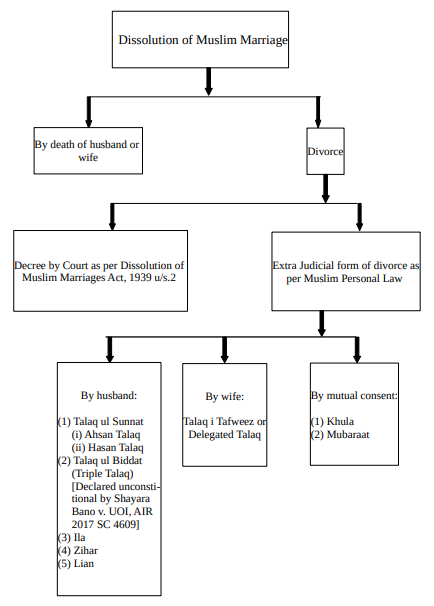
5. The Muslim Law recognizes divorce (talaq) through various modes, two of the modes which are recognized are ‘khula’ and ‘m
AI
The Family Court has jurisdiction to declare the dissolution of a Muslim marriage under mutual consent, as established by ‘mubaraat’, even post legal dissolution.
A mutual consent divorce under 'mubaraat' in Muslim law is valid without a written agreement, affirming Family Court's jurisdiction to declare marital status under Section 7 of the Family Courts Act.



(1) Family Court is competent to entertain suit seeking declaration regarding validity of marriage as also regarding matrimonial status of any person.(2) Dissolution of marriage by way of Mubaraat un....

The main legal point established in the judgment is that the marriage between the parties already stood dissolved by way of Mubarat as per Muslim Law, as recorded in the settlement.

The court affirmed that extra-judicial divorce via Mubaraat is valid and must be recognized by Family Courts, empowering them to declare marital status under Section 7 of the Family Courts Act.

Family Court only has to declare marital status by endorsing mubaraat invoking jurisdiction under Explanation (b) of Section 7(1) of Family Courts Act. Once a declaration of joint divorce invoking mu....

Mutual consent under Muslim Personal Law allows for divorce without judicial intervention if both parties agree, as established in the case.

Mubarat is a recognized form of Divorce under Muslim Personal Law, and Family Courts must accept such agreements for marriage dissolution.



An indispensable Tool for Legal Professionals, Endorsed by Various High Court and Judicial Officers
Please visit our Training & Support
Center or Contact Us for assistance

Scan Me!
India’s Legal research and Law Firm App, Download now!


For Daily Legal Updates, Join us on :



 Back to top


