
 Back
Back





THE GAUHATI HIGH COURT (THE HIGH COURT OF ASSAM, NAGALAND, MIZORAM & ARUNACHAL PRADESH)
Manish Choudhury, J.
M/s Innovatiview India Limited - Petitioner
Versus
The Election Commission of India, represented by its Secretary, Nirvachan Sadan, Ashoka Road, New Delhi - Respondent
Writ Petition (C) No. 1218 of 2026
Decided On : 27-03-2026
| Table of Content |
|---|
| 1. overview of tender notice, scope of work, and parties involved. (Para 1 , 2 , 3 , 4 , 5) |
| 2. contentions regarding restrictive eligibility criteria vs. autonomy of tendering authority. (Para 6 , 7) |
| 3. review of the pre-bid consultative process and factual background updates. (Para 8 , 9 , 10 , 11 , 12 , 13) |
| 4. justification of technical eligibility criteria based on project complexity and operational requirements. (Para 14 , 15 , 16 , 17 , 18 , 19 , 20 , 21 , 22) |
| 5. scope of judicial review in restrictive tender conditions and expert deference. (Para 23 , 24 , 25 , 26 , 27 , 28 , 29 , 30 , 31 , 32) |
| 6. final determination that conditions were rational and did not violate constitutional protections. (Para 33 , 34 , 35) |
JUDGMENT :
MANISH CHOUDHURY, J.
The instant writ petition under Article 226 of the Constitution of India is preferred by the petitioner to assail a Tender Notice bearing no. ELE.13/2026/03 dated 06.02.2026 for allotment of the contract of ‘Live Web Streaming for General Elections in Assam’. The Tender Notice was published by the Chief Electoral Officer, Assam & Additional Chief Secretary to the Government of Assam, Election Department [hereinafter also referred to as ‘the Tendering Authority’, at places, for ease of reference] whereby on-line bids through e-Procurement system were invited. When the Tender Notice was published on 06.02.2026, the last date and time of bid submission was mentioned as 02-30 p.m. on 27.02.2026. It was mentioned in the Tender Notice that the bid [Technical Bid] would be opened on-line on at 03-30 p.m. on 27.02.2026. It was specifically mentioned in the Tender Notice that due to urgency of the upcoming General Election to the Assam Legislative Assembly, the submission period of bids was made limited to fourteen days. The bidders were asked to view and download the Tender Document comprising all details and terms & conditions from the portal -www.assamtenders.gov.in. It was specified in the Tender Notice that pre-bid queries would be received up to 05-00 p.m. on 11.02.2026.
2. In Clause 2.1 : ‘Scope of Work – Live Web Streaming’ of the Tender Document, the complete Scope of Work is mentioned. As per the said clause, the Scope of Work has been divided into three packages : [i] Package 1 : Live web streaming of Polling Stations; [ii] Package 2 : Live web streaming of PTZ Camera / GPS for Flying Squad Vehicles / Static Surveillance Vehicles [FSV/SSV]; and [iii] Package 3 : Live Web Streaming of Check posts across Assam. In Clause 3 of the Tender Document, the minimum eligibility criteria were laid down. The agencies submitting their proposals must meet the minimum eligibility criteria to qualify for further technical evaluation.
3. As the subject-matter of challenge in the instant writ petition is limited to three specific minimum eligibility criteria, for the purpose of brevity, the discussion is, at first, kept limited to the said three criteria.
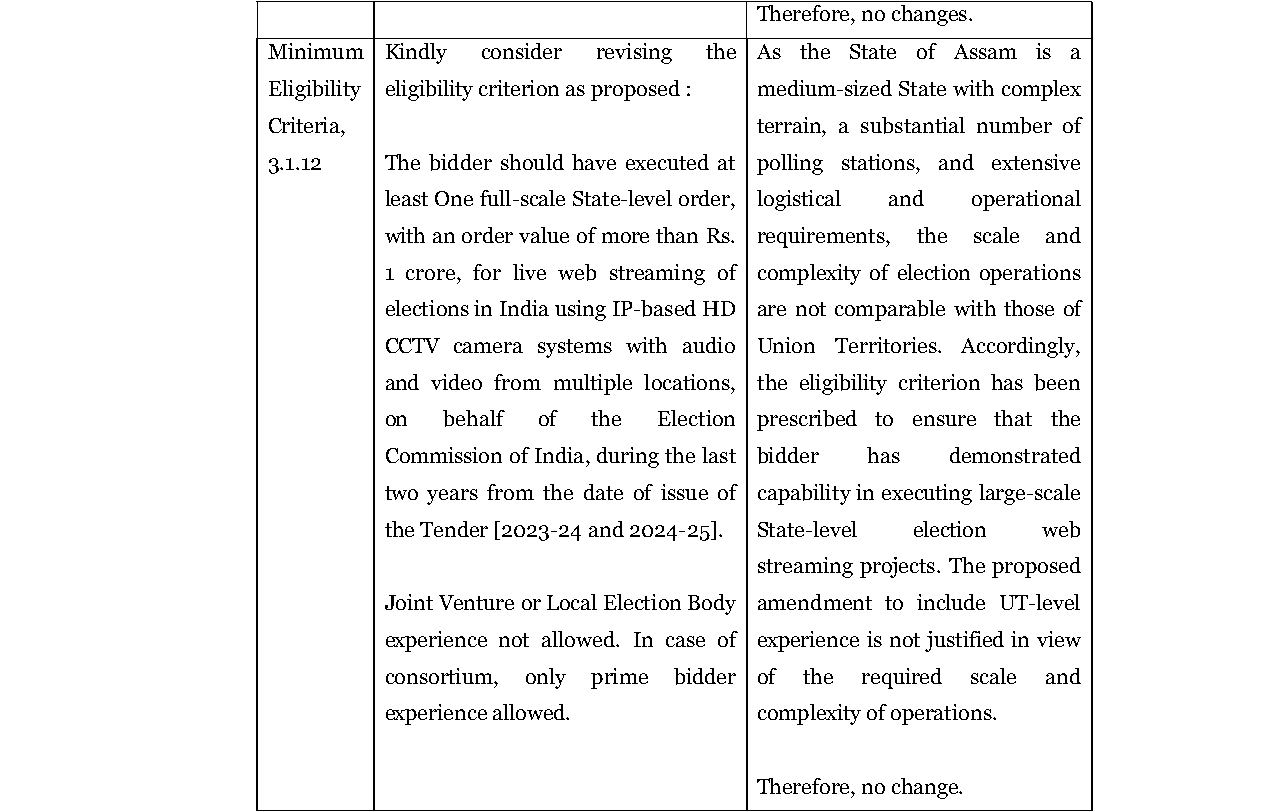
4. For ready reference, the said three eligibility criteria are extracted hereinbelow :-
3. Minimum Eligibility Criteria The agencies submitting their proposals must meet the following minimum eligibility criteria to qualify for further Technical Evaluation :
3.1. Minimum Eligibility Criteria
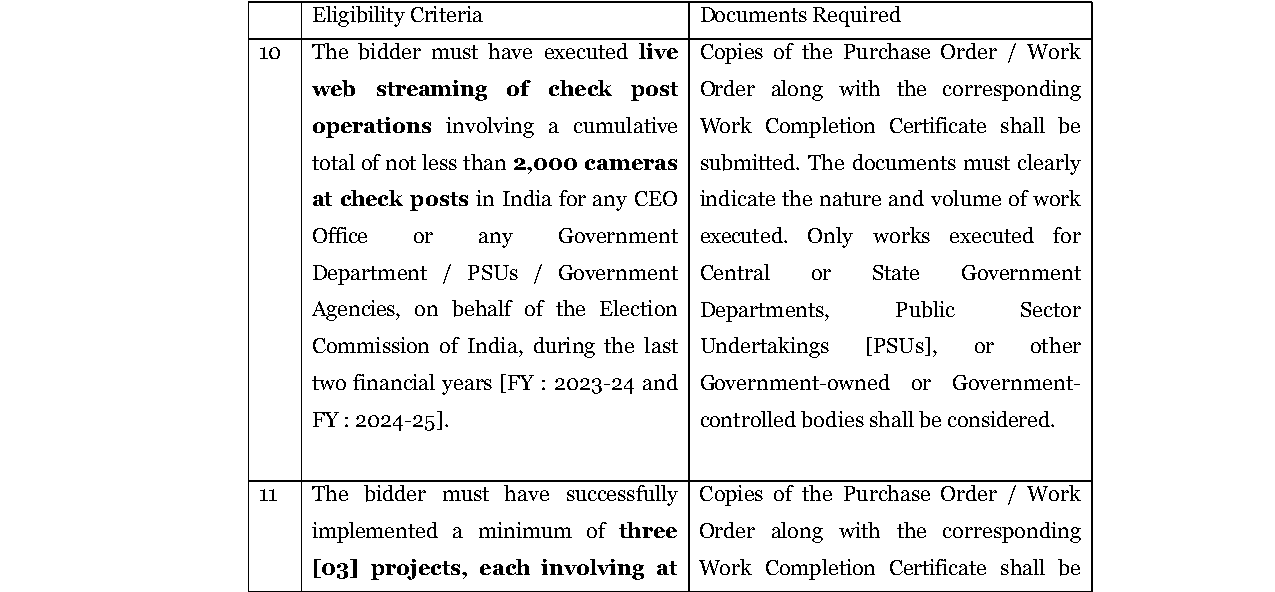
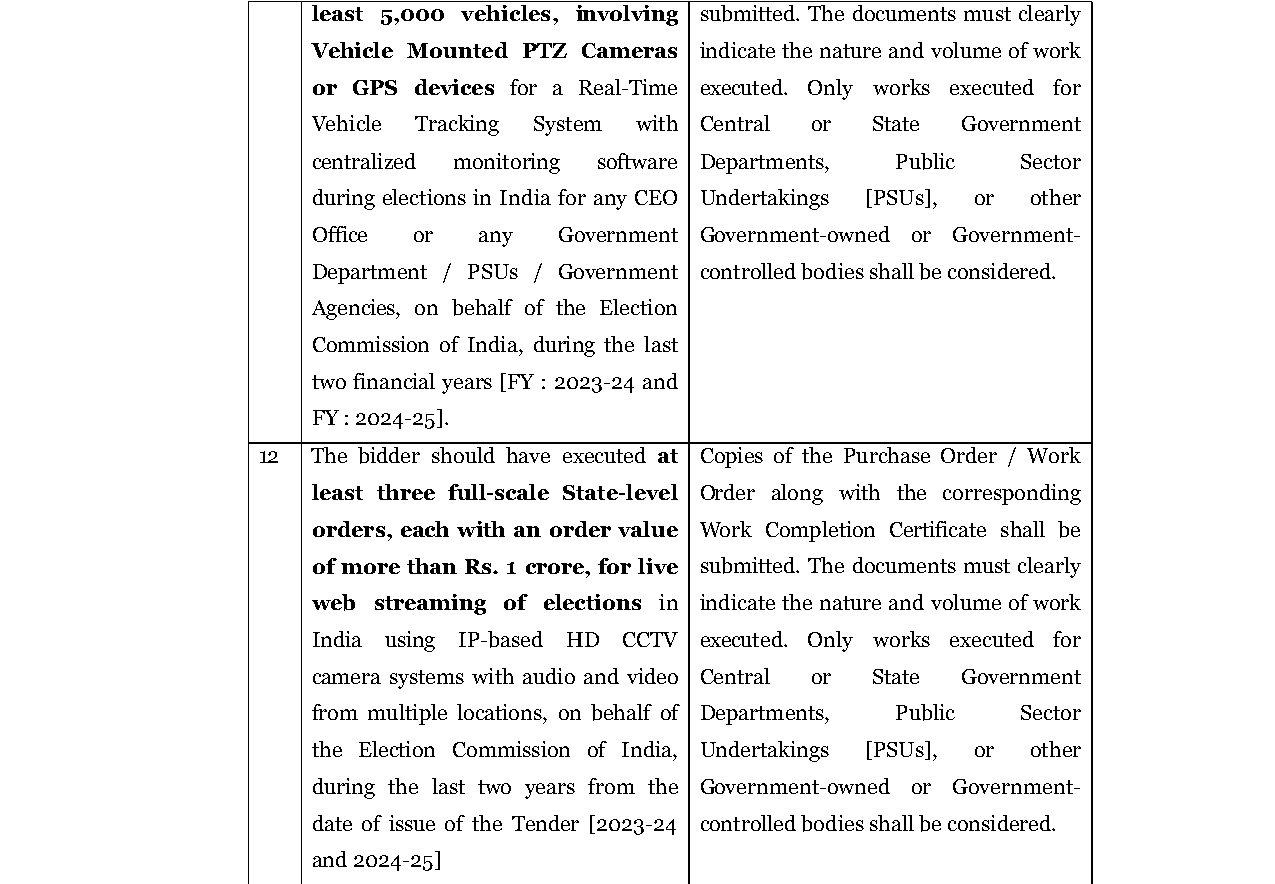
4. Assailing the three eligibility criteria, the petitioner has preferred the instant writ petition.
5. I have heard Mr. A. Saxena, learned counsel assisted by Mr. N. Gautam, learned counsel for the petitioner; Ms. S. Katakey, learned Standing Counsel, Election Commission of India [ECI] for the respondent nos. 1, 2 & 3; and Mr. S.R. Baruah, learned Junior Government Advocate, Assam for the respondent no. 4.
6. Mr. Saxena, learned counsel appearing for the petitioner has submitted that Clause 2.1 : ‘Scope of Work - Live Web Streaming’ has been divided into three packages whereas in a number of elections in other States like Utter Pradesh, Kerala, etc., such division into separate packages was not done. The petitioner has contended that it has successfully c
AI

The court upheld the validity of tender conditions for election webcasting, emphasizing state discretion in criteria formulation while maintaining limits on judicial intervention unless proven arbitr....
The main legal point established in the judgment is the limitation of judicial review in tender matters, the need for commercial prudence in evaluating tenders, and the importance of fairness and non....


Judicial review of tender conditions is limited to preventing arbitrariness; authorities have discretion in setting conditions based on project requirements.

Tender - Tender conditions are required to be read as provided in the tender document and if there are two views or construction possible than the view of the authority interpreting the tender docume....

Eligibility for contracting: To foster competition, firms and individuals to offer goods, work, and services required for the program, any conditions for participation shall be limited to those that ....


Fairness cannot be a one-way street. The fairness required of the Financial Corporations cannot be carried to the extent of disabling them from recovering what is due to them. While not insisting upo....

Public authorities must ensure fairness and non-arbitrariness in tender processes, adhering to established eligibility criteria.



An indispensable Tool for Legal Professionals, Endorsed by Various High Court and Judicial Officers
Please visit our Training & Support
Center or Contact Us for assistance

Scan Me!
India’s Legal research and Law Firm App, Download now!


For Daily Legal Updates, Join us on :



 Back to top


