
 Back
Back





IN THE HIGH COURT OF KERALA AT ERNAKULAM
P.V. KUNHIKRISHNAN, J.
Deepa – Appellant
Versus
State of Kerala – Respondent
Crl. M.C. No.6267 of 2016
Decided on : 10-07-2024
(A) Indian Penal Code - Sections 294(b) and 506 - Quashing of proceedings - Allegations of abusive language and threats - Court finds that the words used do not meet the definition of obscenity under Section 294(b) IPC, and there is no intention to cause alarm under Section 506 IPC - Prosecution deemed unsustainable. (Paras 5, 6, 7, and 8)
(B) Criminal Intimidation - Definition and requirements - The court emphasizes that mere words without intent to cause alarm do not constitute criminal intimidation. (Paras 13, 14, and 15)
Facts of the case:
The petitioner sought to quash proceedings alleging offences under Sections 294(b) and 506 IPC, claiming that the allegations did not constitute the offences as defined by law.
Findings of Court:
The court concluded that the allegations did not satisfy the legal definitions required for the offences charged, leading to the quashing of the proceedings.
Issues: The main issues were whether the words used constituted obscenity and whether there was an intention to intimidate.
Ratio Decidendi: The court ruled that abusive words do not equate to obscenity unless they arouse lascivious thoughts, and mere threats without intent to cause alarm do not meet the threshold for criminal intimidation.
Result: Crl.M.C. allowed; all proceedings quashed.
ORDER :
This Criminal Miscellaneous case is filed to quash the proceedings in Annexure-A final report which is now pending as CC No.1929/2015 before the Judicial First Class Magistrate Court, Kalamassery. The above case is chargesheeted alleging offences punishable under Sections 294(b) and 506(i) of the IPC.
2. The prosecution case is that the accused abused the defacto complainant and his wife using filthy language and it was alleged that the petitioner had threatened that she will do away them. The alleged incident was taken place on 30.04.2013 at about 3.30 pm.
3. Heard the learned counsel for the petitioner and the learned Public Prosecutor. I also heard the learned counsel appearing for the 2nd and 3rd respondents.
4. The short point raised by the petitioner is that even if the entire allegations are accepted, the offence under Sections 294(b) and 506 (ii) of the IPC is not made out. To consider the above contentions, it will be better to extract the relevant portion of the final report.
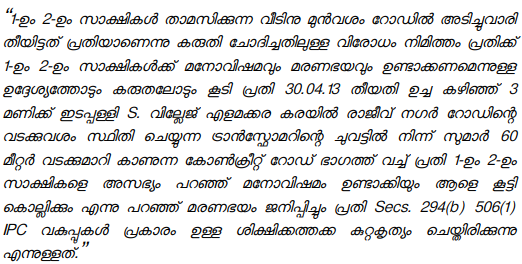
5. This Court in Latheef v. State of Kerala (2014 (2) KLT 987 = 2014 (2) KHC 604) considered the ingredients of Section 294(b) IPC. It will be better to extract the relevant portion of the above judgment.
“5. Abusive words or humiliating words or defamatory words will not as such amount to obscenity as defined under the law. Of course there is no doubt that the words alleged to have been used by the revision petitioner are in fact abusive and humiliating. But to make it obscene, punishable under S.294(b) IPC it must satisfy the definition of obscenity. S.294 IPC does not define obscenity. Being a continuation of the subject dealt with under S.292 IPC the definition of obscenity under 292(1) IPC can be applied in a prosecution under S.294 IPC also. To make punishable, the alleged words must be in a sense lascivious, or it must appeal to the prurient interest, or will deprave and corrupt persons. In P.T. Chacko v. Nainan Chacko reported in (1967 KLT 799 = 1967 KHC 231) this Court held that, “the test of obscenity is whether the tendency of the matter charged as obscenity is to deprave and corrupt those whose minds are open to such immoral influences.” In Sangeetha Lakshmana v. State of Kerala reported in (2008 (2) KLT 745 = 2008 (1) KHC 812 : 2008 (1) KLD 339) this Court held thus, “in order to satisfy the test of obscenity, the words alleged to have been uttered must be capable of arousing sexually impure thoughts in the minds of its hearers.” Thus it is quite clear that, to make obscene the alleged words must involve some lascivious elements arousing sexual thoughts or feelings or the words must have the effect of depraving persons, and defiling morals by sex appeal or lustful desires. I find that the words alleged to have been used by the revision petitioner in this case are really abusive and humiliating, but those words cannot be said to be obscene. As already stated, every abusive word or every humiliating word cannot, by itself, be said to be obscene as defined under the Indian Penal Code. I find that the conviction against the revision petitioner under S.294(b) IPC in this case, on the basis of the above words alleged to have been used by him, is liable to be set aside, and the revision petitioner is entitled to be acquitted. In the result, this revision petition is allowed. The conviction and sentence against the revision petitioner under S.294(b) IPC in ST No.3810/1998 of the Judicial First Class Magistrate Court, Chittoor are set aside, on the finding in revision that the revision petitioner is not guilty of the offence punishable under S.294(b) IPC. The revision petitioner will stand released from prosecution on acquittal, and the bail bond executed by him will stand discharged.”(underline supplied)
6. Even if the entire allegations in the final report filed against the petitioner are accepted, the offence under Section 294(b) is not attracted.
7. As far as Section 506 is concerned, the Apex Court considered the matter in detail in Ma
AI
The court ruled that abusive language does not constitute obscenity under IPC unless it arouses lascivious thoughts, and threats must show intent to intimidate to be actionable.
Further proceedings quashed as allegations did not establish offences under IPC sections claimed.
Vague allegations without specific words do not establish offences under IPC Sections 294(b), 506, and 509, leading to quashing of prosecution.

Specificity in allegations is essential to substantiate charges under IPC Sections 294(b) and 509; vague claims prevent effective defense.

Insufficient evidence does not substantiate allegations under Sections 294(b) and 506(1) IPC, leading to the quashing of proceedings against the accused.

Non-cognizable offences pursued without necessary sanctions result in abuse of process.

The court established that intent is crucial in determining offences under IPC Sections 509 and 506(1), and mere abusive language without such intent does not suffice for prosecution.



An indispensable Tool for Legal Professionals, Endorsed by Various High Court and Judicial Officers
Please visit our Training & Support
Center or Contact Us for assistance

Scan Me!
India’s Legal research and Law Firm App, Download now!


For Daily Legal Updates, Join us on :



 Back to top


