


 Back
Back





2024 Supreme(Ker) 1484
IN THE HIGH COURT OF KERALA AT ERNAKULAM
P.V. KUNHIKRISHNAN, J.
Rahul, S/o. Revi – Petitioner
Versus
State Of Kerala, Represented By The Public Prosecutor, High Court Of Kerala, (Through The Sub Inspector Of Police), Pandalam Police Station – Respondent
Crl.MC No. 6099 Of 2017
Decided On : 09-09-2024
For the Petitioner: SRI. ROSHEN D. ALEXANDER, SMT. TINA ALEX THOMAS.
Other Present : SRI.RENJITH.T.R, SR.PP.
IMPORTANT POINT
To establish abetment under Section 306 IPC, there must be clear intent and direct actions by the accused that compel the victim to commit suicide; emotional distress alone is insufficient.
Headnote:
(A) Indian Penal Code, 1860 - Section 306 - Abetment of suicide - The petitioner sought to quash the final report alleging abetment of suicide under Section 306 IPC after the deceased committed suicide due to love failure - The court found no nexus between the accused's conduct and the suicide, emphasizing that mere emotional distress does not constitute abetment - The court referenced previous rulings to clarify the necessary intent and actions to establish abetment under Section 306 IPC. (Paras 10, 17, 18)
(B) Criminal Procedure Code, 1973 - Section 482 - Quashing of proceedings - The court held that if the allegations do not prima facie constitute an offence, the proceedings can be quashed under inherent powers. (Paras 22, 8)
ORDER :
(P.V. Kunhikrishnan, J.)
This Criminal Miscellaneous case is filed to quash Annexure-A2 final report in Crime No. 2308/2016 of Pandalam Police Station, which is presently numbered as CP No. 22/2017 on the file of the Judicial First Class Magistrate Court, Adoor. Now, the case is pending before the Addl. Sessions Court-II, Pathanamthitta as SC No. 257/2018. The offence alleged is under Sec. 306 IPC.
2. One Rehana committed suicide on 04.11.2016 between 8 am and 5.30 pm at her house. The cause of death was stated to be death by hanging. The allegation is that the petitioner and the deceased were in love and on examination of the personal diary of the deceased and whatsapp messages of the victim, the police alleged that the accused abetted her to commit suicide. Thus, it is alleged that the accused committed offence under Sec.306 IPC. According to the petitioner, even if the entire allegations are accepted, no offence under Sec.306 IPC is made out.
3. Heard the learned counsel for the petitioner and the learned Public Prosecutor.
4. The learned counsel for the petitioner reiterated the contentions and also relied the order passed by this Court in Crl.M.C. No.4161/2015 and submitted that even if the entire allegations are accepted, no offence is made out. The Public Prosecutor made available the case diary in the case and submitted that the entries of the deceased in the diary will show that there is abetment from the side of the petitioner.
5. This Court considered the contentions of the petitioner and the Public Prosecutor. This Court also perused the case diary including the entries in the diary maintained by the deceased. The allegation in the final report is like this :
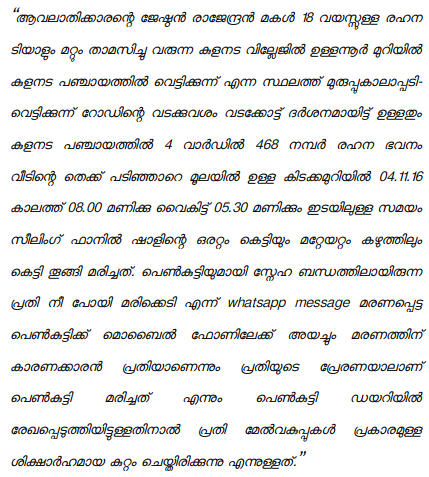
6. Admittedly, the petitioner and the deceased were in love. It is true that there is some entry in the diary to the effect that the reason for the suicide is the love failure with the petitioner. Whether the same will attract the offence under Sec.306 IPC is the question to be decided. This Court considered the ingredients of Sec.306 IPC in detail in the order dated 06.08.2024 in Crl.M.C. No. 4161/2015. The relevant portion of the above judgment is extracted hereunder :
“9. This Court considered the contention of the petitioner and the Public Prosecutor. To attract an offence under Section 306 IPC, the essential ingredients that need to be proved is the intention of the accused ie., it is not enough if the act of the accused caused persuasion in the mind of the deceased to commit the suicide. The accused should have intended by such acts, the consequence of suicide. Abetment is the main ingredients of Section 306 IPC. If any person commits suicide, whoever abets the commission of such suicide, shall be punishable under Section 306 IPC. Section 107 IPC defines ‘Abetment of a thing’. It would be better to extract Section 107 IPC herebelow:
107: who— A person abets the doing of a thing, First.—Instigates any person to do that thing; or Secondly.—Engages with one or more other person or persons in any conspiracy for the doing of that thing, if an act or illegal omission takes place in pursuance of that conspiracy, and in order to the doing of that thing; or Thirdly.— Intentionally aids, by any act or illegal omission, the doing of that thing. Explanation I: A person who, by willful misrepresentation, or by willful concealment of a material fact which he is bound to disclose, voluntarily causes or procures, or attempts to cause or procure, a thing to be done, is said to instigate the doing of that thing.’
10. Unless there is ‘abetment’ as stated in Section 107 IPC, there cannot be any conviction under Section 306 IPC. The prosecution case in this case is that there was a love affair between the petitioner and the deceased girl. There were several communications between the petitioner and the deceased. Subsequently, when the deceased called the petitioner over phone before her death, he informed that he is in friendship with another girl and he will not be able to












