Back
Back





2025 Supreme(Kar) 427
IN THE HIGH COURT OF KARNATAKA AT BENGALURU
M. NAGAPRASANNA, J.
Nandisha K. S/o Kadirappa - Appellant
Versus
State of Karnataka - Respondent
Criminal Petition No. 9901 of 2024
Decided On : 20-06-2025
Advocate Appeared:
For the Appellant : Rajath
For the Respondent: B.N. Jagadeesha
To establish abetment of suicide under Section 306 IPC, evidence of instigation or encouragement by the accused is essential; mere emotional turmoil does not suffice.
Headnote:(A) Indian Penal Code, 1860 - Sections 306 and 107 - Abetment of suicide - The petitioner challenged the proceedings under Section 306 IPC, contending no ingredients of abetment were established. The Court noted the absence of instigation or incitement by the petitioner and emphasized the necessity of mens rea, ultimately holding that proceeding against the petitioner would constitute an abuse of process. (Paras 8, 15, 9)
Facts of the case:
The case involved accusations against the petitioner related to the suicide of the complainant's son, allegedly driven by his wife's affair with the petitioner, leading to claims of emotional torture.
Findings of Court:
The Court found that the allegations did not meet the required legal threshold for abetment of suicide as specified in the relevant legal provisions.
Issues: The key issue was whether the actions of the petitioner constituted abetment under Section 306 IPC.
Ratio Decidendi: The court ruled that mere emotional turmoil in a relationship does not translate to criminal liability under Section 306 IPC without clear evidence of instigation or encouragement to commit suicide. The prosecution failed to demonstrate the requisite mens rea necessary for abetment.
Result: The criminal petition was allowed, and the proceedings against the petitioner were quashed.
ORDER :
1. The petitioner – accused No.2 is at the doors of this Court calling in question proceedings in C.C.No.8089/2024, pending before the Additional Chief Judicial Magistrate, Bengaluru Rural District, for the offences under Sections 306 r/w. 34 of the IPC, arising out of Crime No.200/2024. The second respondent is the complainant, the father of the victim.
2. Heard Sri Rajath, learned counsel for petitioner and Sri B.N.Jagadeesha, learned Additional State Public Prosecutor for respondent No.1. Respondent No.2 - complainant though served, has chosen to remain unrepresented.
3. Unfolding of facts, are as follows:
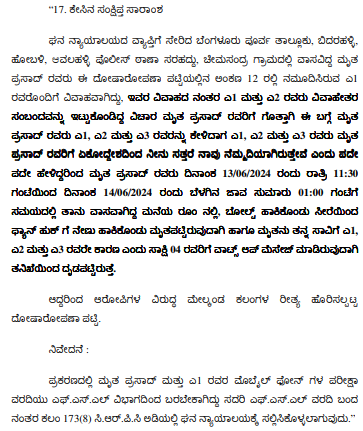
The son of the second respondent gets married to accused No.1 on 18.02.2024. The son and the daughter in-law shift to a separate residence. The relationship between the two soon began to sore after marriage and the husband generated apprehension of the newly married wife to be having an affair with the petitioner – accused No.2. The allegation in the complaint is that, on the discovery of the affair of the wife with the petitioner, she began to torture the son of the complainant, whom she was married three months ago. Alleging that the son – victim was tormented and tortured by his wife, at 1.20 a.m., i.e., 14.06.2024, commits suicide. He had hung himself to the hook of the fan. The father of the son registers a complaint against accused No1. and others and the complaint becomes a crime in Crime No.200/2024, for the offences under Section 306 r/w. 34 of the IPC . The police conduct investigation, investigation leads to filing of a charge sheet and the matter is now registered as C.C.No.8089/2024 for the afore-quoted offences. Filing of the charge sheet is what has driven the petitioner – accused No.2 to this Court in the subject petition.
4. The learned counsel for petitioner Sri Rajath, would vehemently contend that none of the ingredients of Section 107 of the IPC, which defines abatement, for it to become an offence under Section 306 of the IPC are present even to its remotest sense against the petitioner – accused No.2. The only allegation against the petitioner is that, the wife of the son having relationship with the petitioner, lead the son of the complainant committing suicide. He would contend that if further proceedings are permitted to continue, it would become an abuse of the process of the law, as he is a stranger to the entire episode of crime.
5. The learned Additional State Public Prosecutor would contend that the complaint and the summary of the charge sheet would undoubtedly point at the ingredients of the offences of abatement to suicide and therefore, he would contend that it is a matter of trial and all the accused must face the trial and come out clean including the petitioner.
6. I have given my anxious consideration to the submissions made by the learned counsel for the respective parties and have perused the material on record.
7. The aforesaid narrate facts, link in the chain of events are all a matter of record. What has driven the petitioner to this Court is filing of the charge sheet, retaining him as accused No.2. The backdrop of the allegation is, accused No.1 gets married to the son of the complainant and the marriage happens on 18.02.2024. It soon transpires that the relationship between the two, floundered, floundering of the relationship has brought up squabble between the two. The squabble is allegedly on account of the petitioner having an affair with the wife of the deceased. On 14.06.2024, at about 1.20 a.m., the son of the complainant hangs himself to the hook of the fan and commits suicide. No death note is left behind. The alleged reason for committing suicide was for the first time drawn in the complaint. Since the entire issue is now triggered from the complaint, I deem it appropriate to notice the complaint. The complaint reads as follows:
“To
The Police Inspector
Aavalahalli Police Station
Bengaluru District
From,
Karunakaran R
S/O Ravichandran
Age: 46 years
Naidu Caste
Cab Driv