


 Back
Back





2024 Supreme(Ker) 1491
IN THE HIGH COURT OF KERALA AT ERNAKULAM
P.V. KUNHIKRISHNAN, J.
Bibin @ Ambily, S/o. Prakasan – Petitioner
Versus
State Of Kerala, Represented By The Public Prosecutor, High Court Of Kerala and Ors. – Respondents
Crl.MC No. 4161 Of 2015
Decided On : 06-08-2024
For the Petitioner: Dr. K.P. Satheesan (SR.), Sri. Anoop V. Nair, Smt. Bindu Raghavan, Sri. P. Mohandas Ernakulam.
For the Respondents: Sri. C.A. Chacko, Sri. Renjith T.R, Senior Public Prosecutor.
IMPORTANT POINT
To establish abetment of suicide under Section 306 IPC, there must be clear evidence of the accused's intention to instigate the suicide, which was absent in this case.
Headnote:
(A) Indian Penal Code, 1860 - Section 306 - Abetment of suicide - The case involves allegations against the petitioner for abetting the suicide of the deceased due to a failed love affair - Court held that mere emotional distress caused by the petitioner does not amount to abetment under Section 306 IPC, which requires intention to instigate the act of suicide. (Paras 9, 10, 17)
(B) Abetment - Essential ingredients - The court emphasized that to establish abetment, there must be a clear intention by the accused to drive the victim to suicide, which was not present in this case. (Paras 12, 16)
Facts of the case:
The petitioner was accused of abetting the suicide of the deceased, who was in a relationship with him and allegedly committed suicide after he informed her about his new relationship. The prosecution claimed that the petitioner's actions led to the deceased's mental distress. (Paras 2, 8)
Findings of Court:
The court found that even accepting the prosecution's allegations, there was no sufficient evidence to hold the petitioner accountable under Section 306 IPC, as the necessary intention to instigate suicide was absent. (Paras 10, 18)
Issues: The main issue was whether the petitioner's actions constituted abetment of suicide under Section 306 IPC. (Paras 9, 10)
Ratio Decidendi: The court ruled that to convict under Section 306 IPC, there must be clear evidence of instigation or intent to cause suicide, which was not established in this case. (Paras 17, 18)
Result: Criminal Miscellaneous Case allowed; all proceedings against the petitioner quashed.
ORDER :
(P.V. Kunhikrishnan, J.)
This Criminal Miscellaneous Case is filed to quash the final report in Crime No.717/2015 of Perumbavoor Police Station which is now pending before the Additional District & Sessions Court, North Paravur. The above case is charge sheeted alleging offence punishable under Section 306 IPC.
2. The prosecution case is that, on 17.02.2015 in between 8 A.M. and 12.40 P.M., the defacto complainant's adopted daughter Chinju, due to depression in her life, hang in their house and while taken to hospital at Perumbavoor, she was declared as dead. The police registered Annexure I FIR under Section 174 Cr.P.C. Thereafter the offence under Section 306 IPC is also added. The allegation against the petitioner is that the girl who committed suicide had contacted the petitioner over phone several times before committing suicide. There was a love affair between the petitioner and the deceased girl. When the petitioner withdrawn from the love affair, the girl committed suicide. Hence it is alleged that the accused committed the offence under Section 306 IPC. According to the petitioner, even if the entire allegations are accepted, no offence is made out against the petitioner.
3. Heard the learned counsel appearing for the petitioner, the learned counsel appearing for the 3rd respondent and the learned Public Prosecutor.
4. The counsel appearing for the petitioner submitted that, even if the entire allegations are accepted, no offence is made out. The counsel takes me through several decisions of the Apex Court and this Court and observed that the offence alleged will not attract, even if the entire allegations are accepted.
5. The counsel appearing for the 3rd respondent submitted that the statements of CW5, CW14 and CW16 would show that the ingredients of Section 306 IPC is made out and therefore this Court may not interfere with the matter at this stage and it is a matter of evidence.
6. The learned Public Prosecutor also made available the Case Diary and submitted that the contentions raised by the petitioner is to be raised before the trial court at the appropriate stage.
7. This Court perused Annexure V final report filed by the police in this case. It will be better to extract the relevant portion of Annexure V final report:
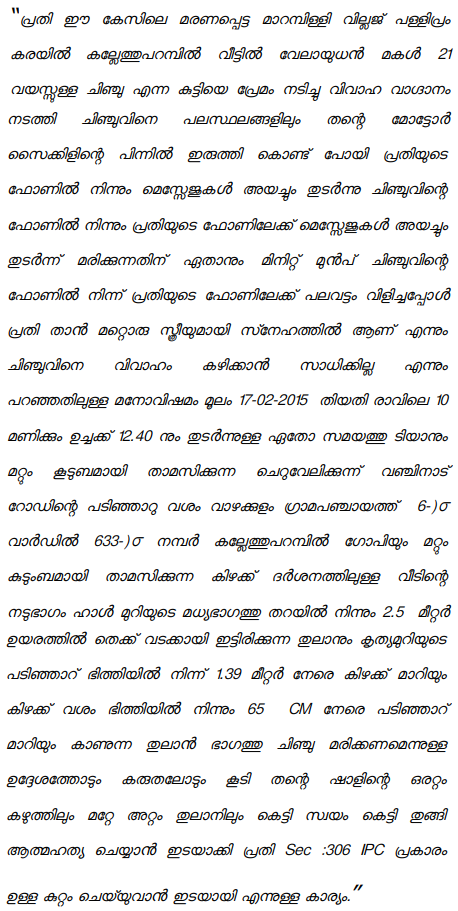
8. The case of the prosecution is that there was a love affair between the petitioner and the deceased girl. There were several communications between the petitioner and the deceased. Subsequently, when the deceased called the petitioner over phone before her death, he informed that he is in friendship with another girl and he will not be able to marry the deceased girl. Because of the above mental stress, the deceased committed suicide. This is the crux of the prosecution case. Whether this amounts to an offence is the point to be decided in this case. The counsel appearing for the defacto complainant also takes me through the statements given by CW5, CW14 and CW16. This Court perused the same also.
9. This Court considered the contention of the petitioner and the Public Prosecutor. To attract an offence under Section 306 IPC, the essential ingredients that need to be proved is the intention of the accused ie., it is not enough if the act of the accused caused persuasion in the mind of the deceased to commit the suicide. The accused should have intended by such acts, the consequence of suicide. Abetment is the main ingredients of Section 306 IPC. If any person commits suicide, whoever abets the commission of such suicide, shall be punishable under Section 306 IPC. Section 107 IPC defines ‘Abetment of a thing’. It would be better to extract Section 107 IPC herebelow:
‘107:-A person abets the doing of a thing, who—
First.—Instigates any person to do that thing; or
Secondly.—Engages with one or more other person or persons in any conspiracy for the doing of that thing, if an act or illegal omission takes place in pursuance of that conspiracy, and in order to the doing of that thing; or
Thirdl












