
 Back
Back





IN THE HIGH COURT OF KERALA AT ERNAKULAM
P.V.Kunhikrishnan, J.
Celinamol Mathew – Petitioner
Versus
State Of Kerala Represented By Sho Of Cherthala Police Station and ors. – Respondents
CRL.MC NO. 5401 OF 2018
Decided On : 21-10-2024
(A) Indian Penal Code - Section 304A - Medical negligence - Prosecution of a nurse under IPC for alleged negligence dismissed as no expert opinion was provided to substantiate the claims - The court emphasized that negligence must be proven beyond mere allegations, as established in Jacob Mathew v. State of Punjab. (Paras 3, 6, 8, 12)
(B) Nursing professionals - The court recognized the vital role of nurses and the need for their protection against malicious prosecution, advocating for guidelines similar to those for doctors. (Paras 9, 11)
Facts of the case:
The petitioner, a nurse, was charged under Section 304A IPC following the death of a child in the hospital. The complaint alleged negligence on her part in responding to the child's symptoms. The petitioner argued that she had acted according to the doctor's instructions and was unable to attend immediately due to her duties. (Paras 1-5)
Findings of Court:
The court found no evidence of negligence and highlighted the importance of expert opinions in such cases. The allegations were deemed unsubstantiated. (Paras 10-12)
Issues: Whether a nurse can be prosecuted for medical negligence without expert testimony and the need for protection against frivolous charges. (Paras 2, 11)
Ratio Decidendi: The court ruled that for a conviction under Section 304A, there must be clear evidence of negligence, and the prosecution must establish a direct causal link between the accused's actions and the death. (Paras 6, 8)
Result: The proceedings against the petitioner were quashed.
ORDER :
P.V.KUNHIKRISHNAN, J.
Petitioner, who was a nurse attached to the Taluk Headquarters Hospital, Cherthala, is charge-sheeted under Section 304A of the Indian Penal Code (for short, IPC) alleging medical negligence on her part while treating a patient. The question to be decided is whether a nurse can be prosecuted under Section 304A IPC alleging medical negligence merely based on the oral statement of some witness without an expert opinion from an expert body.
2. If anybody is admitted in a hospital as a patient or is there as bystanders of patients, they will definitely express their appreciation to the nurses caring for different patients by folding their hands in respect. The devotion, hard work and readiness to face any medical emergency of the patient day and night by the nursing community is to be appreciated by the society. Nursing is not just a job, its a calling. They are known as the backbone of the health care system. Nurses don't just care for patients, they care about patients. Florence Nightingale, an English social reformer and the founder of modern nursing, is renowned for her dedication to healthcare reform and her compassionate approach to patient care, leaving an indelible mark on the nursing profession and public health. Her unwavering commitment to patient care portrays the fact that the nurses' role is not just to treat the disease but to care for the patients. To do what nobody else will do, in a way nobody else can do is the nurses' way. Nursing is an art and if it is to be made an art, it requires an exclusive devotion. As I said earlier, if any of us are admitted in a hospital we can understand the devotion and hard work of nurses in the hospital. They work day and night and they spent most of the time with their patients. The time spent by a doctor with the patients is less when compared to the time spent by a nurse with a patient. An experienced nurse can do wonders to a patient than an experienced doctor in some medical emergency situations. Therefore, the nurses also deserve care, protection and also moral support from the society while doing their duty.
3. The Apex Court in Jacob Mathew v. State of Punjab [2005 KHC 1045] observed that, the Investigating Officer in criminal cases should, before proceeding against the doctor accused of rash or negligent act or omission, obtain an independent and competent medical opinion preferably from a doctor in Government service qualified in that branch of medical practice who can normally be expected to give an impartial and unbiased opinion to the facts collected in the investigation. Why not the same principle be applicable to the nurses in the hospital who are spending their day and night with patience, for the wellbeing of their patients?
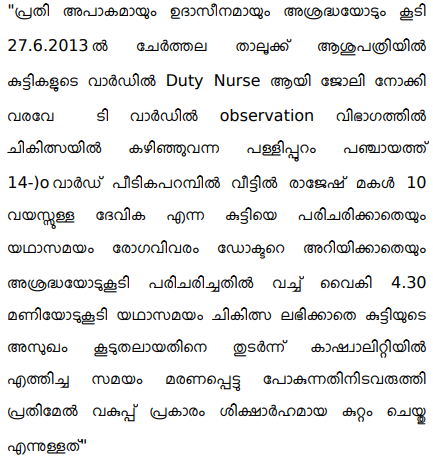
4. I will come to the facts in this case first. The additional 2nd respondent in this case filed a complaint before the Sub Inspector of Police, Cherthala Police Station on 27.06.2013 at 6.10 p.m. He stated that his daughter, aged 10 years, was taken to the Taluk Headquarters Hospital, Cherthala on 27.06.2013 because of diarrhea and vomiting. The doctor concerned treated the child of the defacto complainant and administered tablets and an injection. Thereafter, the daughter of the defacto complainant was admitted in the observation ward. After an hour, another doctor examined her and recommended blood and urine tests. Accordingly, the child was taken to the lab and the result was obtained and shown to the doctor. He indicated that there were no issues with the child and that the defacto complainant could take her home after sometime. It is the further case of the defacto complainant that, subsequently, the child of the defacto complainant showed symptoms of a high temperature and he informed the same to the nurse concerned. But the nurse said that, he can sponge the body of the child with a wet towel. But, according to the defacto complainant, the temperature increased again, and he contacted the doctor and nurse, bu
AI
For a conviction under Section 304A IPC, clear evidence of negligence and a direct causal link between the accused's actions and the death must be established.

Medical professionals cannot be prosecuted for negligence unless there is gross negligence established through expert opinion; mere errors or lack of consent do not suffice.


Criminal negligence requires substantial proof of gross negligence; mere allegations do not suffice for prosecution under IPC, particularly in medical cases.

The main legal point established in the judgment is the requirement of expert medical opinion in cases of alleged medical negligence and the need for a high degree of negligence to establish criminal....

The main legal point established in the judgment is the requirement for a preliminary enquiry in cases of medical negligence, the need for caution in prosecuting doctors, and the seriousness of summo....

Cognizance of medical negligence cannot proceed without prima facie expert opinion as per established legal standards, emphasizing the need for significant evidence to substantiate claims of gross ne....


Criminal prosecution for medical negligence requires evidence of gross negligence, not merely attendance during emergencies, and must be substantiated with expert testimony.

Criminal negligence allegations against medical professionals require proof of gross negligence; mere errors in judgment do not establish criminal liability under Section 304A IPC.



An indispensable Tool for Legal Professionals, Endorsed by Various High Court and Judicial Officers
Please visit our Training & Support
Center or Contact Us for assistance

Scan Me!
India’s Legal research and Law Firm App, Download now!


For Daily Legal Updates, Join us on :



 Back to top


