
 Back
Back





IN THE HIGH COURT OF KERALA AT ERNAKULAM
P.B.SURESH KUMAR, JOBIN SEBASTIAN, JJ
Mobitha M.M. D/o Muraleedharan - Appellant
Versus
State Of Kerala - Respondent
WP(CRL.) NO. 116 OF 2025
Decided On : 27-03-2025
(A) Kerala Anti-Social Activities (Prevention) Act, 2007 - Section 3(1) - Narcotic Drugs and Psychotropic Substances Act, 1985 - Section 22(c) - Writ of habeas corpus sought for the release of the detenu detained under the Act - The order of detention was issued based on prior criminal activities and the possibility of release on bail - The court upheld the detention order, finding that the detaining authority had sufficient reasons to believe the detenu would indulge in prejudicial activities if released - The court emphasized that the link between the detention order and the purpose of detention remained intact despite the delay in issuing the order - The argument regarding the need for compelling reasons for detention while in custody was rejected. (Paras 1 - 8 )
(B) Detention Orders - The court clarified that a detention order can be validly passed against a person in custody if there is a real possibility of release on bail and likelihood of engaging in prejudicial activities thereafter. (Paras 4 - 5 )
(C) Amendment of Legislation - The court interpreted the amended Section 12 of the Act, ruling that it applies to the first detention order under the Act irrespective of prior orders, thereby allowing detention beyond six months in subsequent orders. (Para 8 )
Facts of the case:
The petitioner sought a writ of habeas corpus for the release of his brother, detained under the Act based on his involvement in several criminal cases, including a recent narcotics charge.
Findings of Court:
The court found that the detaining authority had applied its mind to the possibility of the detenu being released on bail and potentially engaging in further criminal activity, thus upholding the detention order.
Issues: The main issues included whether compelling reasons were required for detaining a person already in custody and the interpretation of the amended Section 12 of the Act concerning the duration of detention.
Ratio Decidendi: The court held that the detaining authority's subjective satisfaction regarding the possibility of bail and subsequent criminal activity justified the detention, and the amendment to Section 12 allows for longer detention under subsequent orders.
Result: Writ petition dismissed.
JUDGMENT :
P.B.Suresh Kumar, J.
This is a proceedings instituted seeking a writ of habeas corpus commanding the respondents to produce the brother of the petitioner, Mobish, who is detained as per Ext.P1 order issued under Section 3(1) of the Kerala Anti-Social Activities (Prevention) Act, 2007 (the Act) and to set him at liberty. Ext.P1 order of detention was issued on 23.11.2024 and the same was confirmed as per Ext.P6 order on 22.01.2025. In terms of Ext.P6 order, the period of detention is for one year.
2. Six cases in which the detenu was involved during the last seven years were considered for the purpose of issuing Ext.P1 order. Among the said cases, the last case is Crime No.794 of 2024 registered at Ollur Police Station on 24.08.2024 under Sections 22(c) of the Narcotic Drugs and Psychotropic Substances Act, 1985 (NDPS Act). The detenu is the first accused in the said case. He was arrested in that case on 24.08.2024 itself and has been in custody since then. It was whilst so, the competent authority made the proposal for his detention under the Act on 22.10.2024. Later, two additional reports were also submitted before the detaining authority by the competent authority which made the proposal on 08.11.2024 and also on 14.11.2024. It is thereafter, on a consideration of the proposal as also the additional reports, the order of detention was issued on 23.11.2024.
3. Heard the learned counsel for the petitioner as also the learned Government Pleader.
4. The learned counsel for the petitioner contended that inasmuch as the detenu was in judicial custody when the order of detention was issued, there should be compelling reasons for the detaining authority to detain him under the Act, and the order of detention does not show any reason, much less any compelling reason, to detain him under the Act. It was also contended by the learned counsel that there was a long delay of almost three months between the date of the last prejudicial activity and the date of the order of detention and that the said delay snaps the live link between the order of detention and the purpose of detention. It was also contended by the learned counsel that the last case in which the detenu is involved namely, Crime No.794 of 2024 of Ollur Police Station is a case which is pending investigation, and it is placing reliance on the records in that case, including the mahazar in terms of which the contraband involved in that case was allegedly seized from the detenu, that the order of detention was issued. According to the learned counsel, in the circumstances, the detenu is entitled to be given copies of every document which are relied on, to issue the order of detention and he was not given a legible copy of the seizure mahazar in the case. The detenu is a person who was detained under the Act once and the impugned order is the second detention order against him. The last contention advanced by the learned counsel is that inasmuch as the first order of detention against the detenu was one issued prior to the amendment made to Section 12 of the Act with effect from 31.12.2014, the present order of detention has to be treated as the first detention order against him under the Act and if that be so, Ext.P6 order directing his detention beyond the period of six months, is illegal. The learned counsel relied on the decision of the Apex Court in Supdt., Narcotic Control Bureau v. Parash Singh, (2008) 13 SCC 499 , in support of his argument.
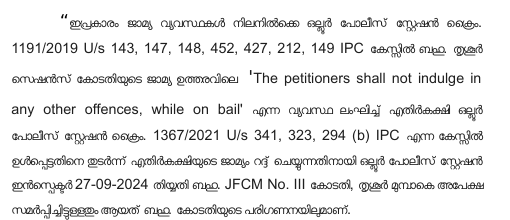
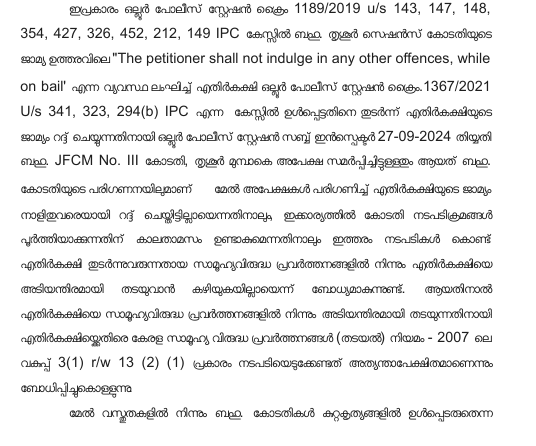
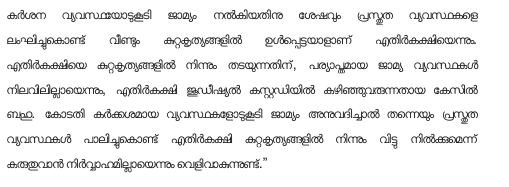
5. In Kamarunnissa v. Union of India, (1991) 1 SCC 128 , it was held by the Apex Court that a detention order can validly be passed even against a person who is in custody, if the detaining authority has reason to believe, on the basis of reliable materials placed before him, that (a) there is a real possibility of his being released on bail and (b) on being so released he would, in all probability, indulge in prejudicial activities. Reverting to the case on hand, the detaining authority has rendered a finding in Ext.P1 order o
A detention order can be validly issued against a person in custody if there is a real possibility of bail and likelihood of engaging in prejudicial activities thereafter.

Amendment by substitution has effect of wiping out earlier provision from statute and replacing it with amended provision, as if the unamended provision never existed.
A detention order under the Kerala Anti-Social Activities (Prevention) Act must demonstrate compelling reasons, especially when the individual is already in judicial custody, including a real possibi....
Time consumed by the detaining authority for seeking additional particulars in the case on hand cannot be said to be reasonable, justifying the delay.

Detention orders under preventive laws require explicit justification of the possibility of bail and propensity for future offenses, especially when the individual is already under judicial custody.

Detention order valid despite bail as authority considered and found bail conditions insufficient to prevent anti-social activities.
Undue delay in passing a detention order under the KAA(P) Act can undermine its validity by snapping the link between the last prejudicial act and the purpose of detention.
The court established that while successive writ petitions for habeas corpus are generally discouraged, they are possible if new grounds are raised. However, if the substantial challenge is against t....
Detention valid during custody if authority satisfies triple test: custody awareness, bail likelihood, and preventive necessity.
A detention order can be validly issued against a person in judicial custody if there is a belief of likelihood of bail release and potential continuation of prejudicial activities post-release, subj....



An indispensable Tool for Legal Professionals, Endorsed by Various High Court and Judicial Officers
Please visit our Training & Support
Center or Contact Us for assistance

Scan Me!
India’s Legal research and Law Firm App, Download now!


For Daily Legal Updates, Join us on :



 Back to top


