Back
Back





2025 Supreme(KER) 829
IN THE HIGH COURT OF KERALA AT ERNAKULAM
Sathish Ninan, Shoba Annamma Eapen, JJ.
Dr.A.P.Sunil Kumar, S/O.Savithri Amma – Petitioner
Versus
Savithri Amma, D/O.Late Nani Amma and ors. – Respondents
RFA No. 6 of 2021
Decided On : 07-02-2025
Advocate Appeared:
For the Appellant : BY ADVS. ASHWIN SATHYANATH ANISH ANTONY ANATHAZHATH THAREEQ ANVER K.
For the Respondent: BY ADVS. SRI.B.KRISHNAN SMT.DEEPA NARAYANAN (caveator) SRI.ZUBAIR PULIKKOOL SRI.T.SETHUMADHAVAN (SR.) SHRI.R.PARTHASARATHY SHRI.SALMANUL FASIL O.P. SMT.PREETHI. P.V. SRI.M.V.BALAGOPAL
Properties can retain thavazhi character post-partition under the Madras Marumakkattayam Act, allowing joint holding despite per capita division.
Headnote:
(A) Madras Marumakkattayam Act, 1932 - Sections 38 and 40 - Partition of properties - Plaintiffs claimed that items 1 to 3 of plaint B schedule are thavazhi properties, while defendants contended they are separate properties post-partition decree in OS 34/1967 - Court held that properties can retain thavazhi character even after per capita division, affirming rights of plaintiffs born prior to 1976 - Item 4 was correctly held as separate property of Naniamma. (Paras 21 and 22)
(B) Appeal - Nature of properties post-partition - Court clarified that a partition does not necessarily alter the character of properties as tarwad properties, allowing for joint holding with all incidents of tarwad property. (Paras 20 and 21)
| Table of Content |
|---|
| 1. nature of properties post-partition (Para 7 , 8 , 9 , 10 , 11 , 12 , 13 , 14 , 15 , 16 , 17 , 18 , 19 , 20) |
| 2. retention of thavazhi character (Para 21 , 22) |
JUDGMENT :
(Sathish Ninan, J.)
The preliminary decree in a suit for partition is under challenge by plaintiffs 1 and 2.
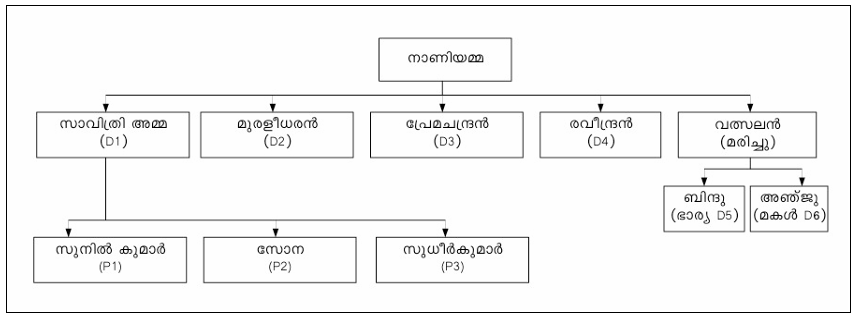
2. The plaint 'A' schedule is the genealogy. Plaint 'B' schedule are the immovable properties sought to be partitioned. It consists of item numbers 1 to 4.
3. According to the plaintiffs, plaint 'B' schedule item Nos.1 to 3 belonged to the thavazhi of Naniamma who was the grand mother of the plaintiffs as per the partition decree in OS 34/1967 of Vadakara Sub Court. The thavazhi consisted of Naniamma, her daughter Savathri Amma who is the first defendant, and her brothers namely defendants 2 to 4 and late Valsalan. The plaintiffs are the children born to the first defendant prior to the year 1976. Defendants 5 and 6 are the wife and daughter of late Valsalan. The claim is that the plaintiffs and defendants 1 to 4 and the late Valsalan are each entitled to one by eight shares out of the properties.
4. Plaint 'B' schedule item No.4 belonged to Naniamma, the mother of the first defendant (plaintiff's grand mother) under Partition Deed No.1826 of 1960. It being Thavazhi property the plaintiffs are entitled to 1/8 shares each in the said item of property also, is the claim.
5. The defendants disputed the claim that the properties are tarwad properties. It was contended that the plaint B schedule items 1 to 3 are the separate properties of the respective allottees under the partition decree. So also, with regard to B schedule item 4, the claim that it belonged to the Thavazhi of Naniamma was denied.
6. The trial court negatived the claim of the plaintiffs that plaint 'B' schedule are 'thavazhi' properties. Preliminary decree was passed reckoning it to be the separate properties. It is aggrieved thereby that this appeal has been filed.
7. We have heard the learned Senior Counsel Sri.T.Krishnanunni on behalf of the appellants, Sri.T.Sethumadhavan, the learned Senior Counsel, Advocates Sri.B.Krishnan and Sri.Zubair Pulikkool on behalf of the respondents.
8. The points that arise for determination in this appeal are:-
“(i) Are plaint B schedule item Nos.1 to 3 thavazhi properties or the separate properties of the allottees in the partition decree in OS 34/1967 ?
(ii) Is the plaint B schedule item No.4 Tavazhy property of Naniamma?”
9. Sri.T.Krishnanunni, the learned Senior Counsel for the appellant would argue that the trial court erred in proceeding as if, since there is a per capita division, the properties could not thereafter remain as 'thavazhi' properties. In terms of Section 40 of the Madras Marumakkattayam Act , 1932 even a partition in the tarwad at the instance of a 'thavazhi' could only be per capita. Under the partition decree in OS 34/1967, plaint 'B' schedule item Nos.1 to 3 having been allotted jointly to plaintiffs 1 to 6 therein who are Naniamma and her children, it partakes the character of 'thavazhi' properties. To support his contention, the learned Senior Counsel relied on the judgment of the Apex Court in Ramachandran and Ors. v. Vijayan and Ors. [2024 KHC Online 6645]
10. Sri.T.Sethumadhavan, the learned Senior Counsel and Sri.B.Krishnan who are appearing for the respondents would on the other hand submit in unison that, under the preliminary decree in OS 34/1967, a per capita division having been effected, the nature and character of the property has transformed into the separate properties of the sharers; it no longer continues to be 'thavazhi' properties. Relying on the judgments in Kalyani (dead) by L.Rs v. Narayanan and Others 1980 KHC 473 , Madhavan Pillai v. Gopala Kurup ( (1954 KHC 253) ), Sreedevi Antherjanam and Others v. Bhavadasan namboodiri ( (2014 KHC 540) ), they contended that by virtue of the preliminary decree for partition there has been a severance of status and the property loses the character of Tarwad property. O