


 Back
Back





2025 Supreme(Ker) 2592
IN THE HIGH COURT OF KERALA AT ERNAKULAM
SATHISH NINAN, P. KRISHNA KUMAR, JJ.
Dodla International Enterprises Pvt. Limited – Appellant
Versus
Seenithai Ammal,(Died; Lrs Impleaded As Addl R7 & R8) – Respondent
RFA No. 588 of 2007
Decided on : 26-08-2025
For the Appellant : SMT.O.A.NURIYA, SRI.ANAND B. MENON, SRI.S.SREEKUMAR (SR.)
For the Respondent: SRI.V.SURESH, SHRI.R.S.KALKURA, SRI.B.KRISHNA MANI, SRI.SHANAVAS.S, SHRI.M.S.KALESH, SRI.HARISH GOPINATH, SMT.R.BINDU, SMT.P.ANJANA, SMT.NEENU PAVITHRAN, SRI.M.AJAY (IRUMPANAM), SRI.A.BALAGOPALAN, SHRI.A.RAJAGOPALAN, SRI.G.SUDHEER, SRI.V.VINAY MENON, SRI.H.KIRAN, SHRI.P.I.NAJUMAL HUSSAIN
The court held that exclusive title to partitioned ancestral property belonged to the fourth defendant, rejecting the plaintiff's claim based on precedent case admissions regarding prior settlements.
Headnote:(A) Hindu Succession Act, 1956 - Mitakshara Law - Partition and legal heirs - The property in question originally belonged to N.K.Chattanatha Karayalar, who executed a Will in favor of Subramonia Karayalar. The trial court declared the share of the plaintiff over the property; however, it was found that the joint family status was disrupted resulting in partition. The 4th defendant claimed exclusive title and possession, but the court ruled there was no evidence to substantiate such exclusive ownership regarding the plaint scheduled property. (Paras 1-33)
(B) Estoppel - The 4th defendant purchased rights of the plaintiff pending appeal. The court discussed whether this act constituted estoppel to argue against the decree of the trial court. The court found no representation that would support estoppel. (Paras 30-31)
Facts of the case:
The plaintiff sought partition claiming a 1/9 share in property belonging to her father under the will executed by N.K.Chattanatha Karayalar. The 4th defendant claimed exclusive title based on previous agreements and sales.
Findings of Court:
The court concluded that the plaint schedule property was not included in prior litigations and held that the 4th defendant held exclusive rights to the property.
Issues: The primary issues were the claims of exclusive title by the 4th defendant and the maintainability of the appeal after the purchase of the plaintiff’s rights.
Ratio Decidendi: The court ruled that admissions made in previous judicial proceedings supported the conclusion of the 4th defendant’s exclusive title to the property, and the preliminary decree of the trial court was set aside.
Result: Appeal allowed; decree and judgment of the trial court are set aside and suit dismissed.
| Table of Content |
|---|
| 1. challenge to preliminary decree in partition case. (Para 1 , 2 , 3 , 4 , 5) |
| 2. identification of title and management of ancestral property. (Para 6 , 7 , 8) |
| 3. impact of previous judgments on property claims. (Para 10 , 11 , 12 , 13 , 14) |
| 4. admissibility of prior admissions regarding property. (Para 17 , 18 , 19 , 20 , 21) |
| 5. final determination of property ownership rights. (Para 26 , 32 , 33) |
| 6. estoppel and conduct in partition appeal. (Para 27 , 30) |
JUDGMENT :
Sathish Ninan, J.
The preliminary decree in a suit for partition is under challenge by the fourth defendant.
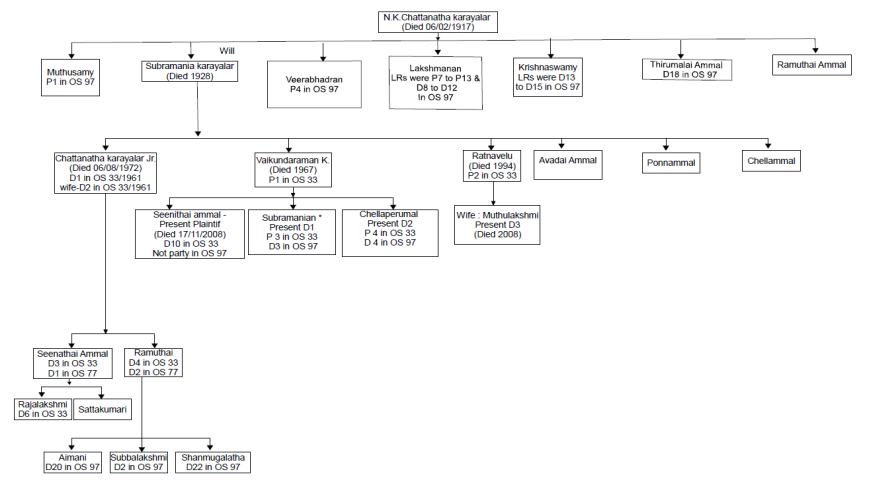
2. The plaint schedule property has an extent of 1 acre 80 cents. The property originally belonged to one N.K.Chattanatha Karayalar. He had five sons and two daughters. He died in the year 1917. He had executed a Will in favour of one of his sons Subramonia Karayalar. Subramonia Karayalar had three sons and three daughters viz. Chattanatha Karayalar(Jnr.), Vaikunta Raman, Retnavelu, Avadi Ammal, Ponnammal and Chellammal. A truncated genealogy with the bare minimum members as is necessary for an easy understanding of the facts of the case is given hereunder.
3. The parties were governed by Mitakshara law. Subramonia Karayalar died in the year 1928. As per Ext.B29 agreement of the year 1950 entered into between his sons Chattanatha Karayalar(Jnr.), Vaikuntaraman and Retnavelu, the joint family status was disrupted resulting in each of the sons holding 1/3 shares over the ancestral properties.
4. Vaikuntaraman died in the year 1967. The plaintiff is his daughter. She seeks for partition and separate possession of her 1/9 shares over the plaint scheduled property. The plaintiff's brothers are defendants 1 and 2. Retnavelu died in the year 1994. His wife is the third defendant. Chattanatha Karayalar(Jnr.) died in the year 1972. His successors had conveyed the entire plaint scheduled property to the 4th defendant, asserting exclusive right in themselves.
5. Defendants 1 to 3 supported the case of the plaintiff.
6. The 4th defendant, who is the successor-in-interest of Chattanatha Karayalar(Jnr.) contested the suit. The 4th defendant claimed exclusive title and possession over the property under Exts.A1 and A2 Sale Deeds (Exts.B22 and 23) dated 19.04.2000, executed by the legal heirs of Chattanatha Karayalar(Jnr.). The 4th defendant asserted the exclusive title of Chattanatha Karayalar(Jnr.) over the property. It was claimed that such right was upheld in the prior litigations in the family viz. OS 33/1961 and OS 97/1981 . Accordingly they prayed for dismissal of the suit.
7. The trial court found that the joint family was disrupted under Ext.B29 agreement. It was found that Chattanatha Karayalar(Jnr.), who was the eldest son of Subramonia Karayalar, was managing and administering the assets of the Family and that there is no material to find his exclusive ownership over the property. Accordingly, a preliminary decree was passed declaring the 1/9 shares of the plaintiff over the plaint scheduled property.
8. Pending the appeal, the appellant-4th defendant, purchased the rights of the plaintiff. Defendants 2 and 3 are pursuing their claim for partition and separate possession of their shares.
9. We have heard the learned counsel on either side.
10. The points that arise for determination in this appeal are: -
(i) Does the evidence on record establish the exclusive title and possession of Chattanatha Karayalar(Jnr.) over the plaint scheduled property?
(ii) The appellant-4th defendant having purchased the share of the plaintiff, pending the appeal, is the appeal maintainable? Does the conduct amount to estoppel?
(ii) Does the decree and judgment of the trial court warrant any interference?
11. Admittedly, the plaint schedule property belonged to Subramonia Karayalar under a Will executed by his father late N.K.Chattanatha Karayalar. The parties were governed by the pristine Hindu Mitakshara Law. Of the three sons of Subramonia Karayalar, Chattanatha Karayalar(Jnr.) was t












