
 Back
Back





IN THE HIGH COURT OF KERALA AT ERNAKULAM
ANIL K. NARENDRAN, MURALEE KRISHNA S., JJ.
N. Prakash - Petitioner
Versus
S. Bindu & Ors. - Respondents
Con.Case(C) No. 723 of 2025
Decided On : 27-03-2025
(A) Contempt of Courts Act, 1971 - Section 12 - Allegation of willful disobedience of court directions regarding political activities in temples - The petitioner alleged that the Temple Advisory Committee allowed political songs during a temple festival, violating the sanctity of the event. (Paras 1 - 2 )
(B) Travancore-Cochin Hindu Religious Institutions Act, 1950 - Section 15A - Duties of the Travancore Devaswom Board - The Board is responsible for ensuring traditional rites and ceremonies are performed without political interference. (Paras 4 - 5 )
(C) Right to worship - The court emphasized that politics has no role in temple worship and ceremonies, reaffirming the sanctity of religious practices. (Paras 6 - 7 )
(D) Interim order - The court directed the Travancore Devaswom Board to prevent political activities in temples and ensure proper accounting of funds collected for temple activities. (Paras 20 )
Facts of the case:
The petitioner filed a contempt case alleging that the Temple Advisory Committee allowed political performances during a temple festival, which hurt devotees' sentiments.
Findings of Court:
The court found prima facie evidence that the program should not have been permitted and emphasized the need for adherence to religious traditions.
Issues: The main issues included the appropriateness of political activities in temple festivals and the responsibilities of the Temple Advisory Committee and the Travancore Devaswom Board.
Ratio Decidendi: The court ruled that political activities are incompatible with the sanctity of temple worship and ceremonies, and the Board must ensure compliance with this principle.
Result: Contempt case closed as the petitioner sought to withdraw it.
JUDGMENT :
Anil K. Narendran, J.
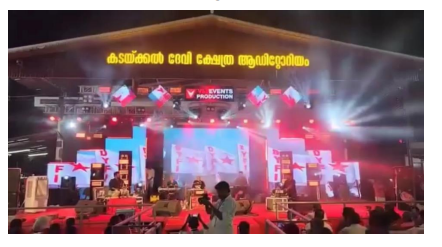
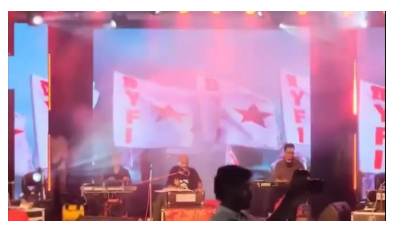
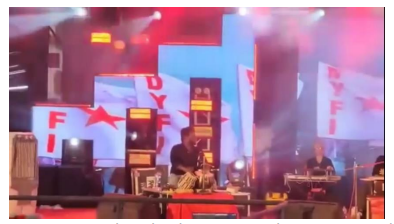
The petitioner has filed this contempt case, invoking the provisions under Section 12 of the Contempt of Courts Act , 1971, alleging willful disobedience of the directions contained in Annexure A1 judgment of this Court dated 14.02.2023 in W.P.(C) No.4729 of 2023- Major Vellayani Devi Temple Advisory Committee v. State of Kerala [2023 (2) KHC 290] by not taking sufficient measures to ensure that politics has no role to play in the conduct of daily worship, ceremonies and festivals in temples. The instance pointed out in this contempt case in connection with the annual festival of Kadakkal Devi Temple, which is a temple under the management of the Travancore Devaswom Board, is regarding a programme conducted on 10.03.2025, in which one singer named Aloshi performed political songs and displayed flags of a political party in the background.
2. The said incident is the subject matter of W.P.(C) No.10893 of 2025 filed before this Court on 17.03.2025, in which this Court has passed a detailed order on 18.03.2025. The said order reads thus;
“The petitioner, who is a devotee of Kadakkal Devi Temple, which is a temple under the management of the 2nd respondent Travancore Devaswom Board, has filed this writ petition under Article 226 of the Constitution of India, seeking a writ of mandamus restraining the 1st respondent Temple Advisory Committee of Kadakkal Devi Temple, the 2nd respondent Travancore Devaswom Board and its Commissioner and Deputy Commissioner, namely, respondents 3 and 4, from using the premises of Kadakkal Devi Temple for the promotion, endorsement or facilitation of any political party or for political activities and to ensure that the temple remains solely dedicated to religious and cultural activities; and a declaration that the 1st respondent Temple Advisory Committee of Kadakkal Devi Temple and the 2nd respondent Travancore Devaswom Board shall not misuse the premises of Kadakkal Devi Temple for any purpose other than religious and spiritual activities, ensuring that the sanctity and traditional character of the temple are preserved.
2. Going by the averments in the writ petition, on 10.03.2025, during the annual festival of Kadakkal Devi Temple for the year 1200ME (2025), one singer named Aloshy performed political songs and displayed flags of a political party in the background, which were inappropriate for the occasion and deeply hurt the sentiments of the devotees. The said singer, who was invited by the 1st respondent Temple Advisory Committee, sang political songs, namely, ‘Pushpane Ariyamo’, ‘Nooru Nooru Pookkale’ and ‘DYFI zindabad’. The 1st respondent Temple Advisory Committee, influenced by political interests, granted approval for such performances. The 2nd respondent Travancore Devaswom Board failed to take any action to ensure that the temple premises is not used for the propaganda of political parties. The actions of respondents 1 and 2 have caused emotional disruptions to the devotees, violating the sanctity of the temple festival.
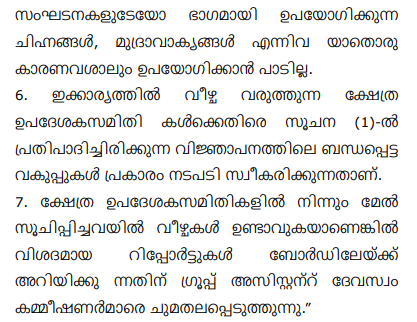
3. In Sinilkumar E.K. v. Travancore Devaswom Board [2023 (5) KHC 85] , in the context of ‘Pooram festival’ in Cherthala Karthiyayini Devi Temple, which is a temple under the management of the Travancore Devaswom Board, a Division Bench of this Court in which one among us [Anil K. Narendran, J.] was a party noticed that Hindu temples represent the culmination of social and religious aspirations of a society. The temple is the focal point in the life of a community and often represents its pride, identity and unity. It draws into its fold people from its various segments and denominations and binds them together. The worship that takes place in the sanctum sanctorum and within the temple premises is important; so are the festivals and occasional processions that involve the direct participation of the entire community. They complement each other. While the worship of the deity in the sanctum sanctorum might be an individual‘s spiritual or relig
Political activities are incompatible with the sanctity of temple worship and ceremonies, and the Travancore Devaswom Board must ensure compliance with this principle.

Temples under the management of the Travancore Devaswom Board must remain apolitical, following the provisions of the Religious Institutions (Prevention of Misuse) Act, 1988, which prohibits politica....

Point of Law : Section 31A of Act deals with formation of Temple Advisory Committees.
Only the Temple Advisory Committee constituted under Section 31A of the Act can conduct activities and collect funds in the temple; unauthorized committees are prohibited from interfering.
A writ of mandamus can only be issued when there is a clear statutory duty and legal right, which was not established by the petitioners in this case.
The central legal point established in the judgment is the duty of the Travancore Devaswom Board to manage temple properties, perform traditional rites, and ensure compliance with statutory duties an....
Only the Temple Advisory Committee can conduct religious rites and collect contributions in temples managed by the Cochin Devaswom Board, as per statutory provisions.
The main legal point established in the judgment is the legal impermissibility of unauthorized committees collecting funds in Hindu religious institutions, emphasizing the need for strict compliance ....
The extension of a Temple Advisory Committee's term without addressing complaints against its members is arbitrary and unjust, warranting judicial intervention and direct administration by the govern....
A writ of mandamus requires the existence of a legal right and a statutory duty, which the petitioner failed to demonstrate, leading to the dismissal of the petition.



An indispensable Tool for Legal Professionals, Endorsed by Various High Court and Judicial Officers
Please visit our Training & Support
Center or Contact Us for assistance

Scan Me!
India’s Legal research and Law Firm App, Download now!


For Daily Legal Updates, Join us on :



 Back to top


