
 Back
Back





IN THE HIGH COURT OF KERALA AT ERNAKULAM
ANIL K. NARENDRAN, MURALEE KRISHNA S., JJ.
Santhosh Warrier, S/o.Late. Sankunni Warrier Kottuvad Warriem - Respondent
Versus
State Of Kerala - Respondent
WP(C) No. 10535 of 2025
Decided on : 08-04-2025
| Table of Content |
|---|
| 1. petitioner's allegations against the vilakku committee (Para 2 , 3) |
| 2. court's procedural considerations and notices (Para 4 , 5 , 6) |
| 3. legal standards and framework for temple management (Para 8 , 9 , 16) |
| 4. duties and rules under the travancore-cochin act (Para 10 , 11) |
| 5. regulation of temple activities and collections (Para 12 , 14 , 22) |
| 6. defense by the padinjare nada vilakku committee (Para 20 , 21) |
Anil K. Narendran, J.
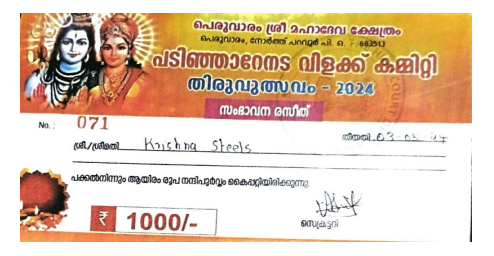
The petitioner, who is a devotee of Peruvaram Sree Mahadeva Temple, North Paravur, which is a temple under the management of the 2nd respondent Travancore Devaswom Board, has filed this writ petition under Article 226 of the Constitution of India, seeking a writ of mandamus commanding the 2nd respondent Board to promptly take action to prevent the 7th respondent Padinjare Nada Vilakku Committee and its associates from conducting parallel Vilakku festival within the premises of Peruvaram Sree Mahadeva Temple; and a writ of mandamus commanding the 2nd respondent Board to implement appropriate measures to prohibit parking of vehicles in the temple property so as to ensure that the parking of vehicles of the devotees of Peruvaram Sree Mahadeva Temple is not obstructed. The document marked as Ext.P1 is a copy of the cash receipt dated 03.05.2024 issued by the 7th respondent Padinjare Nada Vilakku Committee, after collecting Rs.1,000/- from M/s.Krishna Steels as donation for Thiruvulsavam-2024 (Annual Festival) of Peruvaram Sree Mahadeva Temple. Ext.P1 receipt dated 03.05.2024 issued by the 7th respondent Vilakku Committee is extracted hereunder;
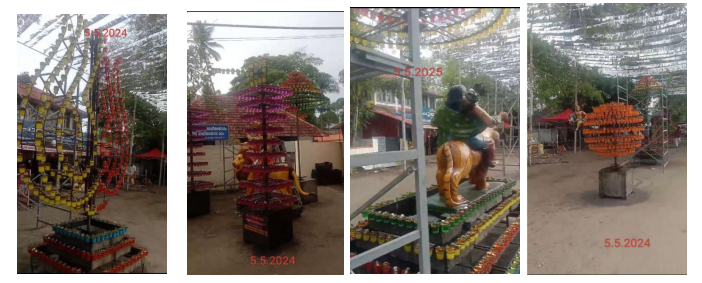
2. The documents marked as Ext.P2 series are a few photographs of the lamps put up by the 7th respondent Vilakku Committee in Padinjare Nada (Western Nada) of Peruvaram Sree Mahadeva Temple, during the annual festival of the year 2024.
The said photographs are extracted hereunder;
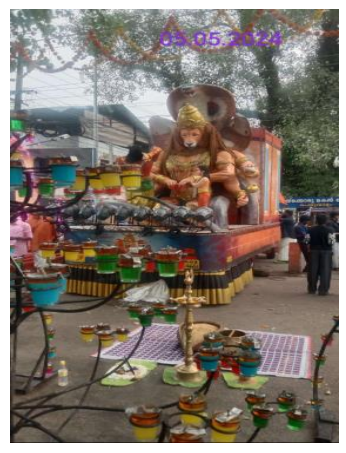
In the writ petition, it is alleged that the persons associated with the 7th respondent Vilakku Committee collected money from the devotees and general public for arranging lamps, without any authorisation from the 2nd respondent Travancore Devaswom Board. The said lamps were put up at the Padinjare Nada of Peruvaram Sree Mahadeva Temple. In addition to that, the 7th respondent Vilakku Committee made arrangements for ‘Para Nirakkal’ in the Padinjare Nada of the temple and collected money from the devotees. The document marked as Ext.P3 is a copy of the photograph taken on 05.05.2024, showing the arrangements made by the 7th respondent Vilakku Committee for ‘Para Nirakkal’ in the Padinjare Nada of Peruvaram Sree Mahadeva Temple. The said photograph is extracted hereunder;
3. The document marked as Ext.P4 is a complaint dated 26.12.2024 made by the petitioner before the Secretary of the 2nd respondent Travancore Devaswom Board against the parallel Vilakku festival conducted in the Padinjare Nada of Peruvaram Sree Mahadeva Temple by the 7th respondent Vilakku Committee and also against illegal parking of vehicles in the Devaswom land. Ext.P5 is a copy of similarly worded complaint dated 26.12.2024 made by the petitioner before the 3rd respondent Devaswom Commissioner. The document marked as Ext.P6 is a photograph showing the condition of the road in front of the Padinjare Nada of Peruvaram Sree Mahadeva Temple, with broken interlock tiles, etc. causing difficulty to the devotees.
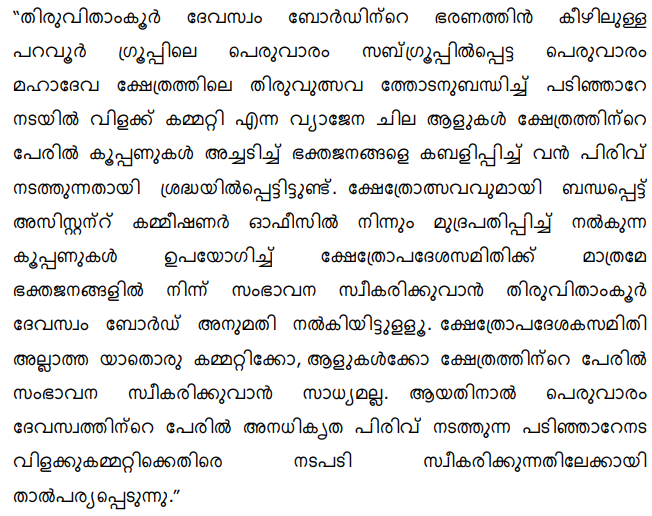
4. On 28.03.2025, when this writ petition came up for admission, the learned Senior Government Pleader took notice on admission for 1st respondent and also for additional respondents 8 and 9 and the learned Standing Counsel for Travancore Devaswom Board for respondents 2 to 5 and also for the additional 10th respondent. Urgent notice on admission by special messenger was ordered to respondents 6 and 7, returnable by 01.04.2025. On a query made by this Court, the learned Standing Counsel for Travancore Devaswom Board submitted that in Peruvaram Sree Mahadeva Temple there is a Temple Advisory Committee

AI
Only the Temple Advisory Committee constituted under Section 31A of the Act can conduct activities and collect funds in the temple; unauthorized committees are prohibited from interfering.
Only the Temple Advisory Committee can conduct religious rites and collect contributions in temples managed by the Cochin Devaswom Board, as per statutory provisions.
The main legal point established in the judgment is the legal impermissibility of unauthorized committees collecting funds in Hindu religious institutions, emphasizing the need for strict compliance ....

The Travancore Devaswom Board must ensure proper maintenance of temples, and the Temple Advisory Committee is authorized to collect funds for renovations under strict compliance with statutory proced....

Temples under the management of the Travancore Devaswom Board must remain apolitical, following the provisions of the Religious Institutions (Prevention of Misuse) Act, 1988, which prohibits politica....
The extension of a Temple Advisory Committee's term without addressing complaints against its members is arbitrary and unjust, warranting judicial intervention and direct administration by the govern....
Point of Law : Section 31A of Act deals with formation of Temple Advisory Committees.
The court ruled that a compromise decree is binding on parties involved, and a temple advisory committee cannot re-agitate settled issues regarding ritual performance and fund collection without appr....
A writ of mandamus requires the existence of a legal right and a statutory duty, which the petitioner failed to demonstrate, leading to the dismissal of the petition.
The central legal point established in the judgment is the duty of the Travancore Devaswom Board to manage temple properties, perform traditional rites, and ensure compliance with statutory duties an....



An indispensable Tool for Legal Professionals, Endorsed by Various High Court and Judicial Officers
Please visit our Training & Support
Center or Contact Us for assistance

Scan Me!
India’s Legal research and Law Firm App, Download now!


For Daily Legal Updates, Join us on :



 Back to top


