


 Back
Back





2025 Supreme(Ker) 1438
IN THE HIGH COURT OF KERALA AT ERNAKULAM
Sathish Ninan, P. Krishna Kumar, JJ.
Thomas Varghese, S/O.T.T. Vatghese – Petitioner
Versus
The Government Of Kerala Represented By District Collector and ors. – Respondents
MFA (forest) no. 167 of 2019
Decided On : 23-05-2025
Advocate Appeared:
For the Petitioner: Jomy George, Sri.Deepak Mohan, Smt.Liza Powell, Smt. Chitra N. Das, Shri.Rishab S.
For the Respondent: Sri.Nagaraj Narayanan, Spl. G.P. For Forest
The burden of proof lies with the applicant to demonstrate that the property is not ecologically fragile, which was not established, necessitating remand for further examination.
Headnote:
(A) Kerala Forest (Vesting and Management of Ecologically Fragile Lands) Act, 2003 - Section 10 - Appeal against dismissal of application claiming property is not ecologically fragile land - Tribunal found property principally covered with naturally grown trees - Applicant failed to prove property is not ecologically fragile land. (Paras 1, 5, 9)
(B) Burden of proof - The burden lies on the applicant to prove that the application schedule property is not ecologically fragile land, which was not fulfilled. (Paras 9, 10)
Facts of the case:
The applicant claimed ownership of 4.55 acres of land cultivated with long-term crops, while the State contended it is part of the Nachivayal Forest station. The Tribunal dismissed the application based on the Commissioner's Report indicating natural growth.
Findings of Court:
The court found that the applicant did not provide sufficient evidence to prove the property was not ecologically fragile and allowed the appeal for further examination.
Issues: The main issue was whether the property qualifies as a 'forest' under the EFL Act based on its condition as of 02.06.2000.
Ratio Decidendi: The court ruled that the applicant must substantiate claims with expert evidence regarding the cultivation and age of trees, remanding the case for further examination.
Result: Appeal allowed; matter remanded back to the Tribunal for fresh disposal.
JUDGMENT :
Sathish Ninan, J.
The original application filed under Section 10 of the Kerala Forest (Vesting and Management of Ecologically Fragile Lands) Act , 2003, (hereinafter referred to as “the EFL Act”) claiming that the application schedule property is not an ecologically fragile land, was dismissed by the Tribunal. The applicant is in appeal.
2. The application schedule property has an extent of 4.55 acres. It is situated in R.S. 69/3, 69/4, 69/5 (old survey 29/01/2012, 19/01/2018 and 19/01/2017) of Marayur Village. Exts.A1 to A3 are the documents of title of the applicant which are of the year 2003. Exts.A5 to A9 are its immediate prior deeds. Out of the same Exts.A5 to A8 are of the year 1988 and Ext.A9 is of the year 1965. Ext.A10 is the basic title deed which is of the year 1959. The property was purchased by the vendor thereunder in a Government auction in the year 1929. Ext.A13 is the notification under the EFL Act.
3. The applicant claimed that the property in question was being cultivated by him and his predecessors with long term crops like pepper, gooseberry, nutmeg, coffee and cocoa. That apart, the property contains Mahagani trees and coconut trees. The land is an agricultural land and it had been so. Therefore, the land in question is not a forest within the definition of the word “forest” under the EFL Act, it is claimed.
4. The State on the other hand contended that the property in question comes under the Nachivayal Forest station in Marayur Forest Range of Marayur Sandal Forest Division. Out of the trees standing in the property only a few among them are planted. All the others are natural growth. The property is lying contiguous to forest on three sides. As on the appointed day, the property was a forest within the definition of the EFL Act.
5. The Tribunal held that the Commissioner's Report(Ext.C1) indicates that the land is principally covered with naturally grown trees and that it prominently supports natural vegetation. Accordingly the application was dismissed.
6. We have heard Sri.Jomy George, learned counsel for the appellant-applicant and Sri.Nagaraj Narayanan, the learned Spacial Government Pleader (Forests) for the respondent.
7. The fact that the application schedule property lies contiguous to forest land on three sides, north, east and west is evidenced by Ext.C1 Commissioner's Report. The crucial question for determination is as to whether the property in question is a “forest” as defined under the EFL Act. The contention of the applicant is that the property is principally cultivated with crops of long duration.
8. It is crucial that, what is relevant is the situation that was prevailing as on the appointed day viz. 02.06.2000. In Ext.C1 report, the Commissioner has ascertained the existence of various trees and species in the property, the details of which are given at paragraph 3 of the report as hereunder :-
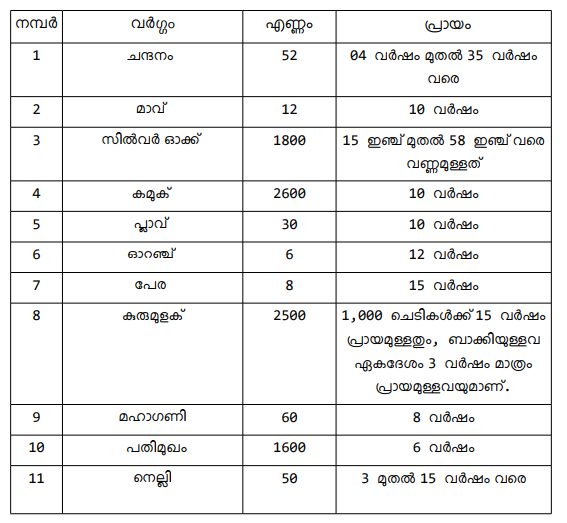
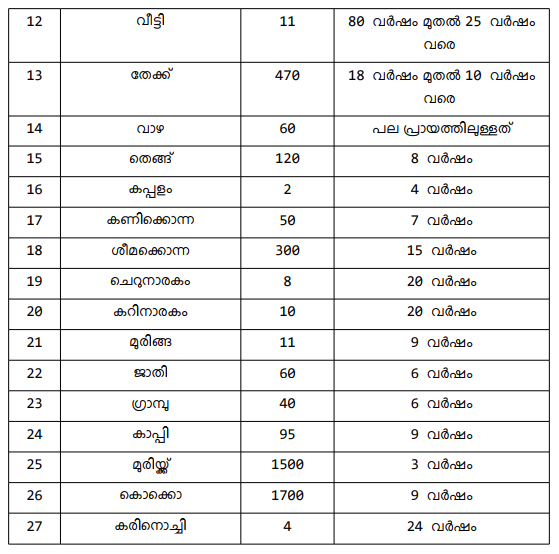
9. Both sides have disputes about the age of certain trees standing in Ext.C1. With regard to silver oak, which is 1800 in number, the age is not even mentioned. With regard to certain other trees there is serious dispute with regard to their age. As noticed supra what is relevant is whether as on 02.06.2000 the property was principally cultivated with crops of long duration. Therefore, the age of the trees, and its number in proportion to the area, are of significance. This can be ascertained only by an expert Commissioner. The burden is on the applicant to prove that the application schedule property is not an ecologically fragile land. However, no attempt was made by him to prove the same by taking out an expert commission. Based on the available evidence viz. Ext.C1, the Tribunal has held against the applicant.
10. Before this Court, the appellant-respondent has filed an application as IA 1/2025, seeking appointment of an expert Commissioner to ascertain the age and nature of the trees. Opportunity is sought to take out an expert Commissioner to substantiate his claim.
11. We do notice t












