
 Back
Back





IN THE HIGH COURT OF KERALA AT ERNAKULAM
P.V. KUNHIKRISHNAN, J.
Bindhu K.P. - Petitioner
Versus
State of Kerala, Represented By The Secretary, Ministry Of Home Department, Thiruvananthapuram and Ors. – Respondents
WP(CRL.) No. 978 of 2025
Decided On : 06-08-2025
| Table of Content |
|---|
| 1. emergency parole requires extraordinary circumstances. (Para 1) |
| 2. convict's family circumstances analyzed. (Para 2) |
| 3. court evaluated emergency leave petition. (Para 3 , 4) |
| 4. specific criteria for emergency leave outlined. (Para 5) |
| 5. judicial discretion in parole must consider victim's rights. (Para 6 , 7) |
| 6. writ petition dismissed due to lack of merit. (Para 8) |
JUDGMENT :
P.V. KUNHIKRISHNAN, J.
The prison walls are not just physical barriers, but also symbol of the suspension of certain fundamental rights that citizens enjoy. A strange request is made by a convict undergoing Life imprisonment in a murder case. He wants emergency leave to give ‘pregnancy care’ to his wife. Emergency parole, as per the Kerala Prisons & Correctional Services (Management) Rules, 2014 (hereinafter referred to as the “Rules 2014”), is to be granted only on rare occasions, and that too for the reason mentioned in Rule 400(1) of the Rules 2014. Of course, a prisoner is entitled to ordinary parole as per Rule 397 of the Rules 2014. However, nowadays, convicts are coming before this Court for emergency leave in connection with the 28th day naming ceremony of the child, the first rice feeding ceremony of the child, family functions, and other similar events. If this trend continues, convicts will soon come to this court to participate in local temple festivals, church festivals, family trips, or to visit places like Sabarimala and Guruvayoor. Most of the fundamental rights of the convicts are suspended when they are convicted and sent to jail. The same cannot be diluted by granting emergency leave to convicts regularly unless there are extraordinary situations. Every convict should know that the victim and their relatives are staring at them when they are in prison, and that staring is necessary and should be an eye-opener for their reformation.
2. Petitioner's husband was convicted by the court below in a murder case, and he was sentenced to undergo life imprisonment as per the judgment in S.C. No.435/2000 on the file of the Additional District and Sessions Judge (Adhoc – I), Thalassery. The petitioner married the convict in 2010. There were no children in their wedlock. It is the case of the petitioner that she and her husband were trying to conceive for several years and have undergone treatments across various branches of medicine, but their efforts were unsuccessful. It is submitted that the petitioner started treatment under Allopathy when the petitioner's husband was released on ordinary leave last month. The petitioner and her husband are under treatment at Nahas Centre for Assisted Reproduction & Endoscopy, Kannur and underwent an IVF/ICSI procedure. It is the case of the petitioner that the IVF procedure has turned fruitful, and the petitioner is now two months pregnant. Ext.P1 is the certificate showing the same. According to the petitioner, she is extremely distressed as there is no one else to look after her. Therefore, she needs the presence of her husband. It is the case of the petitioner that she conceived at the age of 42 years, and considering her age and the fact that the pregnancy is the result of IVF treatment, there exists a high risk of miscarriage if proper support and care are not given. Therefore, the petitioner submitted a representation to the 3rd respondent requesting emergency parole for the petitioner's husband. The same is rejected as per Ext.P2.
Aggrieved by the same, this Writ Petition (Crl.) is filed.
3. Heard the learned counsel appearing for the petitioner and the learned Public Prosecutor.
4. This Court perused Ext.P2 order. The 3rd respondent rejected the representation submitted by the victim, showing sufficient reason and observed that emergency leave cannot be granted to the petitioner's husband based on the provisions of Rule 2014. Rule 400(1) of Rule 2014 is extracted hereunder:
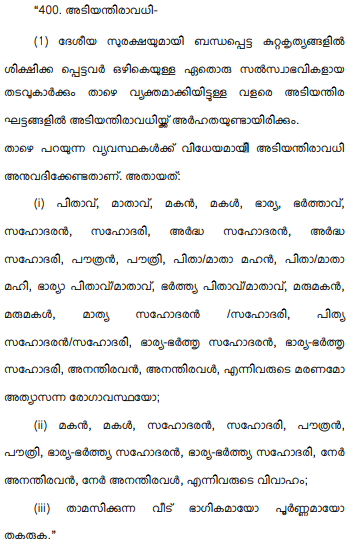
5. As per sub-clauses (i) to (iii) of Rule 400(1) of Rule 2014, three circumstances are mentioned in which the emergency l
AI
Emergency leave for convicts is only granted under specific exceptional circumstances; requests for familial or non-emergency reasons do not suffice.

Emergency leave for convicts can be granted in exceptional circumstances under Article 226 of the Constitution.
Emergency leave for convicts may be granted under compassionate grounds as per prison regulations.
Emergency parole can be granted based on compelling family circumstances, balancing individual rights with correctional policies.
Emergency leave can be granted to convicts for attending to family health emergencies under Article 226.
Emergency parole may be granted under specific law provisions, considering the immediate family circumstances.
A court may grant parole if significant qualifying circumstances exist, such as caring for a seriously ill family member.
Emergency parole can be granted under specific circumstances for familial support alongside mandatory legal compliance.
Emergency leave for convicts to attend to family medical needs is permissible under applicable prison rules.

Compassionate grounds can justify the granting of emergency leave to a convict prisoner, provided that the leave is utilized for the stated purpose and conditions of the Jail Manual are followed.



An indispensable Tool for Legal Professionals, Endorsed by Various High Court and Judicial Officers
Please visit our Training & Support
Center or Contact Us for assistance

Scan Me!
India’s Legal research and Law Firm App, Download now!


For Daily Legal Updates, Join us on :



 Back to top


