
 Back
Back





IN THE HIGH COURT OF KERALA AT ERNAKULAM
P.V.Kunhikrishnan, J.
Manilal – Petitioner
Versus
State Of Kerala, Represented By The Public Prosecutor – Respondent
CRL.REV.PET No. 490 of 2025
Decided On : 14-08-2025
ORDER :
P.V.Kunhikrishnan, J.
A humane touch is necessary in every administrative act of bureaucrats. It is often said that every file has a face, and every decision has a consequence. Behind every decision, there is a person with hopes, fears and dreams. Every decision made in an office affects a life outside of it. Administrative decisions are not just papers; they are lives in progress. The success of democracy is not just about governance by elected representatives of the people alone, but it also relies on the way bureaucrats support such a government with a humane approach. Without a humane approach, a democratic government cannot succeed. The bureaucracy that forgets the people forgets its very purpose. Empathy is the bridge between a democratic government and its people. Bureaucracy has a vital role in it.
-
2. This is a sad story of a 76-year-old man and his son-in-law, who is the revision petitioner in this case. The petitioner's father-in-law contacted the office of the Tahsildar (LR) to have 3 cents of property mutated in his name in the revenue records, for which he had already paid land tax earlier. It is the case of the petitioner that the Tahsildar was reluctant to do the same, stating technical reasons one after the other. At last, a hearing was scheduled in the office of the Tahsildar. The revision petitioner accompanied his father-in-law, who is an old man, to assist him in the enquiry. They entered the chamber of the Tahsildar and requested action on the file, which had been pending consideration for about 1 ½ years. The Tahsildar took a stand that since the opposite party is represented through another person, the hearing cannot be conducted. Considering the embarrassing situation of the father- in-law, the revision petitioner questioned the stand of the Tahsildar, which resulted in a wordy quarrel with the Tahsildar. Subsequently, a criminal case was registered against the petitioner, alleging offences punishable under Sections 353 and 294(b) IPC.
-
3. The prosecution case is that the accused entered the cabin of the de facto complainant, who is the Tahsildar and uttered obscene words, snatched the office file from the section clerk, and also threw the file and plastic chairs kept in the room, thereby obstructing the duty of the de facto complainant. Annexure I is the FIR and FI Statement. Thereafter, the police submitted a final report, as evident by Annexure-II. The petitioner received the summons from the court and thereafter filed a discharge petition as CMP No. 6757/2024 in CC No. 2273/2020 before the Judicial First Class Magistrate Court-II, Kollam. The learned Magistrate, as per the impugned order, allowed the discharge petition in part, by discharging the petitioner from the offence under Section 294(b) IPC. But the learned Magistrate found that the petitioner had to face trial under Section 353 IPC. Aggrieved by the same, this Criminal Revision Petition is filed.
-
4. Heard Adv. Sri. P Prameswaran Nair, who appeared for the petitioner and also the learned Public Prosecutor.
5. Advocate Parameswaran Nair submitted that, even if the entire allegations are accepted, the offence under Section 353 IPC is not made out. The counsel takes me through the ingredients of Section 353 IPC and submits that the admitted case of the prosecution will not constitute the offence under Section 353 IPC. The Public Prosecutor, on the other hand, submitted that the ingredients of Section 353 IPC are made out. The Public Prosecutor takes me through the definitions of “force,” “criminal force,” and “assault.” The Public Prosecutor submitted that in the light of the above definition in the Indian Penal Code , the offence under Section 353 IPC is prima facie made out. Therefore, it is submitted that there is nothing to interfere with the impugned order.
-
6. This Court considered the contention of the petitioner and the Public Prosecutor. The allegations in the final report filed against the petitioner are extracted hereunder:
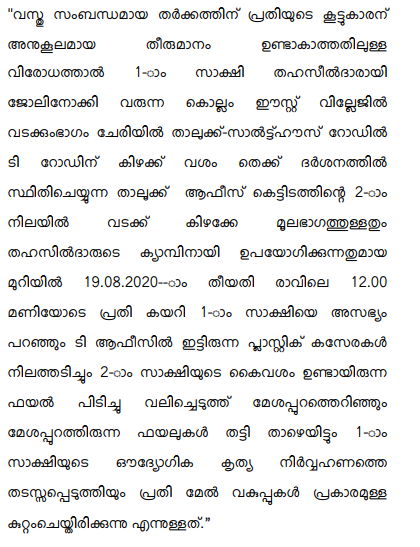
7. A pe
Criminal charges under Section 353 IPC require actual criminal force directed at a person, not merely obstruction or verbal disputes.

Section 353 IPC requires proof of criminal force or assault against a public servant; mere verbal disputes do not meet this threshold.

The court affirmed the conviction under Sections 353 and 504 IPC, establishing that abusive actions towards a public servant can constitute assault, deterring them from performing their official duti....

The essential elements required under Section 353 IPC were not established, leading to the quashing of the FIR as an abuse of process of law.


Essential ingredients of assault under Section 353 IPC must be proven, including the use of criminal force against a public servant, which was not demonstrated in this case.


The court emphasized that for a charge under Section 353 IPC to stand, it must be proven that the public servant was executing their duties at the time of the incident.



An indispensable Tool for Legal Professionals, Endorsed by Various High Court and Judicial Officers
Please visit our Training & Support
Center or Contact Us for assistance

Scan Me!
India’s Legal research and Law Firm App, Download now!


For Daily Legal Updates, Join us on :



 Back to top


