


 Back
Back





2026 Supreme(Ker) 171
IN THE HIGH COURT OF KERALA AT ERNAKULAM
C.JAYACHANDRAN, J.
Roslin John D/o K.V. Joseph – Appellant
Versus
State of Kerala – Respondent
W.P. (C) No. 25186 of 2025
Decided On : 24-02-2026
For the Appellant : Rajeev V. Kurup
For the Respondents: T.V. Vinu, O.M. Shalina, Zakhier Huzzain, Ajith Viswanathan, Shafik M.A.
The authority must provide justifiable reasons when refusing to condone delay in processing compensation claims, ensuring compliance with statutory requirements and protecting substantive rights.
Headnote:(A) Right to Fair Compensation and Transparency in Land Acquisition, Rehabilitation and Resettlement Act, 2013 - Section 64(1) and Section 64(2) - Delay in filing reference application - Refusal to condone the delay resulting in rejection of reference application - Authority had no power to entertain petitions under the second proviso to Section 64(2) as asserted by District Judge in Ext.P9 - Court holds that even though the authority's findings were legally sound, the lack of reasoning in Ext.P7 cannot stand due to infringement of constitutional rights under Article 300A - Ext.P7 set aside, 3rd respondent directed to consider applications with justifiable reasons for delay, and to complete the exercise within two months. (Paras 4-7)
(B) Condonation of Delay - The authority must consider applications for condonation of delay and apply the law correctly, taking into account the substantive rights of the parties involved. (Para 6)
Facts of the case:
Petitioners challenged the refusal to condone delays in filing for a reference to increase compensation for their acquired property, leading to Upholding of the legal position but criticizing the lack of reasoning in the authority’s decision.
Findings of Court:
The delay should be addressed comprehensively, reflecting legal principles, within mandated timelines as prescribed by law.
Issues: Whether the authority has the power to condone delay under the relevant Sections of the Act?
Ratio Decidendi: The lack of reasoning in the authority's order impeded the petitioners' rights, necessitating fresh consideration by the authority, guided by the rules.
Result: Writ Petition allowed; Ext.P7 set aside.
| Table of Content |
|---|
| 1. background of petitioners' challenge to compensation. (Para 1 , 2) |
| 2. authority limitations and procedural context. (Para 3 , 4) |
| 3. court's interpretation and ensuring compliance with rights. (Para 5 , 6) |
| 4. judicial directive regarding delay condonation process. (Para 7) |
JUDGMENT :
C. JAYACHANDRAN, J.
1. Petitioners are aggrieved by Ext.P9 Order of the Land Acquisition, Rehabilitation and Re-Settlement Authority, Kottayam, which refused to interfere with Ext.P7 Order of the Special Tahsildar. Vide Ext.P7, the delay in preferring a reference in terms of Section 64 (1) of the RIGHT TO FAIR COMPENSATION AND TRANSPARENCY IN LAND ACQUISITION, REHABILITATION AND RESETTLEMENT ACT , 2013 ('2013 Act' for short) has not been condoned, resulting in rejection of the reference application.
2. The following facts are relevant:
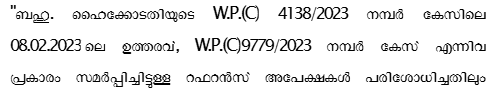
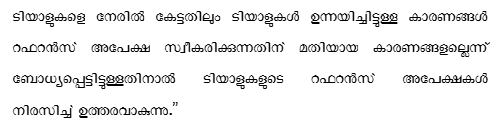
Revised Awards were passed by the competent authority in respect of the petitioners' property on 19.04.2022 and 11.10.2021. The 1st petitioner preferred an application for reference under Section 64 (1) on 03.09.2022. The same was dismissed, holding that the application was preferred beyond the period prescribed in the second proviso to Section 64 (2) and that there exists no sufficient cause to condone the delay in terms of the second proviso. The petitioners approached this Court by filing a Writ Petition, which culminated in Ext.P2 judgment, directing the petitioners to file necessary application before the Special Tahsildar, explaining the reasons which prevented the petitioners from filing an application for reference within six weeks from the date of Award. Ext.P2 also directed consideration of that application, after affording an opportunity of being heard to the petitioners and to issue fresh Orders. The said exercise has been done vide Ext.P7. The operative portion of Ext.P7 is extracted here-below:
3. Challenging Ext.P7, the petitioners approached the Land Acquisition, Rehabilitation and Resettlement Authority, Kottayam (District Court, Kottayam), which resulted in Ext.P9 Order, holding that the said authority has no power to entertain the application from an exercise made under the second proviso to Section 64 (2). In other words, according to the learned District Judge, the power of the Court has been conferred only on the failure of the District Collector to make a reference within the stipulated period of 30 days in terms of the second proviso to Section 64 (1).
4. Having heard the learned counsel for the petitioners and the learned Government Pleader on the issues, this Court cannot strictly find any fault with Ext.P9. Going by the scheme of Section 64 of the 2013 Act, a person who is not accepting the Award can seek a reference. For determination of compensation before the authority, the reference has to be made by the Collector within a period of 30 days from the date of receipt of application. An application for reference has to be made within a period of six weeks from the date of Collector's Award, in case the aggrieved person was represented before the Collector and in cases where there was no such representation, within six months from the date of Collector's Award. Going by the first proviso to Section 64 (1), the Collector is duty bound to make such reference within a period of 30 days from the date of receipt of application; and if he fails to do so, the applicant/aggrieved party is at liberty to approach the authority, and the authority can direct the Collector to make reference within the said period of 30 days, as provided in the second proviso to Section 64 (1). Section 64 (2) speaks of the time period within which an application for reference has to be made. It is the second proviso to Section 64 (2), which confers power on the District Collector to entertain an application for reference, dehors the expiry of the period stipulated in the first proviso to Section 64 (2), but within a period of one year, provided the Collector is satisfied that there exists sufficient












