
 Back
Back





IN THE HIGH COURT OF KERALA AT ERNAKULAM
RAJA VIJAYARAGHAVAN V, K. V. JAYAKUMAR, JJ.
Muniyandi Raj @ Raj (C - 4551), S/o. Dwaraiswami – Appellant
Versus
State Of Kerala Represented By The Public Prosecutor – Respondent
Crl.A No. 1284 of 2022
Decided On : 26-05-2026
| Table of Content |
|---|
| 1. establishing the factual background and procedural history of the case. (Para 1 , 3 , 5 , 7 , 8 , 9 , 10) |
| 2. summary of the trial court's conviction and the basis of the guilty verdict. (Para 11 , 12 , 13) |
| 3. presentation of conflicting arguments on circumstantial evidence and witness reliability. (Para 14 , 15) |
| 4. assessment of witness testimony, hearsay evidence, and the inadmissibility of police statements. (Para 17 , 18 , 19 , 20 , 21 , 22 , 23 , 24 , 25 , 26 , 27 , 28 , 29) |
| 5. established norms for evaluating circumstantial evidence and the requirement for a complete chain. (Para 30 , 31 , 32 , 33 , 34 , 35 , 36 , 37) |
| 6. conclusion that evidence is insufficient to prove guilt, leading to acquittal. (Para 38 , 39 , 40 , 41 , 42 , 43) |
Judgment :
Raja Vijayaraghavan, J.
1.Muniyandi Raj @ Raj, the appellant herein is the accused in S.C.No. 205 of 2019 on the file of the Additional Sessions Judge-III, Pathanamthitta. In the aforesaid case, he faced indictment for having committed offences punishable under Sections 392 and 302 of the IPC. By the judgment, which is impugned in this appeal, the learned Sessions Judge found the appellant guilty of the offences under Section 392 and 302 of the and sentenced him to undergo:
i) Rigorous Imprisonment for 7 years and to pay a fine of Rs. 2000/- for the offence under Section 392 of the IPC; and
ii) Imprisonment for life and to pay a fine of Rs. 5000/- for the offence under Section 302 of the IPC, both with default clauses.
2. The above finding of guilt, conviction and sentence are challenged in this appeal.
3. The incident that allegedly led to the death of one Karuthakannan is stated to have occurred on 19.01.1991. According to the prosecution, Karuthakannan earned his livelihood by collecting alms from pilgrims visiting Sabarimala and was a native of Uthampalayam Taluk in the State of Tamil Nadu. The prosecution case is that, on the aforesaid date, Karuthakannan was found seated beside the Nadappatha near Poonkavanam, consuming food from a steel vessel. A sack containing miscellaneous articles, coins, and other belongings, along with another bag, was lying beside him. It is alleged that the accused approached the deceased and attempted to snatch the sack containing the coins, which resulted in a physical altercation between them. According to the charge, the appellant assaulted the deceased, struck his head against a tree, and thereafter dragged him to a location approximately 19.60 metres away from the spot where he had been sitting. It is further alleged that the appellant inflicted fatal injuries by striking the deceased on the head with a heavy stone, thereby causing his death. The prosecution further alleges that the appellant thereafter robbed the bags containing currency that were in the possession of the deceased.
4. It must be noted at the outset that there are no eyewitnesses to the occurrence. The prosecution case, therefore, rests entirely on circumstantial evidence and the inferences sought to be drawn therefrom.
5. As stated earlier, although the incident occurred in January 1991 and the final report was laid on 31.05.1995, the investigating agency was unable to apprehend the accused. Consequently, an absconding charge was filed before the jurisdictional court. The records reveal that the matter was thereafter classified as a Long Pending Case and numbered as L.P. No. 86 of 1996. It was only on 15.02.2019, nearly 28 years after the alleged occurrence, that the appellant was arrested and committed to the Court of Session. The evidence in the case came to be recorded in February 2020, and the appellant was defended by a legal aid counsel. These circumstances assume considerable significance in the peculiar facts and circumstances of the present case and cannot be lost sight of while appreciating the evidence on record.
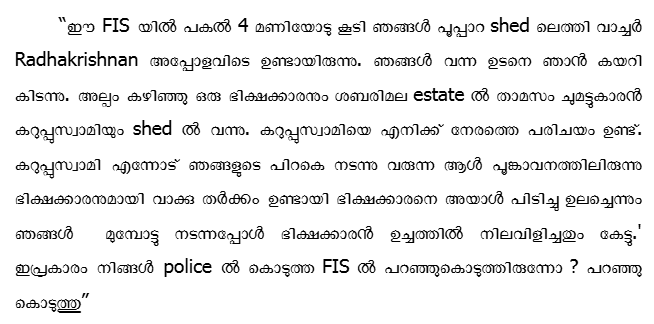
6. It would be apposite to briefly refer to the sequence of events that culminated in the registration of the crime and the eventual submission of the f
In a criminal trial based on circumstantial evidence, the prosecution must establish a complete and unbroken chain of circumstances that excludes every reasonable hypothesis of innocence. Suspicion c....

The prosecution must establish a complete chain of events in cases based on circumstantial evidence, and the burden of proof lies with the prosecution to prove the guilt of the accused beyond reasona....

The central legal point established in the judgment is the requirement for cogent and unerring circumstantial evidence to establish guilt in cases based on such evidence, and the burden on the prosec....



The court emphasized that circumstantial evidence must establish a complete and unbroken chain of guilt beyond reasonable doubt, particularly in capital cases.
Circumstantial evidence – Principle applicable to circumstantial evidence requires that facts must be consistent with hypothesis of guilt of accused.


The main legal point established in the judgment is the burden of proof on the prosecution in cases based on circumstantial evidence. The judgment emphasizes the need for the prosecution to establish....

The prosecution must prove the guilt of the accused beyond a reasonable doubt, and in cases relying on circumstantial evidence, the evidence must form a complete chain that excludes any reasonable do....



An indispensable Tool for Legal Professionals, Endorsed by Various High Court and Judicial Officers
Please visit our Training & Support
Center or Contact Us for assistance

Scan Me!
India’s Legal research and Law Firm App, Download now!


For Daily Legal Updates, Join us on :



 Back to top


