
 Back
Back





IN THE HIGH COURT OF JUDICATURE FOR RAJASTHAN AT JODHPUR
NUPUR BHATI, J.
Smt. Sosar Kanwar, W/o. Samant Singh and Ors. – Appellants
Versus
Amar Singh, S/o. Nand Singh and Anr. – Respondents
S.B. Civil Misc. Appeal No. 2947 of 2017
Decided On : 12-08-2024
WORKMEN'S COMPENSATION - EMPLOYMENT DEATH CLAIM - Workmen’s Compensation Act, 1923, Section 30 - The court analyzed the provisions of the Workmen’s Compensation Act, 1923, particularly Section 30, which limits appeals to substantial questions of law. The court interpreted the requirement for establishing a causal link between employment and death, emphasizing that the burden of proof lies with the claimants. The court concluded that the deceased's death was due to a pre-existing health condition, not related to employment, leading to the dismissal of the appeal.
Fact of the Case:
The appeal was filed under Section 30 of the Workmen’s Compensation Act, 1923, challenging the dismissal of a claim for compensation following the death of Mr. Samant Singh, a driver, who died while on duty. The employer and insurance company denied liability, asserting that the death was due to natural causes and not related to employment.
Finding of the Court:
The court upheld the Commissioner’s finding that the deceased did not die in the course of employment, as he was suffering from a prior ailment before starting his duty. The court found that the claimants failed to provide sufficient evidence to establish a connection between the death and employment.
Issues: 1. Whether Samant Singh died during the course of employment? 2. Whether the tribunal misread evidence regarding the cause of death? 3. Should an adverse inference be drawn against the employer regarding the cause of death?
Ratio Decidendi: The court reiterated that the burden of proof lies with the claimants to establish that the death arose out of employment. It emphasized that mere occurrence of death during employment does not automatically imply liability under the Act. The court found no substantial question of law to warrant interference with the Commissioner’s decision.
Final Decision: The appeal was dismissed as the court found no merit in the claims made by the appellants, affirming the Commissioner’s decision that the death was not work-related.
JUDGMENT :
(Nupur Bhati, J.)
1. The present civil misc. appeal has been filed under Section 30 of the Workmen’s Compensation Act, 1923 (‘Act of 1923’), assailing the award passed by the Commissioner, Workmen Compensation Officer, Rajsamand, Bhilwara, vide order dated 20.12.2016 whereby, the claim filed by the appellants/claimants has been dismissed. Certain other ancillary relief(s) have also been sought by the appellants/claimants.
2. Briefly stated, the facts of the case are that the deceased, Mr. Samant Singh, husband of the appellants/claimants worked as a driver for respondent no. 1, for his truck bearing number RJ-27-G-1257 and used to earn Rs. 5,000/-for the said job. On 05.11.2005, the deceased was taking marble stone to Ahmedabad by the said vehicle and en route, his health deteriorated and subsequently, he died.
3. After the service of notice to the respodents, respondent no. 1, employer did not appear and therefore, the matter was heard ex-parte respondent no.1, employer. Respondent no. 2, insurance company, in its reply denied the factum of the claim and stated that the said incident did not occur due to the insured vehicle bearing number RJ-27-G-1257, and that, the deceased died a natural death. It was also stated by the respondent no.2, insurance company it its reply that, the company was not informed about the said incident and that, there was violation of the policy conditions. It was also stated that the deceased did not possess a valid and effective driving license at the time of the incident, while driving the insured vehicle.
4. Witnesses A.W.1, Sosar Kanwar, A.W.2 Dhan Singh and A.W.3, Kalu Singh were examined from the appellants/claimants’ side, and Exhibits 1 to 6 have been produced by the appellants/claimants. Contrary to this, N.A.W. 1, Bheru Lal was examined from the respondent no. 2/insurance company’s side and Exhibits 1 to 4 have been produced by the respondent no.2.
5. After hearing the parties, the Commissioner framed issues, including:
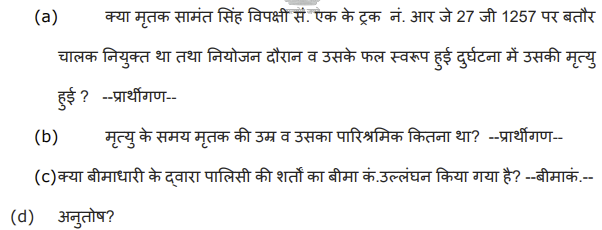
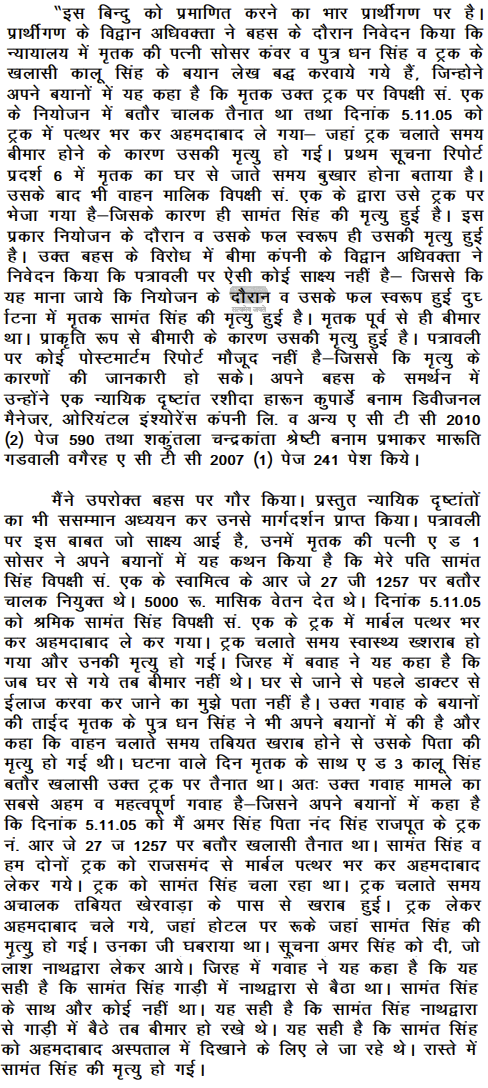
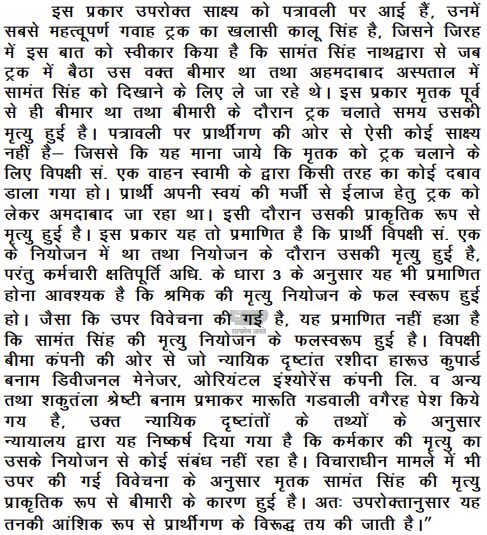
6. The Commissioner, while deciding the issues held that the deceased, Late Samant Singh did not die in the course of employment and his death was not related to his employment on 05.11.2005 and therefore, the claim of the appellants/claimants was dismissed.
7. Thus, aggrieved of the order passed by the Commissioner, Workmen Compensation Officer, Jurisdiction Rajsamand, District Bhilwara, dated 20.12.2016, the appellants/claimants have filed the present appeal.
8. Learned counsel for the appellants/claimants submitted that the death of the deceased occurred in the course of employment of the respondent no.1, employer, since the deceased was carrying marble stone to Ahmedabad, at the time of his death, which forms a part of his job and therefore, the Commissioner erred in coming to the conclusion that the death did not occur during the course of the employment.
9. Learned counsel for the appellants/claimants also submitted that the statement of A.W. 3, Kalu Singh the deceased was already in his ill-health while driving the vehicle on 05.11.2005, cannot be considered in isolation to the fact that the said condition was informed to the employer, respondent no. 1, before the employer assigned the job of taking the marble stones to Ahmedabad, to the deceased. He thus submitted that after disclosing the condition, the burden falls upon the employer, since he assigned the job to the deceased on 05.11.2005, even after knowing that the deceased was not feeling well.
10. Learned counsel for the appellants/claimants also submitted that when the deceased was a driver, then stress and strain can be assumed to have occurred during the course of employment which resulted in his death and the burden to prove the contrary lies upon the employer. He also placed reliance upon the judgment passed by the Hon’ble High Court of Karnataka reported in 2019 ACJ 3086. The relevant paras are reproduced as under:
“7. The cited decisions like Jyothi, Shakuntala and Rashida cases (supra) could b
AI
The court established that under the Workmen’s Compensation Act, the burden of proof lies with the claimants to demonstrate a causal link between employment and the death of the employee, and that th....

Workmen’s compensation - Natural death - Death by heart attack is an accident is well recognized.

The court confirmed that a work-related heart attack constitutes an accident under the Employees Compensation Act if stress from employment contributed to the health condition, validating claims for ....


The establishment of an employer-employee relationship is essential for claiming compensation under the Employee’s Compensation Act, and the liability for interest on compensation lies with the emplo....

Employer's liability to pay as per Commissioner's award and the same varied between wages actually drawn by deceased employee and wages shown by employer as payable to employee for purpose of payment....

An injury is compensable if it arises out of and in the course of employment, establishing a causal connection between the accident and the workman’s duties.

The court affirmed that stress and strain of employment can aggravate pre-existing health issues, allowing for compensation under the Employees Compensation Act.



An indispensable Tool for Legal Professionals, Endorsed by Various High Court and Judicial Officers
Please visit our Training & Support
Center or Contact Us for assistance

Scan Me!
India’s Legal research and Law Firm App, Download now!


For Daily Legal Updates, Join us on :



 Back to top


