
 Back
Back





IN THE HIGH COURT OF JUDICATURE FOR RAJASTHAN AT JODHPUR
NUPUR BHATI, J.
The New India Assurance Co. Ltd. Through its Authorized Office - Appellant
Versus
Smt. Pappu Devi W/o. Late Joga Ram and Ors. – Respondents
S.B. Civil Misc. Appeal No. 1142 Of 2016
Decided On : 12-08-2024
EMPLOYERS LIABILITY - EMPLOYEES COMPENSATION ACT - Section 30, Employees Compensation Act, 1923 - The court discussed the liability of the insurance company under the Employees Compensation Act, 1923, particularly in cases where the driver does not possess a valid driving license. It highlighted that the Act does not impose liability on the insurer for third-party claims, contrasting it with the Motor Vehicles Act, 1988. The court interpreted relevant Supreme Court judgments, establishing that the insurance company is not liable to indemnify when there is a breach of policy conditions, such as the use of a fake license. This interpretation influenced the court's decision to modify the liability imposed on the insurance company.
Fact of the Case:
The appellant, an insurance company, challenged the award of compensation to the legal representatives of a deceased driver, Joga Ram, who died in an accident while driving a truck. The insurance company argued that the driver had a fake license, thus breaching the policy conditions, and claimed it should not be liable for compensation under the Employees Compensation Act, 1923.
Finding of the Court:
The court found that the learned Commissioner had erred in imposing liability on the insurance company despite the driver not having a valid license. It concluded that the insurance company could not be held liable under the Act of 1923 due to the breach of policy conditions.
Issues: 1. Whether the learned Commissioner had jurisdiction to direct the insurer to pay compensation when there was a breach of policy conditions? 2. Whether the insurance company was liable to pay compensation when the deceased driver had a fake license?
Ratio Decidendi: The court relied on previous Supreme Court judgments which established that under the Employees Compensation Act, the insurer is not liable to indemnify for claims arising from breaches of policy conditions, such as the absence of a valid driving license. The court emphasized the distinction between the provisions of the Employees Compensation Act and the Motor Vehicles Act regarding insurer liability.
Final Decision: The court partly allowed the appeal, modifying the learned Commissioner's order to remove the joint and several liability imposed on the insurance company, stating that the claimants could recover the compensation amount from the vehicle owner instead.
ORDER :
(Nupur Bhati, J.) :
1. The instant misc. appeal has been preferred by the appellant under Section 30 of the Employees Compensation Act, 1923 (‘the Act of 1923’) challenging the legality and validity of the judgment/ award dated 23.12.2015 passed by the learned Commissioner, Employee’s Compensation (‘EC’), Balotra (Barmer) Camp Pali, in Claim Case No.E.C.C.F 52/2011 whereby the learned Commissioner held the appellant-Insurance Company liable to pay the compensation to the tune of Rs.8,54,280/-.
2. Brief facts of the case are that on 16.04.2011, Shri Joga Ram (since deceased) was going from Balasore to Cuttak while driving a Truck trailor bearing Registration No.RJ-19GB-1020, when he stopped the vehicle in order to check the condition of wheel, an unknown vehicle hit him and fled away and thus the deceased succumbed to death during the course of the treatment. The incident was registered at police station Khantapada, District Balasor. His legal representatives preferred a claim petition in terms of the Act of 1923 against the employer and insurer of the vehicle.
3. After filing of claim petition, notices were issued to the non-claimant No.1 and none appeared on his behalf and therefore, ex-parte proceedings were initiated against him. A reply was filed on behalf of non-claimant No.2-Insurance Company while denying the averments made in the claim petition. It is stated in the reply that the deceased driver Joga Ram was having a fake license and the appellant-Insurance Company is not liable to pay the compensation in view of violation of the policy conditions and thus, being aggrieved of the joint and several liability imposed upon the appellant-Insurance Company and the respondent no.7/employer, the appellant-Insurance Company prefers the present misc. appeal.
4. After hearing the parties, learned Commissioner framed four issues including:
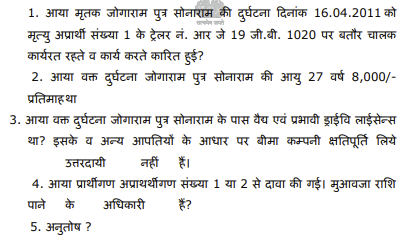
5. In support of the claim petition, the appellant company examined Shri Pankaj Meena as NAW-1 and 9 documents were exhibited and on behalf of the non-claimants, Smt. Pushpa Devi and Subhash Khan have appeared as witness and some documents were exhibited, driving license was exhibited as exhibit-10.
6. Learned counsel for the appellant submits that the learned Commissioner, EC, Balotra (Barmer), vide award dated 23.12.2015, has erred in deciding the issue no.3 that the insurance company is liable to indemnify the insured towards the penalty arising under the Employee’s Compensation Act, 1923. He draws attention of this Court to the judgment passed by the Apex Court in the case of National Insurance Co. Ltd Vs. Mastan & Anr. reported in (2006)2 SCC 641 wherein it has been observed by the learned Tribunal that though under the Motor Vehicles Act, 1988 (‘MV Act’), even if the driver does not have any license, the Tribunal under MV Act may direct the insurer to meet the third party liability, permitting it to recover the same from the insured, however, the same is not the case under the Act of 1923.
7. Learned counsel for the appellant also relies upon the judgment passed by the Hon’ble Apex Court in the case of New India Assurance Co. Ltd. Vs. Harshadbhai Amrutbhai Modhiya reported in (2006) 5 SCC 192, wherein it has been observed by the Hon’ble Apex Court that there are no corresponding provision between the MV Act and the Act of 1923 pertaining to the liability of the insurer towards a third party and the scheme of Act of 1923 does not confer a right on the claimant for compensation under the Act of 1923 to claim the payment of the compensation in its entirety from the insurer himself.
8. Learned counsel for the appellant further places reliance upon the judgment passed by the Hon’ble Apex Court in the case of Beli Ram Vs. Rajinder Kumar reported in 2021 (1) RAR 13 (SC), wherein it has been observed by the Hon’ble Apex Court that unlike the MV Act, in case where the employee is not having a valid license, under the Act of 1923, the insurance company is not liable to pay for such breach of
AI
The insurance company is not liable to indemnify for compensation under the Employees Compensation Act when the driver does not possess a valid driving license, as this constitutes a breach of policy....

An employer may be held vicariously liable when an employee operates a vehicle without a valid license, negating insurer liability in case of substantive policy breach.

The insurance company is not liable for compensation if the driver lacked a valid driving licence at the time of the accident.


Owner solely liable for workmen's compensation when permitting LMV-licensed driver without valid HMV licence to operate heavy vehicle, absolving insurer due to attributable policy breach; appeal dism....
The validity of the driving license is a consideration under a contract of insurance, and the insurer can raise the issue in the proceedings under the Employees Compensation Act.

Injury suffered in course of employment – Insurer would be liable only to reimburse employer, in the event employer fails to make payment for any reason.

Compensation under the Employee's Compensation Act is due immediately upon the accident, with interest applicable from that date, contingent on proper adherence to insurance and licensing conditions.



An indispensable Tool for Legal Professionals, Endorsed by Various High Court and Judicial Officers
Please visit our Training & Support
Center or Contact Us for assistance

Scan Me!
India’s Legal research and Law Firm App, Download now!


For Daily Legal Updates, Join us on :



 Back to top


