Back
Back





2024 Supreme(Raj) 490
IN THE HIGH COURT OF JUDICATURE FOR RAJASTHAN AT JODHPUR
NUPUR BHATI, J.
Rajendra S/o Late Matu Ram – Appellant
Versus
Legal Heirs of Late Laxmi Narayan – Respondent
S.B. Civil Writ Petition No. 1885 of 2024
Decided on : 22-05-2024
For the Appellant : Mr. Nishank Madhan
For the Respondent: Mr. J.S. Bhaleria
IMPORTANT POINT
A family settlement that creates rights in immovable property must be registered to be admissible in evidence; unregistered and unstamped documents cannot be admitted as secondary evidence.
Headnote:
EVIDENCE - ADMISSIBILITY OF EVIDENCE IN FAMILY SETTLEMENT - Indian Evidence Act, 1872 - Section 65; Registration Act, 1908 - Section 17(1)(b); Indian Stamp Act, 1899 - Sections 33, 35 - The court discussed the admissibility of a photocopy of a family settlement as secondary evidence under Section 65 of the Indian Evidence Act. It highlighted that the original compromise was unregistered and unstamped, thus inadmissible under the Registration Act and the Indian Stamp Act. The court emphasized that a family settlement that creates rights in immovable property must be registered, and without registration, secondary evidence cannot be admitted. The court's decision was influenced by precedents establishing that unregistered documents affecting property rights cannot be used as evidence.
Fact of the Case:
The petitioner challenged the dismissal of an application to admit a photocopy of a family settlement as secondary evidence. The original settlement was unregistered and unstamped, and the dispute arose from a partition suit filed by the respondents against the petitioner, who claimed rights over the property based on the settlement.
Finding of the Court:
The court found that the original compromise created rights in the property and required registration under Section 17(1)(b) of the Registration Act. The court concluded that since the original document was inadmissible, the photocopy could not be admitted as secondary evidence under Section 65 of the Indian Evidence Act.
Issues: Whether the photocopy of the unregistered and unstamped family settlement could be admitted as secondary evidence under Section 65 of the Indian Evidence Act.
Ratio Decidendi: The court held that a family settlement that creates or declares rights in immovable property must be registered. The absence of registration renders both the original and any secondary evidence inadmissible. The court relied on established legal principles regarding the necessity of registration for documents affecting property rights.
Final Decision: The writ petition was dismissed, affirming the trial court's order that the photocopy of the compromise could not be admitted as evidence due to the original being unregistered and unstamped.
ORDER :
NUPUR BHATI, J.
1. Though the matter had been listed in the ‘Fresh’ category, at the joint request of both the parties, the matter is heard finally today itself.
2. This writ petition has been filed under Articles 226 and 227 of the Constitution of India, challenging the order passed by learned Additional District and Sessions Judge, Suratgarh (‘Trial Court’) dated 11.01.2024 (Annex.8) whereby the application preferred by the petitioner under Section 65 of the Indian Evidence Act, 1872 (‘Evidence Act’) has been dismissed. The petitioner has also prayed that the compromise dated 27.01.2014 (Annex.5) may be allowed to be admissible as secondary evidence in accordance with the law. Certain other ancillary relief(s) have also been sought by the petitioner.
3. Briefly stated, the facts of this petition are that one late Hukma Ram, during his lifetime, was holding the possession of a patta, issued by the State Council of Bikaner for the land admeasuring 2755 square yards dated 15.07.1912 and had also constructed a house on the said disputed land. After the death of Late Hukma Ram, the parties to the suit (Annex.1), being the legal heirs, got their succession rights and are in the possession of the said land, since the past thirty years.
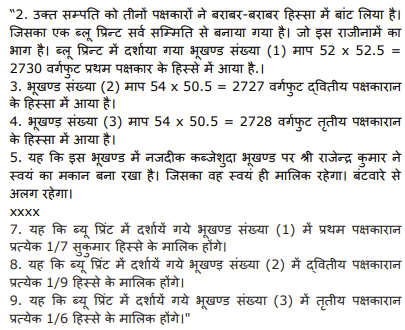
4. The respondent-plaintiffs filed a suit for partition and permanent injunction on 24.10.2010 (Annex.1) on the ground that the petitioner-defendant has partitioned the disputed property without the consent of the respondent-plaintiffs. Subsequently, the petitioner filed an application under Order 11 Rule 14 of the Code of Civil Procedure, 1908 (‘CPC’) dated 09.05.2016 (Annex.2) to bring the compromise dated 27.01.2024 (Annex.5) on record, which was executed between the parties and was in possession of the respondent-plaintiffs at that time.
5. The Trial Court, while deciding the application, vide order dated 27.01.2021 (Annex.4) directed the respondent-plaintiffs to file an affidavit if they were having the original compromise because the said compromise was neither stamped nor registered, however it had signatures of all the respondent-plaintiffs. Thereafter, the petitioner filed an application on 18.03.2021 (Annex.6) under Section 65 of the Evidence Act seeking permission to produce the copy of the compromise dated 27.01.2014 (Annex.5) as secondary evidence, to which a reply had been filed by the respondent-plaintiffs on 12.08.2021 (Annex.7).
6. The said application preferred by the petitioner under Section 65 of the Evidence Act was dismissed by the learned Trial Court vide order dated 11.01.2024 (Annex.8).
7. Thus, being aggrieved of the order dated 11.01.2024 (Annex.8) passed by learned Trial Court, the petitioner has preferred this writ petition.
8. Learned counsel for the petitioner submitted that the learned Trial Court had specifically directed in the order dated 21.01.2021 (Annex.4) to the respondent-plaintiffs to file an affidavit if they were in possession of the original compromise since the compromise was not duly stamped and registered. He also submitted that in compliance to the said order, only one plaintiff filed an affidavit denying the possession of the original compromise, while the other respondent-plaintiffs did not file any such affidavit, nor produced the original compromise dated 27.01.2014 (Annex.5) before the learned Trial Court, which demonstrates that the original compromise is indeed in possession of the respondent-plaintiffs.
9. Learned counsel for the petitioner further submitted that since the petitioner was not in possession of the said original compromise dated 27.01.2014 (Annex.5) and therefore, a photocopy of the said compromise dated 27.01.2014 (Annex.5) was sought to be produced by the petitioner by way of filing an application under Section 65 of the Evidence Act.
10. Learned counsel for the petitioner also submitted that the learned Trial Court has erred in giving the finding that the affidavit is required on account of the said compromise being unregistered an