


1. A police officer challenged a censure penalty order and circular denying promotion on censure, arguing the penalty order lacked reasons and censure cannot bar promotion. (Para 1 , 3 , 4 , 5 , 6 , 16 , 17 )

 Back
Back





IN THE HIGH COURT OF JUDICATURE FOR RAJASTHAN AT JAIPUR
GANESH RAM MEENA, J.
Raghuveer Singh S/o Shri Ummed Singh – Petitioner
Versus
State of Rajasthan – Respondent
S.B. Civil Writ Petition No. 20358 of 2018
Decided On : 07-05-2024
1. A police officer challenged a censure penalty order and circular denying promotion on censure, arguing the penalty order lacked reasons and censure cannot bar promotion. (Para 1 , 3 , 4 , 5 , 6 , 16 , 17 )
2. Petitioner contended penalty order was not reasoned and censure cannot withhold promotion; respondents submitted penalty was justified and circular is valid for effective implementation of rules. (Para 9 , 10 , 11 , 12 , 13 , 32 , 33 )
3. All impugned penalty orders and the Circular were quashed; petitioner entitled to consequential benefits including promotion consideration. (Para 45 , 46 )
Yes, Rule 17 of the Rules of 1958 requires the Disciplinary Authority to pass a speaking order giving reasons for not accepting the explanation of the government servant; an order without reasons is illegal and arbitrary. (Para 21 , 22 , 23 , 24 , 25 , 26 , 27 , 28 )
No, Rule 14 of the Rules of 1958 distinguishes censure from withholding promotion as separate penalties; the rule framers used or indicating withholding annual grade increment does not include withholding promotion; censure cannot bar promotion. (Para 35 , 36 , 37 , 38 , 39 )
No, the Circular is contrary to the intention of the statutory Rules of 1958; it cannot override the statutory rules and was issued to supplement rules in a manner that creates a new state of things not intended by the rules. (Para 34 , 36 , 39 , 44 )
No, the government cannot amend statutory rules by administrative instructions; circulars must not be so rigid as to curtail powers conferred by the rules, and must not be contrary to the rules. (Para 40 , 41 , 42 )
Yes, when the order is passed without application of mind, without reasons, and is illegal and arbitrary, the court can interfere and set it aside even in writ jurisdiction. (Para 13 , 15 , 30 )
ORDER :
1. This petition has been filed by the petitioner challenging the penalty order dated 30.05.2013 passed by the Deputy Commissioner of Police, (South), Jaipur, (for short ‘the Disciplinary Authority’) whereby the petitioner has been imposed with the penalty of ‘Censure’, the order dated 27.12.2013 passed by the Commissioner of Police, Jaipur, (for short ‘the Appellate Authority’) whereby the appeal filed by the appellant-petitioner against the order of penalty of ‘Censure’ was dismissed and so also the order dated 26.10.2015 passed by the Joint Secretary (Appeal) Government of Rajasthan, Department of Home, Jaipur, (for short ‘the Reviewing Authority’) whereby the review petition assailing the penalty order and order of Appellate Authority, was also dismissed.
2. The petitioner has also agitated an issue that promotion of the petitioner on account of penalty of ‘Censure’, cannot be withheld and withholding of promotion on such a ground is illegal and arbitrary.
3. Facts as borne out from the pleadings are that the petitioner while posted as Station House Officer, Police Station Chaksu, a criminal case i.e. F.I.R. No. 300/2012 was registered at Police Station Chaksu for offences under Sections 143 , 341, 323 & 452 of IPC and the investigation of the same was assigned to one Mr. Ramchandra, Head Constable No. 582. During the investigation process, the concerned Head Constable who was assigned the investigation was trapped by the Anti-Corruption Bureau outside the premises of the Police Station while demanding and accepting the bribe of Rs. 5,000/-.
4. The petitioner was served with memorandum of charges dated 01.09.2012 with one of the charge that the investigation of the criminal case No. 300/2012 was handed over to Mr. Ramchandra, Head Constable who was not competent to make investigation for non-bailable offences and other charge was that there was supervisory negligence of the petitioner in regard to investigation of the criminal case No. 300/2012 and because of his supervisory negligence the Police Personnel who was making investigation, demanded and accepted the bribe of Rs. 5,000/-.
5. The petitioner submitted an explanation to the memorandum of charges. As regards the charge No. 1, the petitioner in the explanation stated that at the time when the Criminal Case No. 300/2012 was registered at Police Station, Chaksu, he was out of Police Station because of some official work and the Duty Officer, Mr. Net Ram, Sub-Inspector who was holding the charge at the relevant point of time, assigned the investigation of the Criminal Case No. 300/2012 to one Mr. Ramchandra, Head Constable and therefore petitioner cannot be held guilty for assigning the investigation to an incompetent person. It was also stated that as per the orders and instructions of the State Government, the petitioner was not having the authority to transfer the investigation from one Officer to other and has also made reference of the Circular and the orders issued by the Director General of Police, Rajasthan.
6. As regards the charge No. 2 is concerned, the petitioner has denied the negligence. In regard to supervision of the investigation of Criminal Case No. 300/2012, it was stated by the petitioner that he instructed the concerned Investigation Officer time to time and also warned that if the investigation remains pending, he would be accountable for that. It was also stated that petitioner has nothing to do with the demands and acceptance of the bribe made by Shri Ramchandra, Head Constable, who was having the investigation.
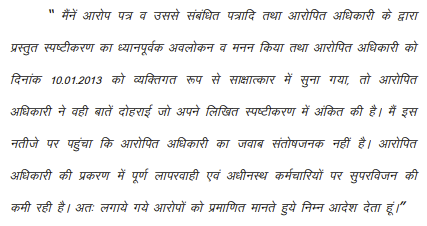
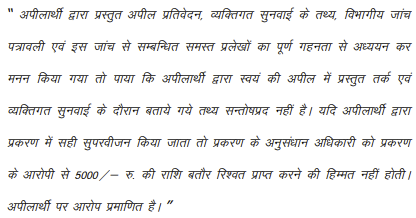
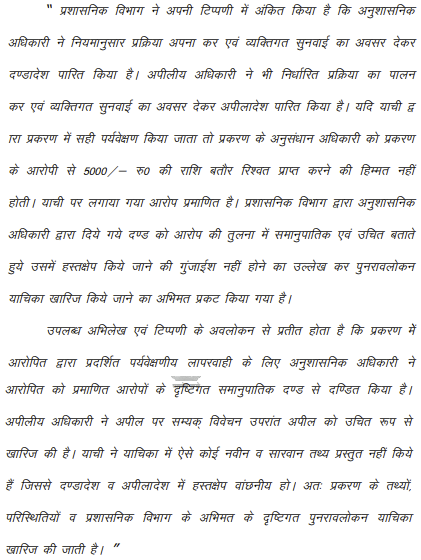
7. The Disciplinary Authority i.e. Deputy Commissioner of Police, (South), Jaipur passed the order dated 30.05.2013 and imposed the penalty of ‘Censure’. Against the order of penalty dated 30.05.2013, the appellant-petitioner preferred an appeal under Rule 23 of Rajasthan Civil Services (Classification Control and Appeal) Rules,1958 (for short the ‘Rules of 1958’) before the Appellate Authority and the Appellate Authority vide order date
AI

The court affirmed the principle that judicial review of administrative actions in disciplinary processes is limited to procedural correctness, not evidential review, and mandated reconsideration of ....

Disciplinary authorities must issue reasoned orders and apply due process to ensure adherence to the principles of natural justice, safeguarding employees against arbitrary judgments.

Disciplinary actions must be supported by clear reasoning; failure to provide reasons renders such actions invalid.



An indispensable Tool for Legal Professionals, Endorsed by Various High Court and Judicial Officers
Please visit our Training & Support
Center or Contact Us for assistance

Scan Me!
India’s Legal research and Law Firm App, Download now!


For Daily Legal Updates, Join us on :



 Back to top