
 Back
Back





IN THE HIGH COURT OF JUDICATURE FOR RAJASTHAN BENCH AT JAIPUR
GANESH RAM MEENA, J.
Shankar Lal Chhaba S/o Shri Binya Ramji – Appellant
Versus
State of Rajasthan – Respondent
S.B. Civil Writ Petition No. 7822 of 2008
Decided On : 22-01-2026
| Table of Content |
|---|
| 1. charge-sheet issuance and initial proceedings. (Para 1 , 2) |
| 2. grounds for challenging the charges. (Para 3 , 4 , 5) |
| 3. legal interpretation of procedural fairness. (Para 6 , 10) |
| 4. court's evaluation of procedural adherence. (Para 7 , 8 , 9) |
| 5. concluding judgment on unfair proceedings. (Para 26 , 27 , 28) |
ORDER :
1. The petitioner by filing instant writ petition under Article 226 of the Constitution of India has made a challenge to the charge-sheet dated 11.05.2005 (Annexure-3) issued under the signatures of the Inspector General of Police, Jaipur Range (I), Jaipur, the order dated 02.08.2005 (Annexure-5) issued under the signatures of the Inspector General of Police, Jaipur Range-I, Jaipur, the order dated 26.07.2006 (Annexure-7) issued under the signatures of the Director General of Police, Rajasthan, Jaipur so also the order dated 12.02.2008 (Annexure-10) issued under the signatures of the Dy. Secretary of the Government, Government of Rajasthan, Home (Gr. 11) Department.
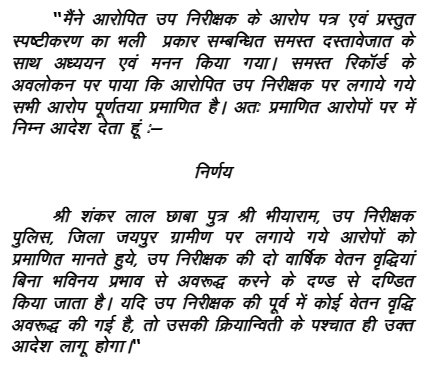
2. The facts emerge out from the pleadings are that when the petitioner was posted as SHO police station Pragpura, District Jaipur, he was issued a charge-sheet on 21.02.2005 (Annexure-1) under Rule 16/18 of the Rajasthan Civil Services (Classification, Control and Appeal) Rules, 1958 and Amendment Rules of 1983 (for short 'the Rules of 1958, amended Rules of 1983') by the Inspector General of Police, Jaipur (I), Jaipur after conducting a preliminary enquiry with regard to the incident alleged to have taken place on 18.12.2004. The petitioner submitted a detailed reply to the said charges. The respondent no. 4 after considering the reply of the petitioner came on the conclusion that his action was not malicious and dropped the said charge-sheet, however, on the same day directed to issue the charge-sheet to the petitioner under Rule 17 of the CCA Rules vide order dated 11.05.2005. On 26.05.2005 the petitioner submitted a detailed reply to the charge-sheet. The respondent without applying the judicious mind on the reply so submitted by the petitioner, found the charges proved against the petitioner and imposed a penalty of stoppage of two annual grade increments without cumulative effect vide order dated 02.08.2005.
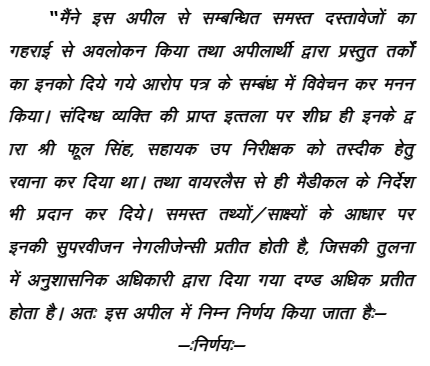
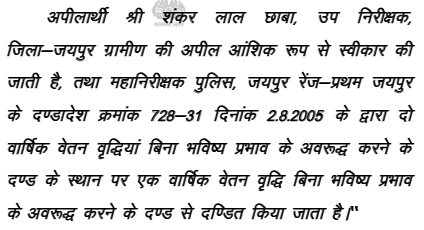
Against the punishment order, the petitioner preferred an appeal before the Director General of Police, Rajasthan, Jaipur. The respondent no. 3 considering the reply of the petitioner came on the conclusion that the petitioner on receiving the information regarding the incident of 18.12.2004 immediately took necessary action despite that respondent-Authority held the petitioner guilty of supervisory negligence without assigning any plausible and cogent reasons and vide order dated 26.07.2006 reduced the penalty from stoppage of two grade increments without cumulative effect to one annual grade increment without cumulative effect.
Against the punishment order dated 26.07.2006 (Annexure-7), the petitioner filed a review petition before His Excellency the Governor of Rajasthan. Vide order dated 12.02.2008 (Annexure-10) issued under signatures of Dy. Secretary of the Government, Government of Rajasthan, Home (Group 11) Department, the review petition filed by the petitioner was rejected. Hence, this writ petition.
3. Mr. M.M. Mehrishi, learned counsel appearing for the petitioner submitted that the impugned charge-sheet dated 11.05.2005 (Annex-3), the orders dated 02.08.2005 (Annex-5), 26.07.2006 (Annex-7), 02.02.2008 so also the order dated 12.02.2008 (Annex-9 and 10) are ex-facie illegal, arbitrary, malicious and perverse and therefore same deserve to be quashed and set aside. He further submitted that all the charges are absolutely baseless and against the material available on record and sufficient enough to prove the petitioner innocent and thus charge-sheet as well as the impugned orders deserve to be quashed and set aside.
Learned counsel for the petitioner submitted that respondents failed to appreciate report No. 889 of daily diar
AI
Disciplinary authorities must issue reasoned orders and apply due process to ensure adherence to the principles of natural justice, safeguarding employees against arbitrary judgments.
The main legal point established in the judgment is that the punishment order against an employee must provide good and sufficient reasons, and a non-speaking order is not sufficient.


The main legal point established in the judgment is that disciplinary proceedings must adhere to the provisions of the relevant disciplinary rules and acts, and the penalty imposed must be commensura....
Judicial review in disciplinary proceedings is limited; High Courts cannot interfere with findings or penalties unless they are manifestly illegal or shockingly disproportionate.



An indispensable Tool for Legal Professionals, Endorsed by Various High Court and Judicial Officers
Please visit our Training & Support
Center or Contact Us for assistance

Scan Me!
India’s Legal research and Law Firm App, Download now!


For Daily Legal Updates, Join us on :



 Back to top


