
 Back
Back





IN THE HIGH COURT OF JUDICATURE FOR RAJASTHAN, BENCH AT JAIPUR
ANOOP KUMAR DHAND, J.
In Re: Dignity, Respect & Honour Of Girls And Women
Decided On : 03-12-2024
(A) Constitution of India - Article 21 - Right to life and dignity - The Court emphasizes the necessity for clean and safe public toilets for women, recognizing it as a fundamental right essential for health and dignity. The lack of facilities leads to health issues and undermines women's rights. The Court directs the State and local authorities to formulate comprehensive schemes for construction and maintenance of women's toilets in public spaces. (Paras 1, 3, 12, 13)
(B) Public Health - The Court highlights the State's duty to ensure public health by providing adequate sanitation facilities, particularly for women, as a matter of dignity and human rights. (Paras 10, 12, 13)
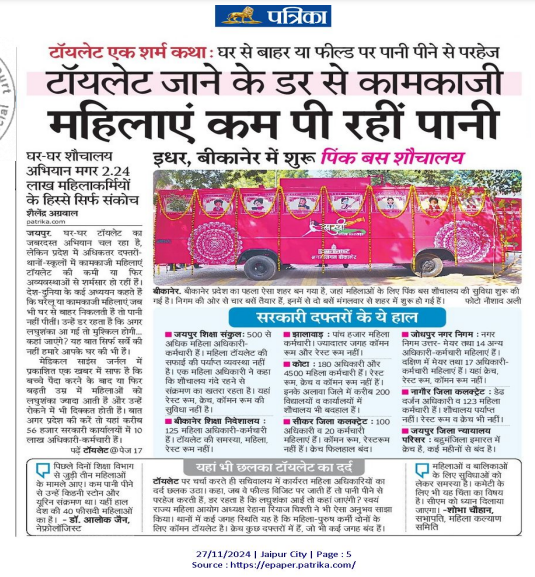
(C) Public Interest Litigation - The Court takes cognizance of a newspaper report regarding the lack of toilet facilities for working women, treating it as a suo motu PIL to address the issue. (Paras 14, 15)
ORDER :
(Anoop Kumar Dhand, J.)
1. Verse 3.56 of Manusmriti says:-
“yatra naryastu pujyante ramante tatra devata? yatraitastu na pujyante sarvastatraphala kriya ”
(Means: Where women are given due respect, even Gods like to reside there.)
2. The Right to Dignity and Decency ensure that every women is treated with respect and honour. This right protects women from any kind of harassment, abuse or violence that undermine their dignity. It is vital to create an environment where women can live and work without fear of discrimination and degradation.
3. Every women should live a life of respect, equality and decency, free from any kind of fear, force, violence and discrimination. According to Article 21 of the Constitution of India, every citizen, including women is entitled to the right to life and dignity.
4. Women are the backbone for any progressive nation. Ancient literature like Vedas, Brahmana, Upanishad, Grihya Sutra, Dharmasastra and Epics, Smritis and Puranas have placed women with utmost respect and integrity. Earlier civilization evidence emphasised the status of women were at par with the men. In long-standing history of India, women always catered key role in the history of mankind.
5. In the era of globalization, when the civilization has reached into the 21st century and the status of women is still being defined by patriarchy society, the women are still fighting and finding to have a place in the society. There are various road-blocks that women, still in modern times, do face on daily basis these includes poor health, lack of washrooms and unhygienic environment in public and working places.
6. In spite of having several schemes, the Central as well as the State Governments have failed to discharge their duties in providing better facilities of building public toilets and distribution of sanitary napkins to the women, walking on the streets and working at their workplaces.
7. Lack of facilities, i.e., toilets for women, which is a basic necessity, can lead to several health issues to women.
8. Due to lack of toilet facilities for women or where toilets exist, but they lack in cleanliness, sanitation and hygiene, women tend to ‘hold on’ and defer urination until they can find a clean public toilet or till they reach home. Infact, at times, women do not drink water, when required to step out, with the fear that she may not have access to a clean and safe toilet. Medical science has shown that urinary tract infections, problems of distended bladders, and a range of other uro-gynocological problems are a consequence of deferring urination. For example, the chances of toxic shock from internal sanitary protection is increased, if there are no toilets available to change sanitary napkins/tampons when women are away from home. The long term effects of controlling the bladder is a matter which is medically recognized all over the world.
9. It is pertinent to note, that various studies and research have been conducted all over the world with respect to the issue in hand and all have emphasized the need for public toilets for women. The problems faced by women walking on the streets vis-a-vis toilets are universal. Public toilets used by women have to be user-friendly, sustainable, safe, clean, hygienic and children/senior citizens/disabled friendly. Toilet issues affect all ‘users’, but more particularly women, who comprise approximately 50% of the population. Men in general, have twice as much provision compared to women, as they have urinals, closets and a greater number of gents toilet blocks overall. The necessity for women to visit toilets is more and for a greater range of reasons, essentially because of biological differences. Women when they are out on the streets during the day, in connection with work, for shopping, or for carrying out other essential tasks, may find themselves without the benefit of a convenient place to visit a washroom/rest room/toilet, when they need ‘to go’ while away from home. The facilities as are
AI
The right to clean and safe public toilets for women is essential for dignity and health, recognized under Article 21 of the Constitution.


Access to proper sanitation is a fundamental right under Article 21, requiring the State to provide and maintain adequate toilet facilities in judicial premises for all genders.


Municipal corporations obligated to provide adequate toilet facilities and maintenance in slums on public land as fundamental right under Articles 14 and 21, irrespective of encroachments or partial ....


Municipality - Citizens are entitled to enjoy a clean and healthy environment both in buildings and in open, which is a right emanating from Article 21 of the Constitution of India dealing with the p....
The court affirmed the fundamental rights of nursing mothers and infants, mandating the establishment of breastfeeding facilities in public spaces to ensure dignity and privacy.



An indispensable Tool for Legal Professionals, Endorsed by Various High Court and Judicial Officers
Please visit our Training & Support
Center or Contact Us for assistance

Scan Me!
India’s Legal research and Law Firm App, Download now!


For Daily Legal Updates, Join us on :



 Back to top


