
 Back
Back





IN THE HIGH COURT OF JUDICATURE FOR RAJASTHAN AT JAIPUR
NARENDRA SINGH DHADDHA, J.
Gayatri Sharma W/o Shri Bhagwan Sahai - Appellant
Versus
Deen Dayal Tiwari S/o Late Shri Gopal Sahai - Respondent
S.B. Civil First Appeal Nos. 705, 710 of 2012
Decided On : 21-04-2025
(A) Civil Procedure Code, 1908 - Section 54 - Rajasthan Tenancy Act - Partition of ancestral property - The trial Court erred in ruling that civil Court lacked jurisdiction over agricultural land, failing to adjudicate on the shares of the parties - The legal heirs of Deen Dayal are entitled to 1/5th share in the property. (Paras 1, 2, 4, 5)
(B) Jurisdiction - The trial Court must decide on shares regarding agricultural land as part of a composite suit, as per the applicable tenancy laws. (Paras 4, 5)
Facts of the case:
The plaintiff filed a suit for partition and permanent injunction concerning ancestral property, claiming a 1/6th share, while defendants contested based on customary adoptions and prior agreements. (Paras 1, 2)
Findings of Court:
The trial Court's decision was modified to reflect that the legal heirs of Deen Dayal are entitled to 1/5th share in the property, and the matter is to be sent for partition to the District Collector. (Paras 5, 6)
Issues: The main issues included the jurisdiction of the civil court over agricultural land and the determination of shares among the legal heirs. (Paras 4, 5)
Ratio Decidendi: The court held that the trial Court should have adjudicated on the shares of the parties regarding agricultural land, emphasizing the necessity of following the Rajasthan Tenancy Act. (Paras 5, 6)
Result: Appeals partly allowed.
JUDGMENT :
1. With the consent of learned counsel for the parties, the appeals are being decided by this common judgment.
2. These appeals arise out of the judgment and decree dated 12.10.2012 passed by Additional District Judge No.7, Jaipur Metropolitan, Jaipur (for short ‘the trial Court’) in civil suit No. 68/2006 (56/2006), whereby the suit filed by the plaintiff-Smt. Gayatri Devi (for short ‘the plaintiff’) for partition as well as permanent injunction was partly allowed in her favour and preliminary decree was passed.
3. Brief facts of the case are that the eldest daughter of Deen Dayal i.e. Smt. Gayatri Sharma filed a civil suit for partition and permanent injunction against the defendants about the ancestral property. The pedigree is showing the relationship of parties in para No. 1 of the plaint. It was further mentioned in the para 2 of the plaint that the properties left by plaintiff’s grand father Late Shri Gopal Sahai son of Shri Raghu Nath Sahai were joint immovable properties situated in heart of Jaipur City Chokri i.e. Nohra House Muncipal No.1766 Vishvesharji Sauthli Walon Ka Rasta, inside Deewan Bhagchandra Ki Gali, Chaura Rasta, Jaipur and agricultural land situated in Tehsil-Sanganer, Village Mahal Patwar Jagatpura, Jaipur bearing old khasra No. 82 & new khasra No. 454 admeasuring 0.20 hectare, khasra No. 455 admeasuring 3.01 hectare, khasra No. 456 admeasuring 0.01 hectare Gair Mumkin Chah, Khasra No. 457 admeasuring 3.36 hectare total admeasuring 6.58 hectare. It was also mentioned that said property was undivided and the plaintiff was having 1/6th share therein.
4. Defendant Nos. 1 and 2 had filed joint written statement and defendant No. 3 filed separate written statement and mentioned father and brothers of the plaintiff alleged their rights based therein on the customary adoptions, Will and mutation. It was also mentioned that they have sold the property by way of one agreement in favour of defendant No. 8 i.e. Hasanpura Grah Nirman Sahkari Samiti. Prior to this suit, disputed property was mutually partitioned. Plaintiff received the amount of her share at the time of marriage, so, she had no right to file the present suit.
5. Defendant No. 8 also filed written statement and mentioned that Hasanpura Samiti had purchased the property by way of one agreement and allotted the plot to their members and gave possession to them also. It was also mentioned that present suit is related to agricultural land. So, civil court had no jurisdiction to try it.
6. Defendant Nos. 4 and 5 also filed their written statement and claimed 1/6th share alongwith plaintiff in the disputed property.
7. On the basis of the pleadings of the parties, the trial Court framed following issues:-
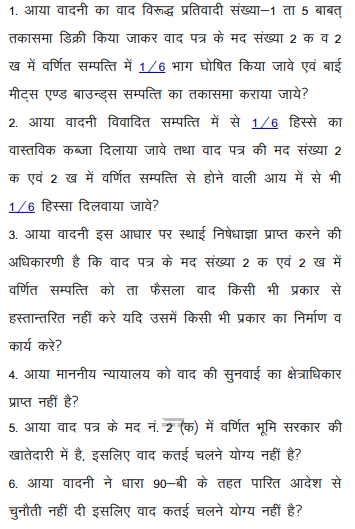
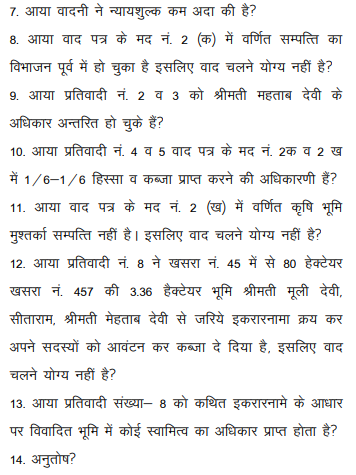
9. Learned Sr. counsel for the appellants as well as learned counsel for the respondents further submits that as per the Section 54 of the Civil Procedure Code, 1908 as well as the Rajasthan Tenancy Act and other tenancies Law, the trial Court had to draw the preliminary decree with regard to agricultural land and direct the District Collector or any other Gazetted officer subordinate to District Collector who may be
The trial Court erred in ruling that it lacked jurisdiction over agricultural land, necessitating a determination of shares among legal heirs as per the Rajasthan Tenancy Act.

Civil courts have jurisdiction to adjudicate partition of agricultural land when no tenancy dispute exists, as per Section 242(1) of the Rajasthan Tenancy Act, 1955.
A clerical error in a decree's operative portion does not invalidate a judgment if substantive issues are resolved, and prior partition must be proven by the defendants.

The main legal point established in the judgment is the interpretation and application of the provisions of the Punjab Land Revenue Act, 1887, specifically regarding the jurisdiction of the civil cou....


The purchase of a specified portion of land in an un-partitioned area results in co-ownership, and jurisdiction for partition lies with both Revenue Authorities and Civil Courts depending on land typ....

The jurisdiction of Civil Courts is fundamental and must be specifically addressed; failure to do so vitiates the judgments.



An indispensable Tool for Legal Professionals, Endorsed by Various High Court and Judicial Officers
Please visit our Training & Support
Center or Contact Us for assistance

Scan Me!
India’s Legal research and Law Firm App, Download now!


For Daily Legal Updates, Join us on :



 Back to top


