
 Back
Back





HIGH COURT OF RAJASTHAN (JODHPUR BENCH)
MR. JUSTICE VINIT KUMAR MATHUR, J
Lrs. of Late Sanwarmal - Appellant
Versus
Smt. Seeta Devi - Respondent
CW / 19263 / 2024
Decided On : 10-02-2025
(A) Rajasthan Tenancy Act, 1955 - Section 242(1) - Writ petition against order dismissing application to refer agricultural land partition issue to revenue court - Civil court retains jurisdiction to decide partition where no tenancy dispute exists - Previous judgments cited by petitioners distinguished based on differing circumstances. (Paras 1, 4, 5, 6, 7)
(B) Jurisdiction of Civil Courts - Civil courts can adjudicate partition of agricultural land when no tenancy rights are in dispute - Referral to revenue court only applicable when tenancy rights are contested. (Paras 6, 7)
Facts of the case:
The writ petition challenges the dismissal of an application to refer a partition issue of agricultural land to the revenue court, asserting that the civil court has jurisdiction as no tenancy dispute exists.
Findings of Court:
The court found that the civil court has jurisdiction to decide the partition issue as there is no tenancy dispute, affirming the trial court's order.
Issues: The main issues were whether the civil court had jurisdiction to decide the partition of agricultural land and the applicability of previous judgments cited by the petitioners.
Ratio Decidendi: The court ruled that civil courts can adjudicate partition matters when no tenancy rights are in dispute, emphasizing that referral to revenue courts is only warranted when tenancy issues arise.
Result: Writ petition dismissed.
Order :
1.Heard learned counsel for the parties.
2. The present writ petition has been filed against the order dated 24.10.2024 passed by Additional District Judge No.6, Jodhpur Metropolitan, Jodhpur in Original Civil Suit No.51/2013 (N.C.V. No.14935/2014) titled as “Sita Devi V/s Sanwarmal” whereby the application preferred by late Sanwarmal Sharma for referring the matter to the revenue court on the issues framed on the agricultural land has been dismissed.
3. Learned counsel for the petitioners submits that plaintiffs preferred a suit seeking decree of partition, which is pending consideration before the Civil Court. He submits that as per the issues framed by the learned trial court, one of the issues pertains to the partition of the land, which is agriculture in nature. Learned counsel submits that the issue with respect to the partition of agriculture land is required to be sent to the revenue court for its adjudication. To buttress his contention, learned counsel for the petitioners has relied upon the judgment dated 16.02.2015 passed by a Coordinate Bench of this Court in S.B.Civil Writ Petition No.2866/2014 (Modu Ram V/s Board of Revenue & Ors.) and judgment dated 03.12.2024 passed by a coordinate bench of this court in S.B.Civil First Appeal No.673.2024 ( Sua Lal V/s Kanhi & Ors.). The learned trial Court has committed an error while rejecting the application preferred by the petitioners. He, therefore, prays that the writ petition filed by the petitioners may be allowed and the order dated 24.10.2024 may be quashed and set aside.
4. Per contra, learned counsel for the respondents submits that there is no dispute with respect to the nature of the land, rather a suit seeking a decree of partition simplicitor has been filed. He submits that there is no tenancy dispute between the parties, therefore, the matter may not be referred to the revenue court for deciding the issue seeking a decree of partition of an agricultural land and therefore, the learned trial court has not committed any illegality, infirmity and jurisdictional error while passing the order dated 24.10.2024. He prays that no interference is warranted in the order passed by the learned trial court, therefore, the writ petition filed by the petitioners may be dismissed.
5. I have considered the submissions made at the bar and also gone through the relevant record of the case including the order dated 24.10.2024 passed by the trial court.
6. It will be useful to reproduce Section 242(1) of the Rajasthan Tenancy Act, 1955 as under :-
“242. Procedure when plea of tenancy rights raised in Civil Courts-
(1) If in any suit relating to agricultural land instituted in a civil court, any question regarding tenancy rights arises and such question- has not previously been determined by a revenue court of competent jurisdiction, the civil court shall frame an issue on the plea of tenancy and record to the appropriate revenue court for the decision of that issue only.
Explanation- A plea of tenancy which is clearly untenable and intended solvely to post the jurisdiction of the civil court shall not be deemed to raise a plea of tenancy”.
(emphasis supplied)
7. This court also deems it appropriate to quote the issues framed by learned trial court vide order dated 15.09.2016 in the suit instituted by the plaintiffs-respondents, which reads as under:-
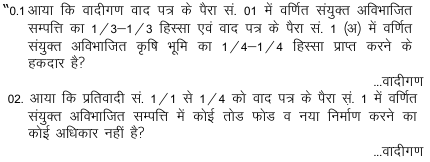
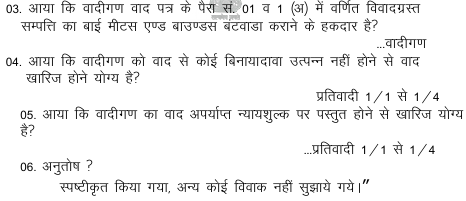
8.The admitted facts in the present case are that the parties have some dispute with regard to partition of the properties in question. It is also an admitted position that one of the properties is an agricultural land for which an issue has been framed by the trial court and the issue No.1 includes urban land as well as agricultural land too for which partition has been sought for.
9. It is a settled law that civil court is having jurisdiction to decide the question of partition of the properties where no revenue dispute is involved. In the present case, since the issues framed do not reflect any dispute with regard to the tenancy of the
Civil courts have jurisdiction to adjudicate partition of agricultural land when no tenancy dispute exists, as per Section 242(1) of the Rajasthan Tenancy Act, 1955.

The trial Court erred in ruling that it lacked jurisdiction over agricultural land, necessitating a determination of shares among legal heirs as per the Rajasthan Tenancy Act.

The main legal point established in the judgment is the interpretation and application of the provisions of the Punjab Land Revenue Act, 1887, specifically regarding the jurisdiction of the civil cou....


Civil courts lack jurisdiction to challenge partition proceedings by revenue authorities unless a question of title arises or jurisdictional defects are alleged, as prescribed by Section 171 of the H....

A clerical error in a decree's operative portion does not invalidate a judgment if substantive issues are resolved, and prior partition must be proven by the defendants.
A Civil Court can entertain a partition suit despite the land being recorded as agricultural if the actual use has changed to residential, emphasizing that technicalities should not impede substantia....
Civil Courts cannot adjudicate matters concerning partition as per H.P. Land Revenue Act, Section 171, which restricts jurisdiction in partition disputes, asserting that remedy lies within revenue au....



An indispensable Tool for Legal Professionals, Endorsed by Various High Court and Judicial Officers
Please visit our Training & Support
Center or Contact Us for assistance

Scan Me!
India’s Legal research and Law Firm App, Download now!


For Daily Legal Updates, Join us on :



 Back to top


