
 Back
Back





IN THE HIGH COURT OF JUDICATURE FOR RAJASTHAN AT JODHPUR
MANOJ KUMAR GARG, RAVI CHIRANIA, JJ.
State of Rajasthan - Appellant
Versus
Ramlal son of Shri Baldas - Respondent
D.B. Criminal Appeal No. 61/1999
Decided on : 08-08-2025
| Table of Content |
|---|
| 1. appellate court's grounds for appeal. (Para 1 , 2 , 9 , 10) |
| 2. key facts and dying declarations introduced. (Para 3 , 6 , 8) |
| 3. legal standards for dying declarations established. (Para 5 , 21 , 22) |
| 4. inconsistencies in witness statements impact credibility. (Para 12 , 20) |
| 5. final dismissal of the appeal affirming acquittal. (Para 25 , 26) |
ORDER :
RAVI CHIRANIA, J
1. The State has filed this Criminal Appeal under section 378 (iii) & (i) of Cr.P.C. against the judgment dated 06.07.1998 passed by Shri Mahendra Maheshwari, R.H.J.S., Additional District and Sessions Judge, Parbatsar (Rajasthan) in Session Case No. 28/98 (old number 25/95) whereby the sole accused respondent was acquitted. The State has file the present Criminal Appeal on the following grounds:
“i) That learned trial court has gravely erred in law as well as in facts while acquitting the accused-respondent by giving him benefit of doubt and the impugned judgment is quite illegal, invalid, manifestly erroneous, contrary to the provisions of law and perverse to the material on record which deserves to be quashed and set aside.
ii) That the learned trial court has gravely erred in law as well as in facts in disbelieving the prosecution evidence without any cogent reason which has resulted into grave miscarriage of justice and under these circumstances the impugned judgment deserves to be quashed and set aside.
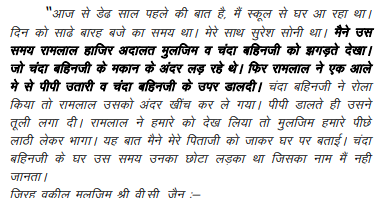
iii) That the learned trial court has not considered the dying declaration of the deceased Chanda Soni which was recorded during the treatment on the police request by the Civil Judge (J.D.) No.7 on dated 11-4-95 in the S.M.S. Hospital. She in her dying declaration has stated that the accusedRam Lal Swami burned her at about 2 O'clock on 31-3-95. It was further stated that the accused-respondent told her that the house has been built by him and has not been transferred to you and threatened her to remove from the house and started abusing. On preventing him from abusing the accused put kerosene over her body and lit the fire and when she cried he carried her inside and poured water over her. It was also stated by her that at the time of her earlier statements she did not take name of the accused due to the reason that the accused threatened him, whereas his husband never quarrels with her. Thus, the learned trial court has not appreciated the dying declaration in right perspective and has ignored the same without giving any cogent reason.
iv) That the learned trial court has not properly considered the statements of prosecution witness Rahul who is minor children of deceased also told that his mother was closed in the room after bruning her. Moreover, p.w.7 has also corroborated the prosecution case but the learned trial court has discarded the statements of prosecution witnesses merely on the basis of surmises and conjectures.
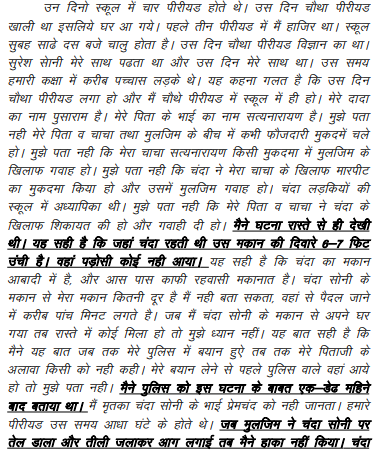
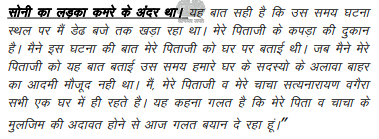
v) That the learned trial court has not considered this aspect of the matter that the presence of the accused-respondent at the spot is very much proved on the record. Thus, there is no reason to take a contradictory view in acquitting the accused- respondent. Moreover, the medical exami-nation of Ram Lal was made after 15 days from the date of incident in support of his contention that the hands were burnt at the time of saving decea-sed, whereas there is no reason to believe on the medical report produced by the accused-respondent. The Dr. Kamal Bajaj has also stated in his statements that the medical examination was made after 15 to 16 days from the date of incident and therefore the medical report is not believable. Under these circumstances, there was no reason for the learned trial court to ignore the dying declaration of the deceased which is against the settled proposition of law laid down by Hon'ble Supreme Court of India reported in 1997 Criminal Law Reporter page 134, 157. Thus, the learned trial court has not applied its judicious mind while acquitting the accused-respondent by giving him benefit of doubt.
vi) That fur
AI
The appellate court emphasizes that reversal of acquittal requires compelling evidence of error in the trial court's judgment has been proved beyond reasonable doubt.

In cases of multiple dying declarations, inconsistencies necessitate corroboration for conviction; the earliest declaration indicating self-immolation was preferred, creating reasonable doubt about t....

A conviction based on inconsistent dying declarations is unsafe without corroborative evidence; discrepancies create reasonable doubt undermining the prosecution's case.


The prosecution must prove guilt beyond reasonable doubt, and inconsistencies in dying declarations can lead to acquittal.

The prosecution must prove guilt beyond reasonable doubt, and acquittals should not be interfered with unless found to be perverse or unsupported by evidence.

Dying declaration – In cases where Court finds that there exist more than one dying declarations, each one of them must be examined with care and caution and only after satisfying itself as to which ....

(1) Dying declaration while carrying presumption of being true must be wholly reliable and inspire confidence – Where there is any suspicion over veracity of same or evidence on record shows that dyi....

Dying declarations can serve as the sole basis for conviction if they are consistent and credible; however, inconsistencies and lack of corroborative evidence can lead to reasonable doubt and acquitt....



An indispensable Tool for Legal Professionals, Endorsed by Various High Court and Judicial Officers
Please visit our Training & Support
Center or Contact Us for assistance

Scan Me!
India’s Legal research and Law Firm App, Download now!


For Daily Legal Updates, Join us on :



 Back to top


