
 Back
Back





HIGH COURT OF JUDICATURE FOR RAJASTHAN BENCH AT JAIPUR
GANESH RAM MEENA, J.
The Superintendent of Police, Jaipur City, Jaipur - Appellant
Versus
Jai Lal Bairwa S/o Shri Ramji Lal - Respondent
S.B. Civil Second Appeal No. 32 Of 2003
Decided On : 08-07-2025
| Table of Content |
|---|
| 1. factual background of the case. (Para 1 , 2) |
| 2. trial court findings and decisions. (Para 3 , 4 , 5) |
| 3. arguments of the appellants and respondents. (Para 8 , 9) |
| 4. legal reasoning regarding natural justice. (Para 20 , 21) |
| 5. employment law on probationary dismissal. (Para 23 , 24 , 25) |
| 6. conclusion and order of dismissal. (Para 26 , 27 , 28 , 29) |
JUDGMENT :
GANESH RAM MEENA, J.
1. The present second appeal arises out of the judgment and decree dated 25.01.2001 passed by the Court of learned Additional District Judge, Bandikui, District Dausa (for short ‘the Appellate Court’) in Regular Civil Appeal No. 07/2000, whereby the learned Appellate Court while dismissing the appeal filed by the appellants/defendants affirmed the judgment dated 24.02.2000 and decree dated 29.03.2000 passed by the Court of learned Civil Judge (Junior Division), Bandikui (Dausa) [for short ‘the trial court’] in Civil Case No. 55/91 (19/95).
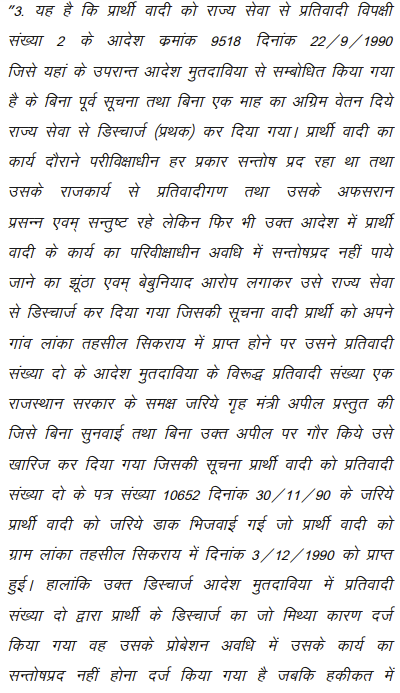
2. Brief facts of the case are that the respondent/plaintiff filed a suit before the trial court under Order 33 Rules 1 and 2 CPC in the year 1991, seeking declaration, permanent injunction, and consequential relief. It was the case of the respondent/plaintiff that he was appointed as a Constable in the Police Department under the Scheduled Caste quota by order dated 05.06.1990 in Jaipur District. He was assigned Belt No. 759 and placed on probation for two years with a monthly salary of Rs. 1305/-.
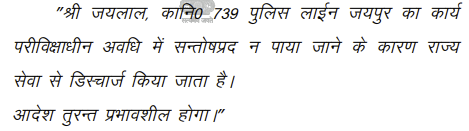
The plaintiff-respondent alleged that his services were abruptly terminated during the probation period vide order dated 22.09.1990, by the Superintendent of Police, Jaipur City, on the ground of unsatisfactory performance during the probation period. The respondent/plaintiff claimed in the suit that the discharge order was illegal, arbitrary, and passed without affording any opportunity of hearing, thereby violating the principles of natural justice because there is nothing on the record that his services were not satisfactory during the probation period
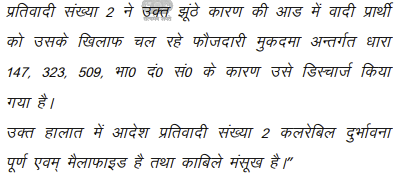
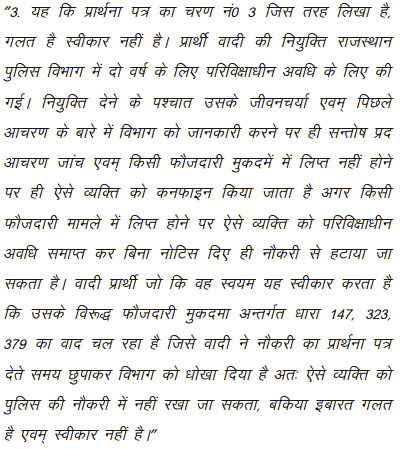
The appellants/defendants in their written statement filed through the Officer-in-Charge on 16.03.1992, opposed the suit. It was specifically contended that the respondent/plaintiff had suppressed the material information at the time of his appointment, namely, that he was facing trial in a criminal case under Sections 147 , 148, and 379 IPC before the Additional Munsif and Judicial Magistrate, Bandikui. This fact was deliberately omitted by the respondent/plaintiff in Columns No. 8 and 9 of the application form, which required disclosure of any involvement in civil or criminal proceedings.
3. On the basis of pleadings of the parties, following issues were framed by the trial court:-
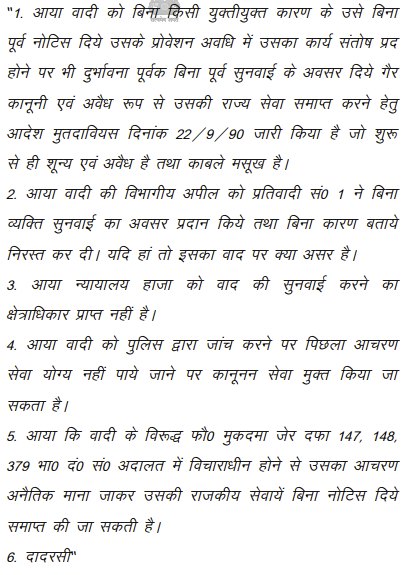
4. During the course of the trial, evidence was led by both parties and arguments were heard. The trial court decided issues No. 1 and 2 in favour of the respondent/plaintiff and against the appellants/defendants. The trial court held that the order of discharge dated 22.09.1990 was passed without affording any opportunity of hearing to the respondent/plaintiff and thereby suffers from illegality on the grounds of breach of principles of natural justice. The trial court declared the order of discharge as a nullity and decreed the suit in favour of the respondent/plaintiff, directing reinstatement with continuity of service, arrears of full back wages, allowances, and entitlement to seniority and promotion.
5. The appellants/ defendants aggrieved with the impugned judgment and decree passed by the trial court preferred first appeal before the Appellate Court. The Appellate Court vide its judgment dated 25.01.2001 dismissed the appeal filed by the appellants/ defendants and affirmed the judgment and decree passed by the trial court.
6. Being aggrieved by the judgment and decree passed by the trial court and so also the judgment of the Appellate Court whereby the appeal filed by the appellants/defendants was dismissed, the appellants/ defendants have preferred the present second appeal.
7.
AI
The termination of a probationary employee requires adherence to principles of natural justice, particularly when allegations of misconduct are involved.


Probationary employees may be terminated for violating appointment terms, including misrepresenting criminal history, without requiring formal procedural safeguards.


Non-disclosure of juvenile criminal cases by candidates does not constitute concealment, and such grounds cannot invalidate employment.

Non-disclosure of a pending criminal case in employment applications must be evaluated against the nature of the charges and the context of acquittal, impacting the candidate's suitability for servic....

Pending criminal charges do not automatically disqualify an individual from government service; fair hearing and natural justice must be observed before termination.

Suppression of material information in job applications, even with subsequent acquittal, justifies termination of employment under temporary service rules, emphasizing the gravity of offenses involve....



An indispensable Tool for Legal Professionals, Endorsed by Various High Court and Judicial Officers
Please visit our Training & Support
Center or Contact Us for assistance

Scan Me!
India’s Legal research and Law Firm App, Download now!


For Daily Legal Updates, Join us on :



 Back to top


