Back
Back





2026 Supreme(Raj) 70
HIGH COURT OF JUDICATURE FOR RAJASTHAN AT JODHPUR
NUPUR BHATI, J.
Hasta Ram, S/o. Panna Ram – Petitioners
Versus
State Of Rajasthan, Through The Principal Secretary – Respondents
S.B. Civil Writ Petition No. 3185 Of 2026
Decided On : 12-02-2026
For the Petitioners: Mr. B.S. Tanwar
For the Respondents: Mr. Ravi Shankar.
Public employees with irregular but legal appointments, having served over ten years, must be regularized based on established principles of administrative law and rights under the Constitution.
Headnote:(A) Constitution of India - Article 226 - Regularization of services - Writ petition seeking directions for regularization of petitioners against vacant posts of Class IV employees held for over ten years, invoking Supreme Court's judgment in Bhola Nath Vs. State of Jharkhand & Ors. - Administrative inertia leading to denied justice - Doctrine of legitimate expectation related to Article 14 and Article 21 discussed. (Paras 17, 18, 19, 24, 25)
(B) Service Law - Regularization criteria established for employees with irregular appointments - Requirement for a Monitoring Committee formed to oversee implementation of judgments - Directions for transparency and accountability detailed. (Paras 25, 26)
Facts of the case:
The petitioners have held Class IV posts for over ten years but were not regularized, prompting the writ petition that contests this prolonged denial and argues that it constitutes institutional exploitation.
Findings of Court:
The State is bound to identify eligible petitioners for regularization and follow outlined procedures within set timelines to rectify administrative injustices.
Issues: The court addresses the criteria for regularization of employees, adherence to Supreme Court precedents, and the necessity for the government to act on longstanding claims of employees.
Ratio Decidendi: The Court emphasized that public employees' longstanding service should not be neglected due to bureaucratic failures, affirming that procedural adherence cannot override the imperative of substantive justice, as dictated by constitutional principles.
Result: Writ petition disposed of with binding directives for regularization of eligible petitioners' services and timely compliance by the State.
| Table of Content |
|---|
| 1. writ petition for service regularization. (Para 1) |
| 2. previous cases of identical nature discussed. (Para 2) |
| 3. disposal of writ petition and directions to respondents. (Para 3 , 4 , 5) |
ORDER :
NUPUR BHATI, J.
1. The present writ petition has been filed under Article 226 of the Constitution of India with the following prayers:
“xxxxxxxx
1. That the respondent may kindly be directed to regularize the services of the humble petitioners against the sanctioned vacant posts of Class IV employees (Cook/Guard) which they have been holding for more than ten years, in strict compliance with the law laid down by the Hon'ble Supreme Court in the case of Bhola Nath Vs. State of Jharkhand & Ors. (2026 INSC 99), with all consequential benefits.
2. Issue a writ, order, or direction to quash and set aside any verbal or written orders that may attempt to discontinue the petitioners' services during the pendency of this litigation, holding such actions as arbitrary and retaliatory.
xxxxxxxxx”
2. Counsel for the parties, at the outset, jointly submit that the Coordinate Bench of this Court took up the identical issue; wherein, petitioners who were appointed at various class III and IV posts, were not being regularized. They jointly submit that vide order dated 01.05.2025 passed in SBCWP No.12662/2013 : Sumera Ram v. State of Rajasthan & Ors., the Coordinate Bench had disposed of the writ petition in light of the judgment passed by the Coordinate Bench in SBCWP No.7603/2023 : Giriraj Prasad Sharma v. State of Rajasthan & Ors. Relevant extract of the said judgment is reproduced hereunder:
“CONCLUSION
17. To sum up, the constitutional ethos mandate not merely procedural fairness but substantive justice. In a welfare State, the prolonged denial of regularization despite continuous service for decades borders on institutional exploitation, which ought not to be countenanced. The delay in implementing the directions of the Constitution Bench in Uma Devi by over three years (from April 2006 to July 2009) is a gross administrative default. Penalizing employees for this governmental inaction would amount to travesty of justice. Let it be reiterated a failure to strictly follow procedure in an otherwise valid and sanctioned appointment does not render the appointment illegal. Blurring this distinction undermines the very spirit of Uma Devi and subsequent jurisprudence. The doctrine of legitimate expectation, well-recognized in administrative law, is clearly attracted. The petitioners, by virtue of decades of continuous service and recurring official assurances or circulars, had a legitimate expectation of being considered for regularization. A denial thereof not only defeats fairness but shakes trust in State's conduct. Apart there from, denial of regularization to persons who are similarly situated as those already regularized is a blatant infringement of the equality clause under Article 14, and continued exploitation of services without security undermines Article 21, which guarantees dignity of life.
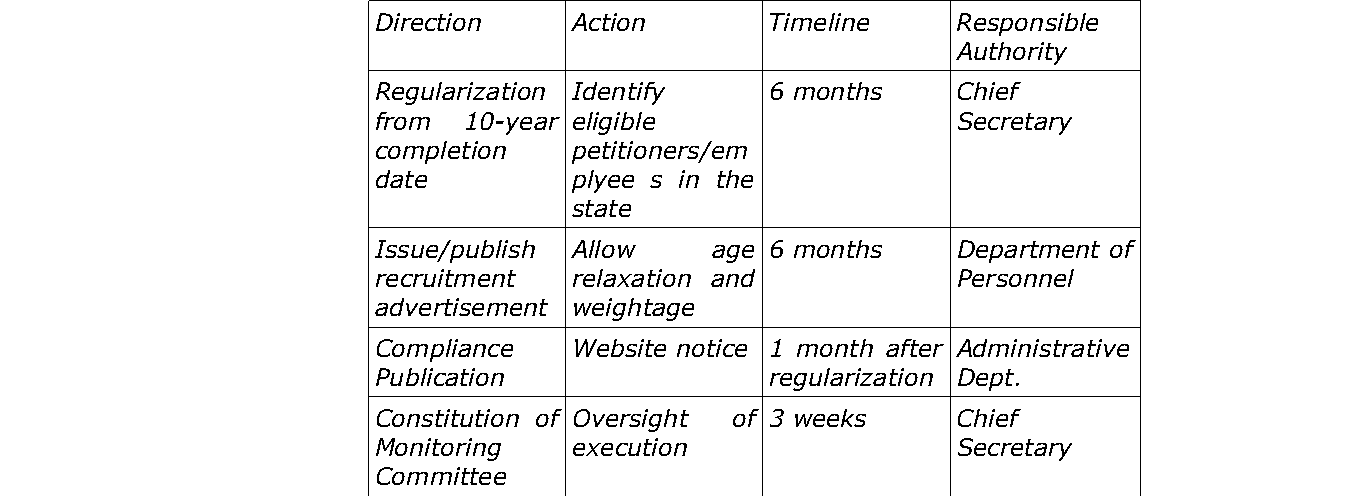
18.1. The State should, in fact, also constitute a Monitoring Committee to oversee compliance with this judgment. This exercise is not intended to create a precedent for future appointments through irregular means.
It is a one-time corrective measure arising from prolonged systemic inertia and continued service rendered by the petitioners. The repeated misuse of Uma Devi judgment to justify denial of justice to deserving employees reflects either a fundamental misunderstanding or a wilful subversion of judicial dicta. This Court cautions against such misuse in future and directs legal sensitization of departmental heads on the correct application of service law jurisprudence.
18.2. At the cost of repetition, it is clarified that the doctrine of legitimate expectation, read with the mandate of Articles 14 and 21, demands that employees who have rendered decades of loyal, uninterrupted service-not through backdoor entry but through sanctioned roles-must