
 Back
Back





HIGH COURT OF JUDICATURE FOR RAJASTHAN AT JODHPUR
NUPUR BHATI, J.
Chief Manager, Rajasthan State Road Transport Corporation - Petitioner
Versus
Ramswaroop Bhambhu, S/o Sh. Ramgopal - Respondent
S.B. Civil Writ Petition No. 6528 OF 2021
Decided On : 05-02-2026
| Table of Content |
|---|
| 1. background of the dispute over employee punishment. (Para 1 , 2) |
| 2. arguments regarding the validity of the labour court's decision. (Para 3 , 4 , 5 , 7 , 8 , 9 , 10) |
| 3. supreme court precedent on judicial review of punishments. (Para 6) |
| 4. court analysis on jurisdiction and standard of review. (Para 11 , 12 , 13 , 14 , 15 , 16 , 17) |
| 5. final conclusion quashing the labour court's award. (Para 18) |
JUDGMENT :
NUPUR BHATI, J.
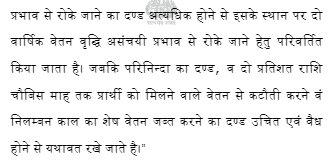
1. The petitioner has filed the present writ petition assailing the propriety, validity, and correctness of the Award dated 24.02.2020 (Annex.1) passed by the Labour Court, whereby the punishment imposed upon the respondent-workman of stoppage of two annual grade increments with cumulative effect was modified to non-cumulative effect, seeking following relief:-
“It is therefore, respectfully prayed that this writ petition may kindly be allowed and by an appropriate, writ order or direction the impugned order dt. 24.02.2020 Annex. I may kindly be declared illegal and be accordingly quashed and set aside.
Any other relief to which petitioners appears entitle to may kindly be also be passed in favour of the petitioner.”
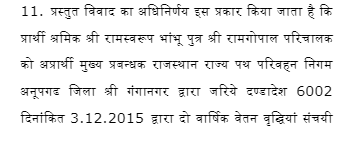
2. The facts giving rise to the dispute are that on 08.08.2014, while the respondent-workman was discharging his duties as a Conductor on the Sri Ganganagar to Raisinghnagar route, the bus was inspected by the inspection team upon its arrival at Chunavadh. During inspection, ten passengers were found travelling without tickets. A red remark was marked by the inspection team, whereafter the respondent-workman allegedly misled the passengers and abused and assaulted the members of the inspection team. A report was submitted to the competent authority, pursuant to which the respondent-workman was placed under suspension vide order dated 10.08.2014. Subsequently, a charge-sheet dated 20.08.2014 was issued, and after due proceedings, the respondent-workman was awarded the punishments of censure, stoppage of two annual grade increments with cumulative effect, deduction of 2% of salary for a period of 24 months, and forfeiture of the balance salary for the suspension period. Aggrieved thereby, the respondent-workman raised an industrial dispute. As the conciliation proceedings failed, a failure report was sent, and the appropriate Government, vide notification dated 25.01.2018, referred the dispute for adjudication, which ultimately culminated in the passing of the impugned Award.
3. Learned counsel for the petitioner submits that the impugned Award dated 24.02.2020 (Annex.1) passed by the Labour Court, Sri Ganganagar is ex-facie illegal, perverse, and without jurisdiction to the extent it modifies a lawful departmental punishment without assigning any cogent or legally sustainable reason. He further submits that the Labour Court itself has recorded a categorical finding that the disciplinary enquiry conducted by the Corporation was fair and proper, that proper opportunity of hearing was afforded to the workman, and further that the charges stood proved, including the serious misconduct of carrying 10 passengers without tickets and misbehaving with the inspection team, having upheld the enquiry and the findings of guilt, the Labour Court could not have interfered with the punishment unless it was shockingly disproportionate, which finding is completely absent in the impugned award.
4. Learned counsel further submits that the worker’s proven misconduct seriously breaks discipline and trust because, as a conductor who is handling public money, carrying passengers without tickets would cause financial loss to the corporation, and misbehaving physically with inspection staff makes the offence even more serious. He also submits that in service jurisprudence, the nature of the misconduct involved has consistently been held to warrant even the extreme penalty of dismissal from service; therefore, the disciplinary authority had already exercised considerable leniency by imposing only the punishment of
AI
The Labour Court cannot modify disciplinary punishment unless it is shockingly disproportionate to the established misconduct; failure to provide cogent reasons for modification renders the interfere....

A Labour Court's discretion to modify penalties under Section 11-A of the ID Act requires clear findings of disproportionate punishment or mitigating circumstances; mere length of service does not su....

The Labour Court must record subjective satisfaction regarding the proportionality of punishment before modifying a dismissal to a lesser penalty under the Industrial Disputes Act.

The main legal point established in the judgment is that the punishment imposed for misconduct must be commensurate with the seriousness of the breach of trust and financial irregularity. The court e....

The Labour Court's interference with the dismissal of an employee was unjustified as the dismissal was proportionate to the misconduct, despite the leave balance.


Judicial intervention in disciplinary actions must be based on legal standards, not compassion, especially when misconduct is proven.
Discretion under Section 11-A must be exercised judiciously; compassion cannot be the basis for modifying penalties in labor disputes involving misconduct.

The reviewing authority must provide adequate justification for enhancing punishment in disciplinary proceedings, adhering to principles of natural justice.



An indispensable Tool for Legal Professionals, Endorsed by Various High Court and Judicial Officers
Please visit our Training & Support
Center or Contact Us for assistance

Scan Me!
India’s Legal research and Law Firm App, Download now!


For Daily Legal Updates, Join us on :



 Back to top


