


 Back
Back





2025 Supreme(Raj) 2582
HIGH COURT OF JUDICATURE FOR RAJASTHAN AT JODHPUR
FARJAND ALI, J.
Mangi Lal S/o Ram Lal Jat – Appellant
Versus
State of Rajasthan – Respondent
S.B. Criminal Miscellaneous 2nd Bail Application No. 9543 of 2025, S.B. Criminal Miscellaneous 3rd Bail Application No. 6468 of 2025
Decided On : 28-10-2025
For the Appellants : Ashok Khillery, Mahipal Vishnoi
For the Respondent: N.S. Chandawat
Prolonged pre-trial detention without sufficient evidence undermines personal liberty and violates constitutional rights as guaranteed under Article 21.
Headnote:(A) Narcotic Drugs and Psychotropic Substances Act, 1985 - Sections 8 and 29 - Code of Criminal Procedure, 1973 - Section 439 - Bail applications - Accused in custody for extended periods without sufficient evidence - Lengthy pre-trial incarceration challenged - Court emphasizes right to a speedy trial under Article 21 of the Constitution - No substantive proof of involvement in the alleged offence presented by prosecution - Pre-trial detention held unconstitutional when no solid evidence exists (Paras 6.1, 6.2, 10).
(B) Bail under special enactments - Interpretation of Section 37 of the NDPS Act highlighted - Burden lies on prosecution to justify continued detention, especially in absence of evidence directly linking accused to contraband (Para 10).
(C) Personal liberty - Balance between individual rights and public interest - Extended detention without trial is punitive and not preventive, violating constitutional guarantees (Paras 6.3, 10).
Facts of the case:
Accused-petitioners were arrested based on the statement of a co-accused following a recovery of illegal opium, but no direct evidence of their involvement was found.
Findings of Court:
The court found the prolonged detention unwarranted due to insufficient evidence and a lack of progress in trial, ruling in favor of bail.
Issues: The questions included the adequacy of evidence for detention under the NDPS Act and the implications of delays in trial proceedings.
Ratio Decidendi: The court determined that the mere existence of charges without substantial evidence does not justify continued incarceration.
Result: Bail applications allowed.
| Table of Content |
|---|
| 1. bail application filed under section 439 crpc (Para 1 , 2) |
| 2. arguments for and against bail application (Para 3 , 4) |
| 3. court observations on evidence and detention (Para 5 , 6) |
| 4. principles of abetment and conspiracy under law (Para 7 , 10) |
| 5. implications of section 37 of ndps act on bail consideration (Para 8 , 9) |
| 6. bail granted to accused-petitioners (Para 11) |
ORDER :
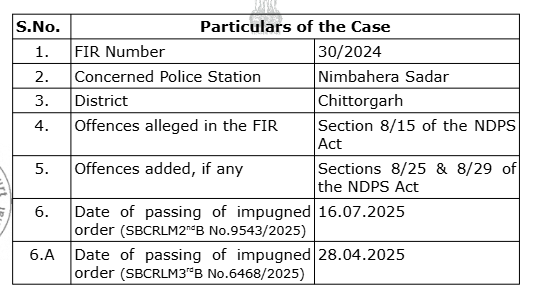
1. The jurisdiction of this court has been invoked by way of filing the instant bail applications under Section 439 CrPC at the instance of accused-petitioners. The requisite details of the matter are tabulated herein-below:
2. Briefly stated the case of the prosecution is that on 25.01.2024, the Station House Officer, Sadar Nimbahera, along with the police team, while conducting naka-bandi at Ahirpura border, intercepted a truck bearing registration No.HR-38-Z1117 coming from Neemuch. The said truck was being driven by Mukesh Garg. Upon conducting a lawful search of the vehicle in his presence, a total of 187 plastic bags containing approximately 36 quintals, 56 kilograms, and 200 grams of illegal opium (Doda Chura) were recovered.
2.1. During the course of investigation, it was revealed that the present accused, Mangilal and Bhura Lal were actively involved in the illegal purchase, sale, and trafficking of the aforesaid contraband. Consequently, on the basis of material collected during investigation, an offence under Sections 8 /29 of the NDPS Act was found established against them, and a charge-sheet was accordingly filed before the competent court.
3. It is contended on behalf of the accused-petitioners that they are arrested since 10.02.2024 & 30.01.2024 on the basis of statement of co-accused, however they were not present at the spot thus, no case for the alleged offences is made out against them and their incarceration is not warranted. There are no factors at play in the case at hand that may work against grant of bail to the accused-petitioners and they have been made an accused based on conjectures and surmises.
4. Contrary to the submissions of learned counsel for the petitioner, learned Public Prosecutor opposes the bail application and submits that the present case is not fit for enlargement of accused on bail.
5. Have considered the submissions made by both the parties and have perused the material available on record.
6. Upon a meticulous scrutiny of the record, it transpires that the petitioners have been under incarceration since 2024. Their implication in the present case rests solely upon the statement of a co-accused, which, in the absence of any independent corroborative material, constitutes a weak and tenuous piece of evidence. It is significant to note that the petitioners were neither apprehended at the scene of occurrence nor has any incriminating recovery been effected from their conscious possession. Consequently, the allegation of their complicity in the alleged transportation of contraband appears to be founded merely on conjecture and unsubstantiated assertion, devoid of any cogent evidentiary basis.
6.1 The Court further observes that despite the considerable lapse of time, the trial has witnessed minimal progress. Though charges have been framed and proceedings have formally commenced, out of a total of twenty-seven witnesses cited by the prosecution, only one witness has been examined till date. In such circumstances, the petitioners’ continued detention partakes the character of punitive pre-trial incarceration rather than preventive custody, which stands proscribed in law. The Hon’ble Supreme Court has consistently underscored that the right to a speedy trial is an integral facet of the guarantee of life and personal liberty enshrined under Article 21 of the Constitution of India ( Hussainara Khatoon v. State of Bihar , AIR 1979 SC 1369 ; Kadra Pahadiya v. State of Bihar , 1981 Supp SCC 308; Satender Kumar Antil v. CBI , (2022) 10 SCC 51 ). Prolonged incarceration without tangible progress in trial militates












