
 Back
Back





HIGH COURT OF JUDICATURE FOR RAJASTHAN AT JODHPUR
FARJAND ALI, J.
Fula Ram S/o Ganga Ram (Since Died) – Appellant
Versus
State of Rajasthan – Respondent
S.B. Criminal Appeal No. 366 of 1993
Decided On : 15-10-2025
JUDGMENT :
FARJAND ALI, J.
1. This appeal has been preferred by the appellants under Section 374 (2) of the Code of Criminal Procedure against the judgment dated 13.08.1993 passed by the learned Additional Sessions Judge, Nohar in Sessions Case No. 64/1992, whereby the appellants were convicted and sentenced as under:
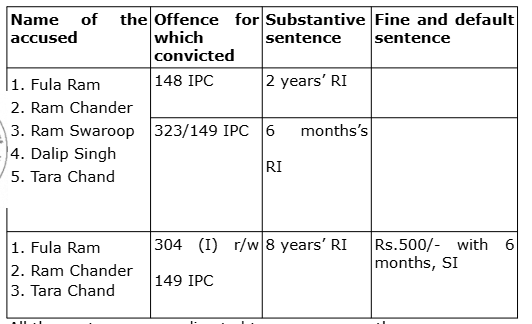
All the sentences were directed to run concurrently.
2. Briefly stated the factual canvas delineates that there had been longstanding enmity between the accused persons namely Fularam, Ram Chandra, Dalip Singh, Tara Chand, Baluram, and Subhash, and the prosecution party comprising Kashiram (since deceased), Singaram, and their family members. This animosity had been simmering for nearly a month preceding the incident.
2.1. On 11.09.1992, accused Fularam allegedly hurled abuses at the prosecution side repeatedly during the day, heightening the tension. On the following morning, i.e., 12.09.1992, at about 9:00 a.m., Fularam went to the house of Singaram and again indulged in filthy abuses. When Smt. Reshma, wife of Singaram, objected, the accused struck her with a lathi, injuring her finger. The complainant, Laxmi Narayan, was present at that time.
2.2. Singaram then proceeded to the agricultural field to inform his relatives Kashiram, Ramkrishan, and Shankarlal about the episode. While returning, as the group reached near the residence of accused Ram Chandra, several accused persons including Fularam, Ram Chandra, Dalip Singh, Tara Chand, Baluram, and Subhash suddenly emerged from the house, armed with lathis, while Baluram held a firearm.
2.3. They collectively shouted that Kashiram “must be eliminated.” Immediately thereafter, accused Fularam delivered a lathi blow on Kashiram’s head, followed by another blow from Ram Chandra. Kashiram fell to the ground bleeding profusely and later succumbed to the injuries. When the complainant and others attempted to intervene, accused Dalip Singh struck Laxmi Narayan on the head, while Baluram fired his gun, injuring Laxmi Narayan’s finger.
2.4. The injured were taken to the Government Hospital, Bhadra, where the SHO, Shri Virendra Kumar, recorded the parcha bayan of Laxmi Narayan and registered FIR No. 111/1992 under Sections 307 , 452, 147, 148, 149, 341, and 323 IPC . Upon completion of investigation and submission of the charge sheet, the case was committed to the Court of Session. The trial culminated in the conviction and sentence as detailed above.
2.5. During the pendency of the appeal, it was brought to the notice of this Court that appellants Fularam and Ram Chandra had expired. Their respective death certificates were placed on record, and vide order dated 06.10.2016, the appeal against them stood dismissed as abated. The present appeal thus survives only in respect of appellants Ram Swaroop, Dalip Singh, and Tara Chand.
3. Heard learned counsel for the appellants and the learned Public Prosecutor. Perused the record with anxious consideration.
3.1. Upon a careful evaluation of the evidence on record, it emerges that the prosecution case primarily rests on ocular testimonies coupled with medical evidence. The post-mortem report (Ex.P/10) reveals that the deceased Kashiram sustained two stitched wounds one on the occipital region and another on the parietal region of the skull with no other external or internal injuries except corresponding bony fractures beneath the wounds. The medical evidence thus corroborates that the total blows were only two in number, clearly attributable to Fularam and Ram Chandra.
3.2. The learned trial court has itself recorded an unambiguous finding that the fatal injuries to the deceased Kashiram were caused by the two now-deceased accused. Consequently, the appeal against them has abated in accordance with law. The surviving appellants Ram Swaroop, Dalip Singh, and Tara Chand have not been assigned any specific role in causing the injuries, nor has it been established that they were armed with deadly weapons at the relevant time. While the pros
AI
Prosecution must establish shared common object and active participation of accused in unlawful assembly for conviction under IPC; mere presence is insufficient.


The court affirmed the conviction of the appellants under sections 147, 148, 149/307, and 149/302 IPC, establishing that they formed an unlawful assembly with a common object to cause harm, leading t....

Membership in an unlawful assembly under Section 149 IPC establishes vicarious liability for actions taken by any member in furtherance of the assembly's common objective.

The prosecution must establish a common object for unlawful assembly under Section 149 IPC; absence of motive and specific allegations can lead to acquittal.
The main legal point established in the judgment is the application of Section 149 IPC to determine the common object of the unlawful assembly and the vicarious liability of the accused, as well as t....

Point of Law : Unlawful assembly – Common object - No doubt section 149 IPC is wide in its sweep but in fixing the membership of the unlawful assembly and in inferring the common object various circu....

The court affirmed the conviction under Sections 302 and 307 IPC, emphasizing the credibility of eyewitnesses and the common object of the accused in a fatal assault.

The court affirmed the conviction for murder based on the established common object of the unlawful assembly, supported by credible witness testimonies and medical evidence.



An indispensable Tool for Legal Professionals, Endorsed by Various High Court and Judicial Officers
Please visit our Training & Support
Center or Contact Us for assistance

Scan Me!
India’s Legal research and Law Firm App, Download now!


For Daily Legal Updates, Join us on :



 Back to top


