



1. Appeal against order rejecting objections under Section 34 of Arbitration & Conciliation Act, 1996, affirming arbitral award. (Para 1 )
 Back
Next 





2026 Supreme(Raj) 539
HIGH COURT OF JUDICATURE FOR RAJASTHAN BENCH AT JAIPUR
SANJEEV PRAKASH SHARMA, ACJ., SHUBHA MEHTA, J.
State Of Rajasthan, Through Administrative Secretary, Public Works Department – Appellant
Versus
Shri I.J. Mamtani, Chairman, Arbitration Committee – Respondent
D.B. Civil Miscellaneous Appeal No. 2530 of 2024
Decided On : 05-03-2026
Advocates Appeared:
For the Appellant : Mr. Vigyan Shah, AAG.
For the Respondent: Mr. A.K. Sharma, Sr. Adv. assisted by Mr. Rachit Sharma& Mr. Madhav Dadich
For the Appellant : Mr. Vigyan Shah, AAG.
For the Respondent: Mr. A.K. Sharma, Sr. Adv. assisted by Mr. Rachit Sharma& Mr. Madhav Dadich
Interference with an arbitral award under Section 34 is strictly limited to grounds of patent illegality, perversity, or conflict with public policy; courts cannot modify awards or substitute their own view for a plausible view taken by the arbitrator or the Section 34 court.
Headnote:(A) Arbitration & Conciliation Act, 1996 - Section 34 - Setting aside arbitral award - Scope of interference - Interference with an arbitral award is limited to specific grounds, including party incapacity, invalidity of the arbitration agreement, lack of proper notice, award dealing with matters beyond the scope of submission, or the award being in conflict with the public policy of India. An award may be set aside if it is vitiated by patent illegality appearing on the face of the award, provided it is not set aside merely due to an erroneous application of law or reappreciation of evidence. (Paras 12, 14)
(B) Perversity and Arbitrariness - A decision is considered perverse if it is so irrational that no reasonable person would have arrived at it, if a finding is based on no evidence, if the tribunal takes into account irrelevant material, or if it ignores vital evidence. Interference is warranted only when perversity goes to the root of the matter without any possibility of an alternative interpretation that could sustain the award. (Paras 13, 14, 15)
(C) Power to Modify Award - Courts exercising power under Section 34, and courts hearing appeals thereunder, have no power to modify an award. The power is limited to setting aside or severing parts of the award. (Para 14(f))
(D) Appeal under Section 37 - The scope of an appellate court is to determine whether the court deciding the Section 34 application exercised its jurisdiction properly and rightly, without exceeding its scope. The appellate court cannot substitute its own view for a plausible view taken by the lower court. (Para 14(g))
Facts of the case:
This is an appeal against an order rejecting objections filed under Section 34 of the Arbitration & Conciliation Act, 1996. The dispute pertained to a construction contract for road work. The contract was terminated mid-way, leading to an arbitral award in favor of the contractor. The appellant argued that the contract was time-bound and the termination was justified, whereas the arbitral tribunal found the termination to be improper and unilateral, noting that requests for time extensions were ignored and the engineer was dominated by the employer.
Findings of Court:
The Court found that the objections raised under Section 34 did not fall within the four corners of the permissible grounds for interference. The tribunal's findings regarding the improper termination and the dominance of the employer over the engineer were based on the record and were a plausible view. There was no evidence of perversity or violation of public policy in the award.
Issues: Whether the arbitral award was perverse, arbitrary, or suffered from patent illegality such that it warranted interference under Section 34 of the Arbitration & Conciliation Act, 1996.
Ratio Decidendi: The court reasoned that Section 34 is not an appellate jurisdiction for reappreciating evidence. Since the tribunal's decision was based on a plausible interpretation of the facts and the contract agreement, and did not ignore vital evidence or rely on no evidence, it did not meet the threshold of perversity or patent illegality required to set aside an award.
Result: Appeal dismissed.
Legal Category Hierarchy
Table of Contents
2. State argued award ignored contract provisions regarding time limit; contractor countered that termination was improper and Engineer lacked independence. (Para 2 , 3 , 6 , 7 )
3. Award not perverse or against public policy; objections not within Section 34 grounds; Arbitrator's findings on Engineer's duties and termination were supported. (Para 16 , 17 , 18 )
4. Section 34 challenge limited to grounds in Section 34(2) or patent illegality per Associate Builders; no reappreciation of evidence permitted. (Para 12 , 13 , 14 , 15 )
5. Appeal dismissed; award and Commercial Court order affirmed; no interference warranted. (Para 19 )
6. What is the scope of a court's power to set aside an arbitral award under Section 34 of the Arbitration and Conciliation Act, 1996?
The court may set aside an award only on grounds specified in Section 34(2) or for patent illegality under Section 34(2A), without reappreciating evidence. (Para 12 , 13 , 14 )
7. Can an arbitral award be set aside on the ground that the arbitrator ignored vital evidence or reached a perverse finding?
Yes, a finding based on no evidence or ignoring vital evidence is perverse and may be set aside as patent illegality under Section 34(2A). (Para 14 , 15 )
8. Under Section 37 of the Act, what is the scope of an appellate court's power when reviewing a Section 34 judgment?
The appellate court must only determine whether the Section 34 court exercised its jurisdiction properly without exceeding its scope; it cannot substitute its own view on merits. (Para 14 )
9. Does a court exercising power under Section 34 have the power to modify an arbitral award?
No, the court cannot modify an award except for correcting computational, clerical, or typographical errors, as held in Gayatri Balasamy v. ISG Novasoft Technologies. (Para 14 )
10. What constitutes 'patent illegality' appearing on the face of an award for the purpose of setting aside under Section 34(2A)?
Patent illegality includes a finding based on no evidence, ignoring vital evidence, or a decision so irrational that no reasonable person would have arrived at it. (Para 13 , 14 , 15 )
JUDGMENT :
1. The State in this appeal assails the order passed by the learned Commercial Court No.2, Jaipur Metropolitan-II dated 20.03.2024, whereby the Commercial Court has rejected the objections raised by the appellant under Section 34 of the Arbitration & Conciliation Act, 1996 (for short ‘the Act of 1996’) and has affirmed the award passed by the Arbitral Tribunal (for short ‘Tribunal’).
2. Mr. Vigyan Shah, learned Additional Advocate General has vehemently submitted that the learned Arbitrator failed to take into consideration the provisions enumerated in the contract and has passed an award without appreciating the facts and circumstances. It is his submission that the concerned Tribunal has failed to take into consideration that the entire contract was time related and if the same would not have been completed within the time frame, the State had full right to determine the contract.
3. He submits that the finding of the Tribunal of the contract not being time bound related is perverse. He also submits that the concerned Engineer had no power to extend the time period of the contract and a wrong presumption has been drawn by the Arbitrator that it can be assumed there must be some obstacles in construction of the road for 98 Kms.
4 Learned counsel has painstakingly taken us to the various provisions of the contract agreement and also to the view taken by the Tribunal.
5. Learned counsel submits that the findings of the Tribunal with regards to the duties of the Engineer being Executive and quasi judicial is wholly erroneous. The Engineer being employed by the employer, i.e., State of Rajasthan, was bound by the instructions issued by the State and its Chief Engineer.
6. The learned counsel has further taken us to the order passed by the Commercial Court No. 2, Jaipur. While deciding the objections under Section 34 of the Act of 1996 to submit that so far as Clauses 44 and 47 regarding power to extend the time limitation and imposing of liquidated damages are concerned, the same were not applicable as the contract was by the World Bank Project and the World Bank directions were required to be followed.
7. In view of the fact that the contractor had failed to perform within the time limit prescribed, the determination of the contract cannot be said to be unjustified.
8. We have considered the submissions.
9. In this case, a Tribunal was appointed consisting of three members. The claimant nominated one Mr. M.D. Deshmukh, as the Arbitrator, while the IRC nominated one Shri I.J. Mamtani and the State named one Mr. J.M. Malhotra, as Arbitrator.
10. The Tribunal commenced its hearing from 07.07.1997 and passed an award on 14.01.2008, further the award was corrected by issuing a corrigendum award on 01.03.2008. The summary of the award is noted as below:
6. Further Direction by the AT
The Respondent Employer are permitted the time of 90 days from the date of publishing and signing the award for payment by the Respondents Employer to the Claimants Contractor. In case the Respondents do not pay the amount to the Claimants, the Claimants shall be paid the interest @14% on the gross amount which includes the awarded amount for the claims and the interest upto the date of the award, thereafter,
SUMMARY OF AWARD

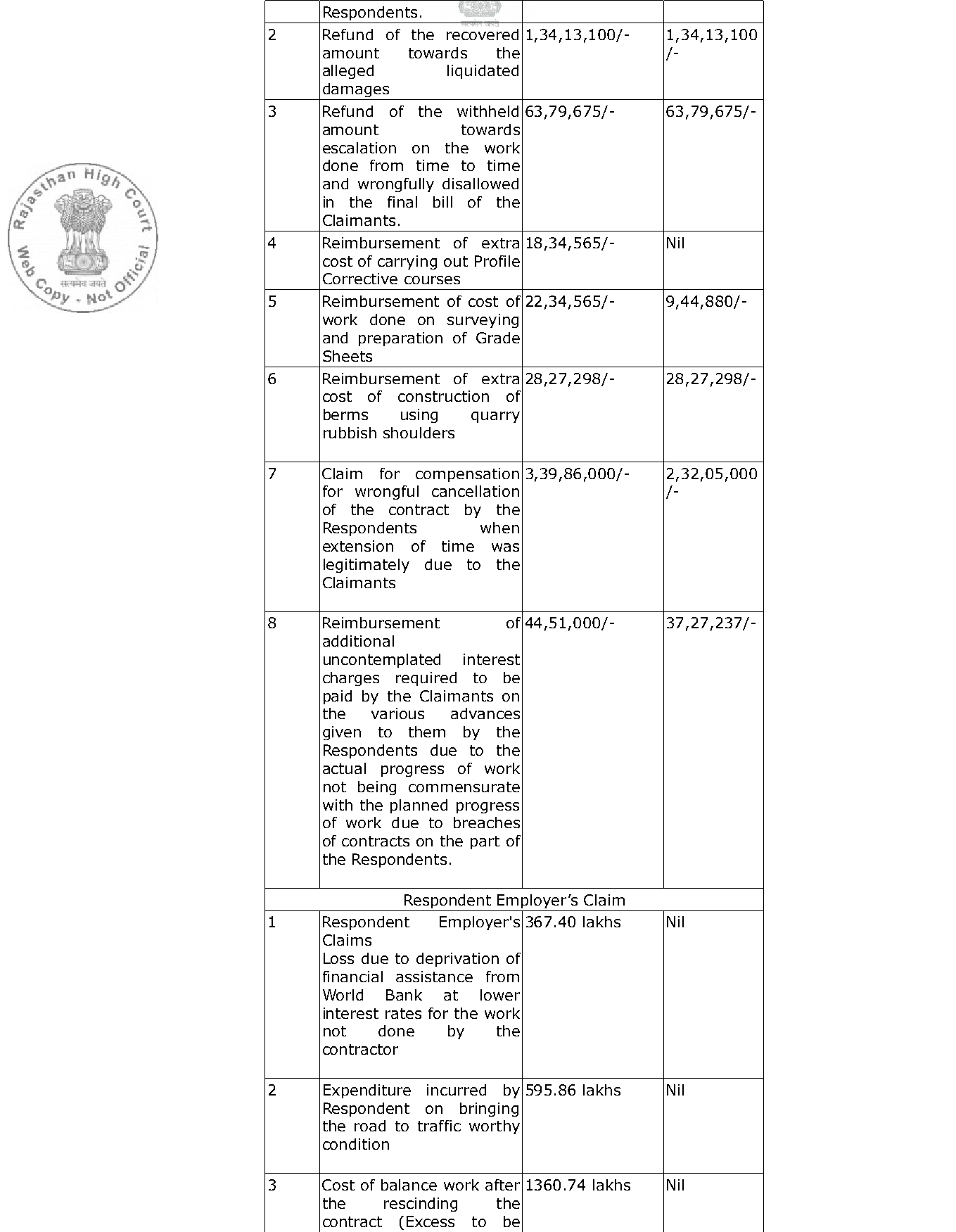
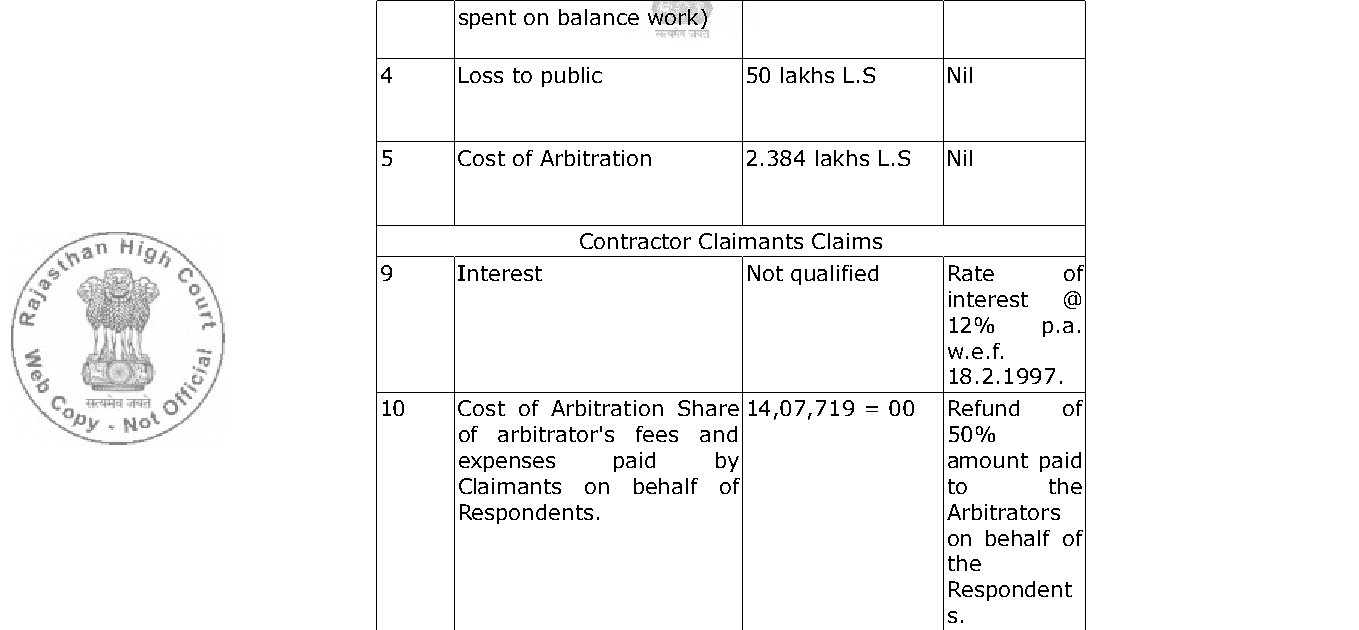
11. The objections to the said award were filed under Section 34 of the Act of 1996 before the District Court & Sessions Judge on 28.05.2008, which was later on transferred to the Commercial Court (supra) on 03.02.2018 and, thereafter, the objections were decided on 20.03.2024.
12. We noticed that more than 25 years have elapsed since the initial arbitration proceedings commenced. The Act of 1996 essentially was passed with the purpose of deciding disputes in an effective and quick manner. However, we see and note that in almost all the cases where arbitration awards are passed, the same are taken up by way of raising objections under Section 34 of the Act of 1996, as if an appeal has been filed. Section 34 of the Act of 1996, provides












