



1. Eviction suit based on default in rent payment and need for repairs after tenancy creation by registered deed. (Para 2 , 3 )
 Back
Next 


2026 Supreme(Raj) 637
HIGH COURT OF JUDICATURE FOR RAJASTHAN, BENCH AT JAIPUR
MANEESH SHARMA, J.
Kailashchand, S/o. Late Shri Gyarsilal Nobatka – Appellant
Versus
Smt. Saroj Devi, W/o. Ramkishan Sharma, through her legal representatives- Amit Sharma – Respondent
S.B. Civil Second Appeal No. 296 of 2024
Decided On : 16-02-2026
Important Points
A second appeal is maintainable only if a substantial question of law exists; concurrent findings of fact are generally not interfered with. Additionally, under the Rent Control Act, failure to deposit provisionally determined rent results in the loss of statutory protection against eviction.
Subject
Civil Law - Landlord-Tenant / Rent Control
Act Referred
Headnote
(A) Rent Control Act, 1950 - Sections 13(3), 13(5) and 13(6) - Default in payment of rent - Tenant's failure to deposit provisional rent as determined by the Court under Section 13(3) leads to loss of protection against eviction under Sections 13(5) and 13(6). (Para 19)
(B) Code of Civil Procedure, 1908 - Section 100 - Scope of Second Appeal - The existence of a substantial question of law is a condition precedent for entertaining a second appeal; it cannot be decided on equitable grounds (Para 21) - High Courts should not re-appreciate evidence to reach another possible view to set aside concurrent findings of fact arrived at by the first appellate court unless they are perverse or illegal. (Paras 22, 24)
Facts of the case:
A suit for rent and eviction was filed against tenants on the grounds of default in rent payment and the need for repairs of the premises. During the pendency of the suit, the property was alienated to a third party who was impleaded as the plaintiff. The defendants contested the suit, claiming ownership of the property rather than tenancy. Both the trial court and the first appellate court concurrently held that the defendants were tenants who had defaulted on rent payments and decreed the suit for eviction.
Findings of Court:
The court found that the defendants failed to prove ownership of the suit property, while the plaintiffs successfully established the existence of tenancy and valid termination through notice. It was further noted that the defendants failed to deposit the provisional rent determined by the court, thereby forfeiting any protection under the Rent Control Act.
Issues: Whether the concurrent findings of the lower courts regarding tenancy, ownership, and default in rent were sustainable, and whether the second appeal raised any substantial question of law.
Ratio Decidendi: The High Court held that in the absence of a substantial question of law, concurrent findings of fact regarding tenancy and ownership are not subject to interference. Furthermore, failure to comply with the statutory requirement of depositing provisionally determined rent under the Rent Control Act removes the tenant's eligibility for protection against eviction.
Result: The present second appeal fails and is hereby dismissed.
Legal Category Hierarchy
- property law
- practice and procedure
Advocates Appeared:
For the Appellant : Mr. Harish Agrawal.
For the Respondents: Mr. Anoop Pareek, Mr. Kshitiz Sharma, Mr. Pranav Pareek.
For the Appellant : Mr. Harish Agrawal.
For the Respondents: Mr. Anoop Pareek, Mr. Kshitiz Sharma, Mr. Pranav Pareek.
Table of Contents
2. Tenant claimed ownership and disputed validity of power of attorney; landlord sought eviction for default and execution was carried out. (Para 5 , 12 , 13 )
3. Concurrent findings on tenancy, ownership, and default upheld; tenant failed to prove title and deposit provisional rent. (Para 14 , 15 , 16 , 17 , 18 , 19 )
4. Second appeal requires substantial question of law; concurrent findings of fact cannot be reappreciated unless perverse. (Para 21 , 22 , 23 , 24 )
5. Second appeal dismissed as devoid of merit; no substantial question of law; possession already delivered in execution. (Para 25 , 26 )
6. What is the condition precedent for entertaining a second appeal under Section 100 of the CPC?
A second appeal can be entertained only if it involves a substantial question of law; equitable grounds or reappreciation of evidence are insufficient. (Para 21 )
7. Can a High Court re-appreciate evidence in a second appeal to reach a different finding of fact?
No, the High Court should not re-appreciate evidence to set aside concurrent findings of fact arrived at by the first appellate court. (Para 22 )
8. What is the effect of failing to deposit provisional rent determined under Section 13(3) of the Rent Control Act?
The tenant loses protection under Section 13(5) and 13(6) of the Act and becomes liable for eviction for default in rent. (Para 19 )
9. Does a tenant's claim of ownership defeat a landlord's suit for eviction and rent recovery?
No, in a suit for eviction and rent recovery, the tenant's ownership claim becomes immaterial if the landlord proves tenancy and valid termination. (Para 17 , 18 )
Order :
MANEESH SHARMA, J.
1. The present second appeal has been filed by the appellants- defendants-tenant against the judgment and decree dated 27.03.2024 passed by the Additional District and Sessions Judge No.4, Kotputli in First Civil Appeal No.28/2020(27/2012) CIS No.27/2012 titled 'Kailashchand & Ors. Vs. Smt. Saroj Devi', whereby the appeal preferred by the appellants was dismissed and the judgment and decree dated 12.10.2012 passed by the Additional Civil Judge and Judicial Magistrate, Kotputli in Civil Original Suit No.220/89 titled 'Smt. Saroj Devi Vs. Kailashchand &Ors.' was confirmed.
2. Brief facts of the case giving rise to the present appeal are that on 28.05.1987, the original plaintiff, namely, legal representatives of Late Lala Surajbhan Gupta filed a suit for rent and eviction against the legal representatives of Late Gyarsi Lal (original tenant).
3. In the eviction suit it was stated that the suit property was let out to Late Gyarsi Lal on 01.01.1983 for a period of 11 months on a rent of Rs.125/- per month. It was also stated therein that Late Gyarsi Lal (tenant) had paid rent up to 01.01.1985 and thereafter, committed default in payment of rent as the legal representatives of Late Gyarsi Lal (tenant) had failed to pay or tender rent for a period of more than six months. It was further stated that the suit premises had deteriorated and needed repairs, thus, eviction of the tenant was necessary.
4. During the pendency of the said suit, the suit property was alienated by the legal representatives of Late Lala Surajbhan Gupta to Smt. Saroj Devi vide registered sale deed dated 26.06.1998. Therefore, Smt. Saroj Devi was impleaded as a party under the provisions of Order 22 Rule 10 of CPC, and thereafter the suit was pursued by Smt. Saroj Devi against the legal representatives of Late Gyarsi Lal.
5. Subsequently, the defendants/appellants filed their written statement on 02.06.1990, wherein they refuted the averments made in the plaint and stated that the suit property was owned by Late Gyarsi Lal (tenant) and upon his death the suit property was devolved on to the present defendants/appellants.
6. On the basis of pleadings of the parties, the learned Trial Court framed as many as seven issues, which are as follows:-
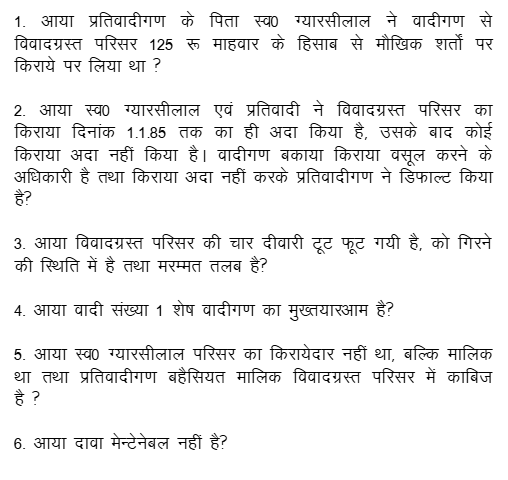
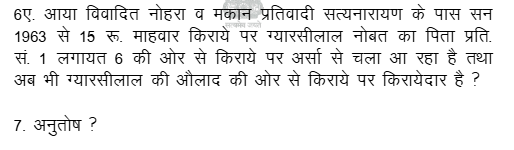
7. Thereafter, in order to substantiate the pleas and averments made in the plaint, the plaintiffs/respondents examined PW-1- Ghansiram, PW-2-Kishore Lal, PW-3-Ramkishan, PW-3-Brijmohan Gupta, PW-4-Dr. Hussain Rajjak Khan, PW-5-Saroj Sharma and produced documents Ex.1-Rent agreement, Ex.2- Patta, Ex.3-Will, Ex.4-property declaration, Ex.5-newspaper cutting, Ex.6-post office slip, Ex.7-Return, Ex.8-Declaration, Ex.9 to Ex.16-Letter, Ex.13B-Hindi translation of Will, Ex.18-Letter, Ex.19-Sale Deed, Ex.20-21-order of land record in favour of Jamnasahay by Nagarpalika Kotputli and Ex.22-Site Plan.
8. In rebuttal, the defendants/appellants examined DW-1 Kailash s/o Gyarsi Lal, DW-2 Kailash Chand Soni, DW-3 Smt. Bharpai, DW-3 Raghuwardayal, DW-4 Lokesh Kumar, DW-5 Satya Naraian, DW-6 Sanjay Mittal and also produced documents Ex.A1- Licence, Ex.A2-Site Plan, Ex.A3-Certificate, Ex.A4-Power of Attorney, Ex.A5-Site Plan.
9. After hearing arguments of both the parties, the learned Trial Court decided all the issues in favour of the plaintiff/landlord and vide judgment and decree dated 12.10.2012 decreed the suit for eviction against the defendants/appellants on the ground of default in payment of rent and directed the defendants/appellants to handover peaceful possession of the disputed suit property to the plaintiffs/respondents within a period of two months, and the defendants/appellants were further directed to pay the outstanding rent @ Rs.125 per month from 01.01.1985 along with6% interest per annum.
10. Being aggrieved of the aforesaid judgment and decree dated 12.10.2012, the defendants/appellants preferred a regular appeal No.28/2020(27/2012) and the learned Appellate Court after considering all the pleadings and







