
 Back
Back





IN THE HIGH COURT OF JUDICATURE AT MADRAS
R.N.Manjula, J.
D.Venkatesan (died) and ors. - Appellants
Versus
G.Rajendran - Respondent
S.A.No.289 of 2011
Decided On : 29-01-2025
| Table of Content |
|---|
| 1. second appeal challenging prior judgments. (Para 1 , 2 , 3) |
| 2. factual background of the property dispute. (Para 4 , 5) |
| 3. arguments on ownership and tenancy relationships. (Para 10 , 11) |
| 4. substantial questions of law regarding ownership. (Para 12 , 13 , 14 , 15) |
| 5. responsibilities of proof in tenant-landlord disputes. (Para 16 , 17) |
| 6. court's analysis of tenant-landlord legal principles. (Para 18 , 19 , 20) |
| 7. final conclusion and dismissal of appeal. (Para 21) |
JUDGMENT :
R.N.Manjula, J.
This Second Appeal has been filed to set aside the judgment and decree dated 22.11.2010 made in A.S.No.17 of 2010 on the file of the Subordinate Judge, Ranipet, Vellore District, reversing the judgment and decree dated 20.01.2010 made in O.S.No.1 of 2003 on the file of the District Munsif Court, Sholinghur.
2. Heard Mr.K.V.Ananthakrushnan, learned counsel for the appellants, Mr.R.P.Ruban Chakravarthy, learned counsel for the respondent and perused the materials available on record.
3. The deceased plaintiff is the first appellant. The appellants 2 to 4 are the legal heirs of the deceased plaintiff who has filed the suit for recovery of possession and for arrears of rent. The Trial Court has decreed the suit. On the First Appeal preferred by the defendant, the First Appellate Court has allowed the First Appeal by reversing the judgment and decree of the Trial Court. Hence, the deceased plaintiff has filed the present Second Appeal.
4. The short facts pleaded in the plaint are as follows:
The suit property was originally belonged to the defendant who was in enjoyment of the same. The defendant had agreed to sell the suit property to the plaintiff and sold the same on 13.10.1986 through a registered sale deed for a sum of Rs.14,000/- and handed over the possession on the same day. At request of the defendant, the plaintiff has rented out the property for the defendant on a monthly rent basis. As per the rental agreement entered into between the plaintiff and the defendant, the defendant had agreed to pay the monthly rent of Rs.300/- and the same has been paid till 01.10.2002. When the plaintiff requested the defendant to vacate the suit property as he was going to renovate the suit property, the defendant did not vacate the suit property. The plaintiff has issued a legal notice on 06.09.2002 and thereafter also, the defendant did not vacate the suit property. Hence the plaintiff has filed the suit.
5. The averments made in the written statement filed by the defendant are as follows:
It is false to state that the plaintiff has purchased the suit property on 13.10.1986 by virtue of the sale deed executed by the defendant. It is also equally false to state that the defendant is a tenant under the plaintiff on a monthly rent of Rs.300/-. The plaintiff has sent legal notices on 06.09.2002 and 23.11.2002 on certain imaginary grounds. The suit property belonged to defendant's paternal uncle Ethiraj Mudaliar by virtue of the sale deed dated 17.07.1961 and he has built a house therein. The defendant is in occupation of the suit property with the permission of Ethiraj Mudaliar. The defendant has also issued a reply notice to the plaintiff on 02.11.2001. The owner of the suit property viz., Ethiraj Mudaliar has also sent a reply to the plaintiff on 05.11.2001. The plaintiff had admitted the title of Ethiraj Mudaliar and hence, he is estopped from claiming the relief of recovery of possession. As the defendant is not the tenant under the plaintiff, the relief sought by the plaintiff cannot be granted.
6. On the basis of the above pleadings, the Trial Court has framed the following issues :
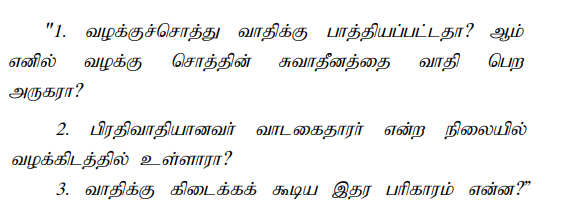
7. During the course of trial, on the side of the plaintiff, one witness has been examined as P.W.1 and Exs.A1 to A5 were marked. On the side of the defendant, three witnesses have been examined as D.W.1 to D.W.3 and Exs.B1 to B10 were marked. The documents produced by the witnesses have been marked as Exs.X1 to X3.
8. At the conclusion of the trial and on considerin
AI
A plaintiff must establish a jural relationship of landlord-tenant to claim possession; failure to prove tenancy and title leads to dismissal of eviction suits.

Legal heirs of an original allottee are co-owners of the property, and a Sale Deed in favor of one heir does not confer exclusive title over the property.
Once property is sold, the title passes to the purchaser, and original owners cannot later claim rights over the property.


The plaintiff must substantiate ownership independently to succeed in a suit for declaration of title, which cannot rely solely on the defendant's weaknesses.
The court affirmed that a Sale Deed is valid only for the share owned by the vendor, and a party can challenge findings of a lower court even without filing a cross-appeal.
The appellate court misdirected its assessment, failing to recognize that property ownership and identity were sufficiently proven by prior deeds and tax records.
The appellate court determined that the First Appellate Court erred in not properly evaluating the ownership evidence, resulting in incorrect distribution of property rights and affirming the Plainti....
Courts cannot entertain claims of adverse possession when ownership is established by a valid title deed, and any agreements contradicting that ownership must be substantiated legally.



An indispensable Tool for Legal Professionals, Endorsed by Various High Court and Judicial Officers
Please visit our Training & Support
Center or Contact Us for assistance

Scan Me!
India’s Legal research and Law Firm App, Download now!


For Daily Legal Updates, Join us on :



 Back to top


