
 Back
Back





IN THE HIGH COURT OF JHARKHAND AT RANCHI
RONGON MUKHOPADHYAY, PRADEEP KUMAR SRIVASTAVA, JJ.
Birju Yadav S/o Late Madhav Mahto - Appellant
Versus
The State of Bihar (Now Jharkhand) - Respondent
Criminal Appeal (D.B.) No. 44 of 1999
Decided On : 11-12-2024
| Table of Content |
|---|
| 1. the factual background of the case. (Para 3 , 4 , 5 , 6) |
| 2. circumstantial evidence against the appellant. (Para 7 , 8) |
| 3. appellant's arguments against conviction. (Para 10 , 11 , 12 , 13) |
| 4. court's assessment of the evidence and legal standards. (Para 14) |
| 5. establishing guilt based on the circumstances. (Para 26 , 28) |
| 6. principles of circumstantial evidence applicable. (Para 27 , 29) |
| 7. final decision and dismissal of appeal. (Para 30 , 31 , 32) |
JUDGMENT :
Pradeep Kumar Srivastava, J.
1. Heard learned counsel for the parties.
2. The present appeal is directed against the judgment of conviction and order of sentence dated 10.12.1998 passed by learned 5th Additional District & Sessions Judge, Giridih in Sessions Trial No. 256 of 1996, whereby and whereunder, the appellant has been held guilty for the offence under Section 302 of the I.P.C. and sentenced to undergo rigorous imprisonment for life.
FACTUAL MATRIX
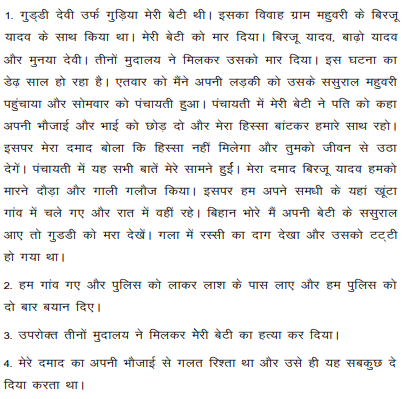
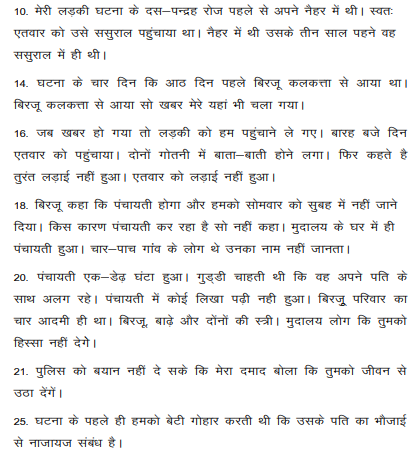
3. The factual matrix giving rise to this appeal in a nut shell is that the informant’s daughter Guddi Devi was married with the present appellant. It is alleged that the present appellant had illicit relation with his bhabhi, which was frequently protested by his wife and she returned to her parental home. Informant Prayag Mahto (P.W.-6) along with his daughter Guddi Devi went to her matrimonial home on 16.06.1996 and on the next day i.e. 17.06.1996 at about 12 O’ Clock, there was a Panchayati and in Panchayati, Guddi Devi has told her husband to get separate from his brother and bhabhi and asked for share in the property, but her husband, brother of husband and bhabhi did not agree to above proposal and asked her to go back. It is further alleged that the husband of Guddi Devi also started abusing her and due to that reason, no decision could be taken in the Panchayati and the informant returned back to Village – Khutta and stayed there in the night and Guddi Devi was left at her matrimonial home. On the next day i.e. 18.06.1996 at about 7 O’ Clock, informant again went to the matrimonial home of his daughter Guddi Devi and found her dead. The dead body was lying on a Cot. He also noticed that there was black spot on the neck and it seems that she has been killed by strangulation. He asked about the reason of death of his daughter from her husband and brother of the husband, but no satisfactory reply was given.
4. On the basis of fardbeyan of the informant, Gawan P.S. Case No. 35 of 1996 was registered against the present appellant, his brother Barho Yadav and Munwa Devi, wife of Barho Yadav for the offence under Sections 302 / 34 of the I.P.C. and after conclusion of investigation, charge sheet was submitted against the accused Birju Yadav and Barho Yadav.
5. After cognizance, the case was committed to the Court of Sessions vide order dated 16.10.1996; where Sessions Trial No. 256 of 1996 was registered. The accused persons denied the charges and claimed to be tried.
6. In course of trial, altogether 10 witnesses have been examined by the prosecution including the I.O. and the Doctor. Apart from oral testimony of witnesses, following documentary evidences were also adduced by the prosecution:-
Exhibit-1 : Signature of Kishun Prasad Yadav on the Inquest Report.
Exhibit-1/1 : Signature of Balram Prasad on the Inquest Report.
Exhibit-1/2 : Signature of Chandrika Yadav on Fardbeyan.
Exhibit-1/3 : Signature of K.B. Singh on formal FIR.
Exhibit-1/4 : Signature of K.B. Singh on formal FIR.
Exhibit-2 : Post Mortem Report.
Exhibit-3 : Fardbeyan.
Exhibit-4 : Endorsement on Fardbeyan.
Exhibit-5 : Inquest Report.
Exhibit-6 : Formal F.I.R.
7. The learned trial court, after appraisal and evaluation of evidence led by the prosecution, found it is a case based upon circumstantial evidence and relied upon following circumstances against the appellant:-
(a) There was dispute between accused person and deceased.
(b) The dead body of deceased was found in the house of accused person.
(c) The death was homicidal and not suicidal.
(d) It is the
AI
The conviction under Section 302 IPC was upheld due to compelling circumstantial evidence linking the appellant to the murder, ruling that suspicion alone is insufficient without definitive proof of ....

Conviction under circumstantial evidence requires proof of an unbroken link of evidence establishing guilt beyond reasonable doubt, not merely suspicion.
The court upheld the conviction for murder based on circumstantial evidence, establishing the accused's guilt through a combination of testimonies, confessional statements, and lack of viable alterna....

The burden of proving specific intention falls onto the individual, and in a case based on circumstantial evidence, an evasive or untrue response from the accused becomes an additional link in the ch....

The court upheld the conviction for murder based on eyewitness testimony and established motive, dismissing intoxication as a defense.

The main legal point established in the judgment is the reliance on circumstantial evidence, the shift of burden of proof to the appellant, and the admissibility of extra-judicial confessions in esta....
Murder conviction on circumstantial evidence requires complete unbroken chain excluding innocence; absent proof of foundational facts like last seen together and court direction, appellants entitled ....

The judgment underscores the principle that in cases based on circumstantial evidence, the prosecution must establish a clear and unbroken chain of evidence that excludes all reasonable hypotheses of....

The court emphasized that circumstantial evidence must form a complete and unbroken chain to establish the guilt of the accused beyond reasonable doubt.



An indispensable Tool for Legal Professionals, Endorsed by Various High Court and Judicial Officers
Please visit our Training & Support
Center or Contact Us for assistance

Scan Me!
India’s Legal research and Law Firm App, Download now!


For Daily Legal Updates, Join us on :



 Back to top


