
 Back
Back





BEFORE THE MADURAI BENCH OF MADRAS HIGH COURT
HON’BLE MR. JUSTICE M. SUNDAR, HON’BLE MR. JUSTICE R. SAKTHIVEL, JJ.
R. Suresh Kumar – Petitioner
Versus
The Principal Secretary to Government, Home Department, Chennai – Respondent
W.P. (MD) No. 29723 of 2023
Decided On : 19-12-2023
Writ Petition - Appointment of Public Prosecutors - Section 24(6), Section 24(6-A), Section 24(8) of the Code of Criminal Procedure, 1973 - The court discussed the provisions of Section 24 of the Cr.P.C., particularly subsections (6), (6-A), and (8), interpreting that the State Government has the authority to appoint Public Prosecutors and Additional Public Prosecutors from a regular cadre, but also has the power to appoint Special Public Prosecutors for specific cases. The court concluded that the petitioner's request for a writ of mandamus to enforce appointments solely from the regular cadre was not supported by the law, leading to the dismissal of the petition.
Fact of the Case:
The petitioner filed a writ petition under Article 226 of the Constitution of India seeking a writ of mandamus to direct the respondents to appoint only regular cadre Public Prosecutors and Additional Public Prosecutors in all District Courts under the Madurai Bench of the Madras High Court, based on a representation made on 07.12.2023.
Finding of the Court:
The court found that the provisions of Section 24 of the Cr.P.C. allow the State Government to appoint Public Prosecutors from a regular cadre but also permit the appointment of Special Public Prosecutors for specific cases. The court emphasized that the power to appoint under sub-Section (6-A) is independent of the regular cadre requirement.
Issues: Whether the State Government is bound to appoint Public Prosecutors and Additional Public Prosecutors only from a regular cadre as per Section 24(6) of the Cr.P.C., and the implications of the Tamil Nadu amendment introducing sub-Section (6-A).
Ratio Decidendi: The court held that while Section 24(6) of the Cr.P.C. discusses the appointment of Public Prosecutors from a regular cadre, the introduction of sub-Section (6-A) allows the State Government to make appointments outside this cadre. The court also noted that the power to appoint Special Public Prosecutors under Section 24(8) is a standalone provision.
Final Decision: The writ petition was dismissed, with the court clarifying the legal position regarding the appointment of Public Prosecutors and Additional Public Prosecutors, and refraining from imposing costs.
ORDER :
Prayer: Petition filed under Article 226 of the Constitution of India to issue a Writ of Mandamus, directing the respondents herein to consider and issue necessary orders for appointing only regular cadre of Public Prosecutors / Additional Public Prosecutors in all District Courts also falling under the realm of Madurai Bench of Madras High Court as the State is empowered to do so as laid down in the said Code, on the lines of the petitioner's representation dated 07.12.2023, within the time stipulated by this Honourable Court.
1. Captioned matter was listed in the Admission Board on 15.12.2023 and this Bench made the following order:
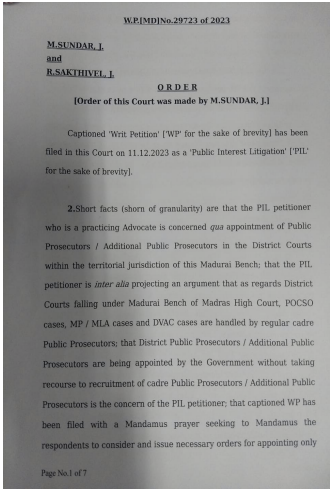
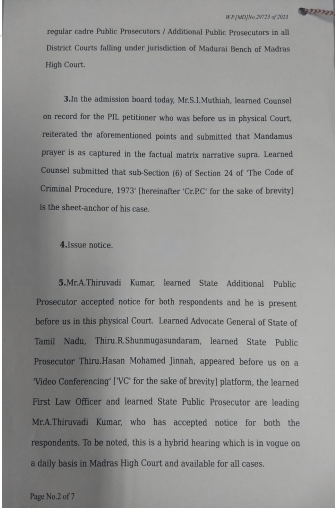
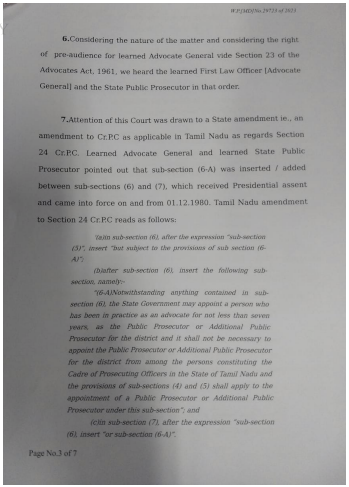
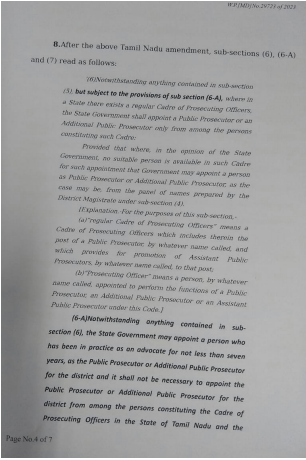
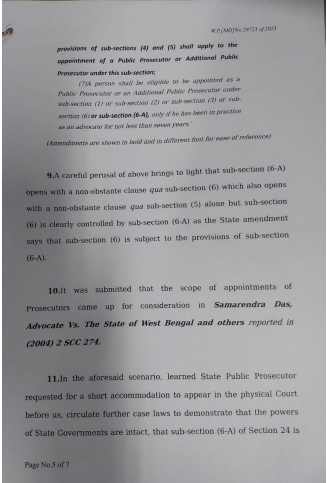
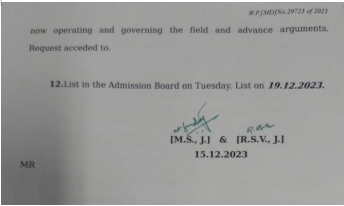
2. Pursuant to the aforementioned 15.12.2023 proceedings / orders, captioned WP is before us today. Aforementioned 15.12.2023 Admission Board proceedings / orders shall now be read as an integral part and parcel of this order. This also means that the short forms, abbreviations and short references used in the aforementioned 15.12.2023 Admission Board order will continue to be used in the instant order also.
3. In the hearing today, Mr.S.I.Muthiah, learned counsel on record for PIL petitioner and Mr.Hasan Mohamed Jinnah, learned State Public Prosecutor, assisted by Mr.A.Thiruvadi Kumar, learned State Additional Public Prosecutor and Mr.S.Santhosh, Government Advocate (Crl. Side) are before us. Considering the limited scope of the captioned WP and the acute angle on which the bone of contention turns, main WP was taken up and heard out with the consent of both sides. In this regard, we deem it appropriate to write that in adopting this course we have resorted to second limb of sub-Rule (3) of Rule 19 of Madras High Court Writ Rules, 2021. {it is made clear that 'Issue notice' in paragraph 4 of admission Board order in this case means that Rule Nisi has been issued}
4. In continuation of his earlier proceedings (captued in Admission Board order dated 15.12.2023), learned State Public Prosecutor made the following submissions:
(a) identical question came up for consideration before Hon'ble Supreme Court in K.J.John's case (K.J. John vs. State of Kerala and others) with regard to States of Kerala and Uttar Pradesh. This is vide a Writ Petition under Article 32 of the Constitution of India and the order made there at by a two member Hon'ble Bench has been reported in (1990) 4 SCC 191. K.J.John's case is one where Uttar Pradesh Public Prosecutor's Association and an individual by way of two separate Writ Petitions brought up the controversy that regular cadre of Prosecuting officers exists and therefore, State Governments are bound to appoint Public Prosecutors and Additional Public Prosecutors only in this cadre vide Section 24(6) of Cr.P.C. {Cr.P.C. denotes 'the Code of Criminal Procedure, 1973 (2 of 1974)'}. After discussion and dispositive reasoning turning on sub-Section (6) as well as other sub-Sections of Section 24 of Cr.P.C., Hon'ble Supreme Court returned a categorical finding that State Governments are not bound to appoint Public Prosecutors or Additional Public Prosecutors only from among the persons constituting cadre under the Code of Criminal Procedure for conducting cases in the Sessions Court. In K.J.John's case reported in (1990) 4 SCC 191 facts are captured in paragraph 3 and the ratio is set out in paragraph 21, which read as follows:
“3. The Writ Petition under Article 32 of the Constitution has been filed by the Uttar Pradesh Public Prosecutors' Association consisting the membership of Assistant Public Prosecutors, including Prosecuting Officers, Senior Prosecuting Officers, Deputy Director of Prosecution serving under the Government of Uttar Pradesh. Petitioner 2 is the President of the Association. In both the cases the controversy raised is that there exists a regular cadre of Prosecuting Officers and as such the State Government is bound to appoint Public Prosecutors and Additional Public Prosecutors only from among the persons constituting such cadre in view of Section 24(6)
AI
The State Government has the authority to appoint Public Prosecutors and Additional Public Prosecutors from a regular cadre, but this is not an exclusive requirement, as it can also appoint Special P....

The main legal point established is the duty to appoint a Special Public Prosecutor to ensure a fair trial, as well as the duty of the Prosecutor to be impartial and present all material facts before....

The appointment of Public Prosecutors must prioritize the District Judge's opinion, governed by Section 24 of the Cr.P.C. and Section 18 of the BNSS, ensuring a fair and competent selection process.


Compliance with the Code of Criminal Procedure is essential in the appointment of Public Prosecutors and Panel Lawyers, and filling up the vacant posts in the cadre of Public Prosecutors.

The main legal point established is that the victim or somebody on behalf of the victim can request for appointment of a lawyer of his/her choice for appointment of Public Prosecutor or Special Publi....

The main legal point established in the judgment is that the establishment and appointments within the Jammu & Kashmir Prosecution Service were in accordance with the amended provisions of the Code o....


The appointment of departmental officers as Assistant Public Prosecutors under S.25 of the Cr.P.C. is valid despite the lack of practice as advocates.



An indispensable Tool for Legal Professionals, Endorsed by Various High Court and Judicial Officers
Please visit our Training & Support
Center or Contact Us for assistance

Scan Me!
India’s Legal research and Law Firm App, Download now!


For Daily Legal Updates, Join us on :



 Back to top


