
 Back
Back





IN THE HIGH COURT OF JUDICATURE AT MADRAS
R. Sakthivel, J.
S.Mohana Sundaram – Appellant
Versus
S.Muthusamy Gounder and ors. – Respondents
S.A.NO.501 OF 2017 AND CMP NO.12163 OF 2017
Decided On : 19-12-2024
JUDGMENT :
PRAYER: Second Appeal filed under Section 100 of the Code of Civil Procedure, 1908, praying to set aside the Judgment and Decree dated December 14, 2016 made in A.S.No.86 of 2014 on the file of the I Additional District Court, Erode, confirming the Judgment and Decree dated September 23, 2014 made in O.S.No.375 of 2010 on the file of Principal Sub Court, Erode.
This Second Appeal is directed against the Judgment and Decree dated December 14, 2016 made in A.S.No.86 of 2014 on the file of the ‘I Additional District Court, Erode’ ['First Appellate Court' for brevity], whereby the Judgment and Decree dated September 23, 2014 made in O.S.No.375 of 2010 on the file of ‘Principal Sub Court, Erode’ ['Trial Court' for brevity] was confirmed.
2. For the sake of convenience, hereinafter, the parties will be referred to as per their array in the Original Suit.
PLAINTIFF'S CASE
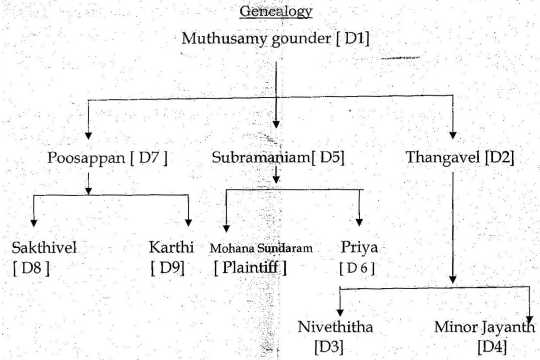
3. The plaintiff is the son of 5th defendant and 6th defendant is his sister. The defendants 2, 5 and 7 are sons of the 1st defendant. The defendants 3 and 4 are the daughter and minor son of the 2nd defendant respectively. The defendants 8 and 9 are the sons of the 7th defendant. The genealogy chart appended hereunder serves for better appreciation of relationship between the parties to the suit:
3.1. The defendants 10 and 11 are the purchasers of Item No.3 and 2 of Suit 'B' Schedule properties respectively. The 12th defendant is the sale agreement holder in respect of the Item No.1 of the Suit 'B' Schedule properties with the 1st defendant.
3.2. Suit 'A' Schedule properties are ancestral and joint family properties of D1 – Muthusamy Gounder and his family. Out of the surplus income therefrom, he purchased Suit 'B' Schedule properties. D1 does not have any separate income and the entire family is an agricultural family. D1, being the Karta, had purchased common 2 Acre 21 ½ Cents Punja land in Survey No.530 of Nanjaiuthukuli Village in his name under Sale Deed dated June 19, 1959, and later, entered into registered Partition Deed dated December 15, 2009 with other co-owners, whereby Item No.1 of Suit 'B' Schedule properties were allotted to him. Further, D1 purchased Item Nos.2 and 3 of Suit 'B' Schedule properties under Sale Deeds dated April 27, 1978, and November 2, 1983 respectively. Similarly, Item No.4 thereof, which is a house property, was also purchased in his name. As stated supra, they were all purchased out of surplus income from ancestral and joint family properties. Thus the Suit Properties are all ancestral and joint family properties and the plaintiff and the defendants are in joint possession and enjoyment of the same.
3.3. While so, D1 entered into an registered Partition Deed dated May 30, 1988 with D2, D5 and D7, whereby D1 was given life estate in Schedule A1, B1 and C1 properties therein while D7, D5 and D2 were allotted Schedule 'A', ‘B’ and ‘C’ properties therein respectively. The same is not valid and binding on the plaintiff due to partial partition as Suit 'B' Schedule properties were not included in it, as well as due to unequal distribution. D5, though he was a party to the said Partition Deed, failed to secure the best interests of his son, the plaintiff, who was a minor then.
3.4. D1 is entitled to common ¼ share in Suit Properties while D2 to D8 are entitled common 1/12 share therein. However, D1 without any legal right, taking advantage of the fact that Suit 'B' Schedule properties are in his name, sold Item No.2 thereof vide Sale Deed dated August 24, 2010 to D11; sold Item No.3 thereof to one Karupanna Gounder, whose legal heirs sold it to D10 vide Sale Deed dated March 14, 2007; and also entered into a Sale Agreement in respect of Item No.1 thereof with D12. The said transactions do not bind the plaintiff. The plaintiff sought for Oral Partition but D1 was evasive. Hence, the Suit for partition of his 1/12 share.
D1 TO D4's CASE
4. D1 filed written statement denying the plaint averments except those specifically admitted. The same
AI
The plaintiff failed to prove that the Suit 'B' Schedule properties were ancestral, and the Suit was barred by limitation under Article 60 of the Limitation Act, 1963.

The absence of evidence proving the joint family status of properties allows a presumption that they are individual assets; thus, plaintiffs' claim for partition is dismissed.

Daughters became coparceners under Hindu Succession (Tamil Nadu Amendment) Act, 1989, allowing them equal rights in joint family properties.
The burden of proof lies on the person claiming property as self-acquired to establish that it was acquired without the aid of joint family funds.
The judicial presumption of joint ownership requires proof of a family nucleus, and mere existence of a joint family does not automatically classify all properties as joint.
The main legal point established in the judgment is that properties acquired from individual earnings of family members cannot be treated as joint family properties unless deliberate abandonment and ....
In a partition suit, the burden of proving that property standing in an individual's name is joint family property lies upon the party asserting it, requiring proof of a sufficient ancestral nucleus.....
Ancestral properties must be proven to remain joint family properties post-partition; otherwise, they are deemed separate and not subject to partition claims.
The court affirmed that admissions made during trial are binding, and ancestral properties cannot be dismissed based on a registered Partition Deed that does not negate the rights of coparceners.
The burden of proof lies on asserting self-acquisition when joint family property is claimed, as evidenced in the judgment affirming the trial court's findings on property character.



An indispensable Tool for Legal Professionals, Endorsed by Various High Court and Judicial Officers
Please visit our Training & Support
Center or Contact Us for assistance

Scan Me!
India’s Legal research and Law Firm App, Download now!


For Daily Legal Updates, Join us on :



 Back to top


