
 Back
Back





IN THE HIGH COURT OF JUDICATURE AT MADRAS
R.SUBRAMANIAN, R.SAKTHIVEL, JJ.
Sneha - Appellant
Versus
K.Sakthivel - Respondent
A.S.NO.1030 OF 2019
Decided On : 06-06-2024
| Table of Content |
|---|
| 1. appellant filed an appeal against trial court's decision. (Para 1 , 2 , 3) |
| 2. plaintiff's case history and claims on properties. (Para 4 , 5 , 6) |
| 3. trial court framed issues for consideration. (Para 7) |
| 4. appellant's arguments regarding ancestral character of properties. (Para 9 , 10) |
| 5. respondent's arguments regarding properties' separate character. (Para 11 , 12) |
| 6. court's analysis on the character of properties under partition deeds. (Para 14 , 15 , 16 , 17 , 19 , 20 , 21) |
| 7. properties devolved under succession act are separate. (Para 22 , 23 , 24 , 25) |
| 8. properties obtained under will characterized as separate. (Para 27 , 28 , 29) |
| 9. court findings on consequences of family partitions. (Para 31) |
| 10. court's final observations on the plaintiff's rights. (Para 34 , 36) |
| 11. final judgment and dismissal of the appeal. (Para 40) |
JUDGMENT :
R. SAKTHIVEL, J.
1. The appellant herein is the plaintiff in O.S.No.260 of 2008 on the file of 'I-Additional District Judge, Erode' (henceforth 'Trial Court').
2. For the sake of convenience, henceforth, the parties will be referred to as per their array in the Suit i.e., the appellant herein and the respondents herein will be referred to as plaintiff and defendants respectively.
3. Feeling aggrieved with the judgment and decree dated June26, 2014, passed by the Trial Court in O.S.No.260 of 2008, the plaintiff has preferred this Appeal under Section 96 read with Order XLI Rule 1 of the ‘Code of Civil Procedure, 1908’ (henceforth ‘CPC’), praying to set aside the judgment and decree.
4. Plaintiff’s case
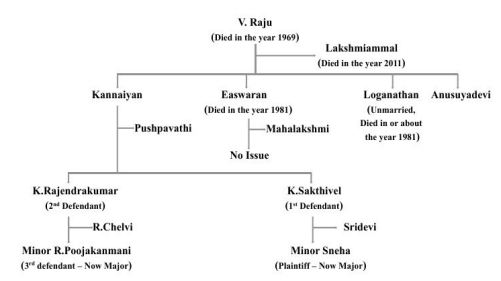
4.1. The case of the plaintiff is that, the marriage between the couple, K.Sakthivel / 1st Defendant (D1) and Sridevi, was solemnized on September 10, 2000. Out of their wedlock, plaintiff - Sneha was born on July 7, 2001. Around 2007, there arose some matrimonial dispute between the couple and they filed petition for divorce. In these circumstances, the minor plaintiff – Sneha (now major) represented by her mother – Sridevi filed O.S.No.260 of 2008 for partition and other reliefs against the defendants.
4.2. According to the plaintiff, the 1 Item of the Suit Properties was originally purchased by Kannaiyan from and out of the income derived from joint family properties vide Sale Deed dated September 23, 1992 and thereafter, as per the family arrangement at the time of partition, it was given to plaintiff’s father vide the Gift Settlement Deed dated November 13, 2007.
4.3. Further, 2nd Item of the Suit Properties are ancestral and joint family properties that were allotted to D1 as 'D' Schedule properties under the Partition Deed dated December 27, 2007.
4.4. Further, 3rd Item of the Suit Properties are properties originally purchased by D2 from and out of the income derived from joint family properties, and thereafter, as per the family arrangement at the time of partition, it was allotted to plaintiff’s family vide the Gift Settlement Deed dated December 28, 2007. Hence, according to the plaintiff, D3– daughter of D2, has no right whatsoever therein. D3 was impleaded as a party to the Suit vide order of the Court dated March 12, 2012 made in I.A.No.82 of 2012.
4.5. Further, 4 Item of the Suit Properties are purchased by D1 from and out of the income derived from joint family properties vide Sale Deed dated September 16, 1992.
4.6. Further, 5th Item of the Suit Properties are the ancestral properties allotted to Lakshmiammal - grandmother of the plaintiff, as life estate without any power of alienation, as ‘A’ Schedule properties under the Partition Deed dated December 27, 2007. After the demise of Lakshmiammal on March 24, 2011, the plaintiff is entitled ¼ share, D1 is entitled ¼ share, D2 and D3 are jointly entitled ½ share therein. Hence, as per the order of the Court made in I.A.No.856 of 2011, D2 was added as a necessary party.
4.7. The contention of the plaintiff in a nutshell is that, the Suit properties are ancestral and joint family properties and the plaintiff has ½ share in Item N
AI
Properties inherited from a divided father are considered separate and not ancestral, affecting claims for partition under Hindu law.

The court upheld the validity of the WILL for self-acquired properties while recognizing the plaintiffs' entitlement to a share in the ancestral property, affirming the distinction between self-acqui....
The burden of proof lies on asserting self-acquisition when joint family property is claimed, as evidenced in the judgment affirming the trial court's findings on property character.
The court affirmed that the plaintiff, as a coparcener by birth, is entitled to a ½ share in ancestral properties under the Hindu Succession Act, 1956, and ruled against the validity of transactions ....
Daughters are coparceners by birth under the amended Hindu Succession Act, entitled to equal shares in ancestral properties.
The plaintiff failed to prove that the Suit 'B' Schedule properties were ancestral, and the Suit was barred by limitation under Article 60 of the Limitation Act, 1963.
The burden of proof lies with the plaintiff to establish that the properties are ancestral, and evidence must be pleaded and proved through evidence.
The judicial presumption of joint ownership requires proof of a family nucleus, and mere existence of a joint family does not automatically classify all properties as joint.

The main legal point established in the judgment is the determination of ancestral properties available for partition and the validity of gift settlement deeds.



An indispensable Tool for Legal Professionals, Endorsed by Various High Court and Judicial Officers
Please visit our Training & Support
Center or Contact Us for assistance

Scan Me!
India’s Legal research and Law Firm App, Download now!


For Daily Legal Updates, Join us on :



 Back to top


